
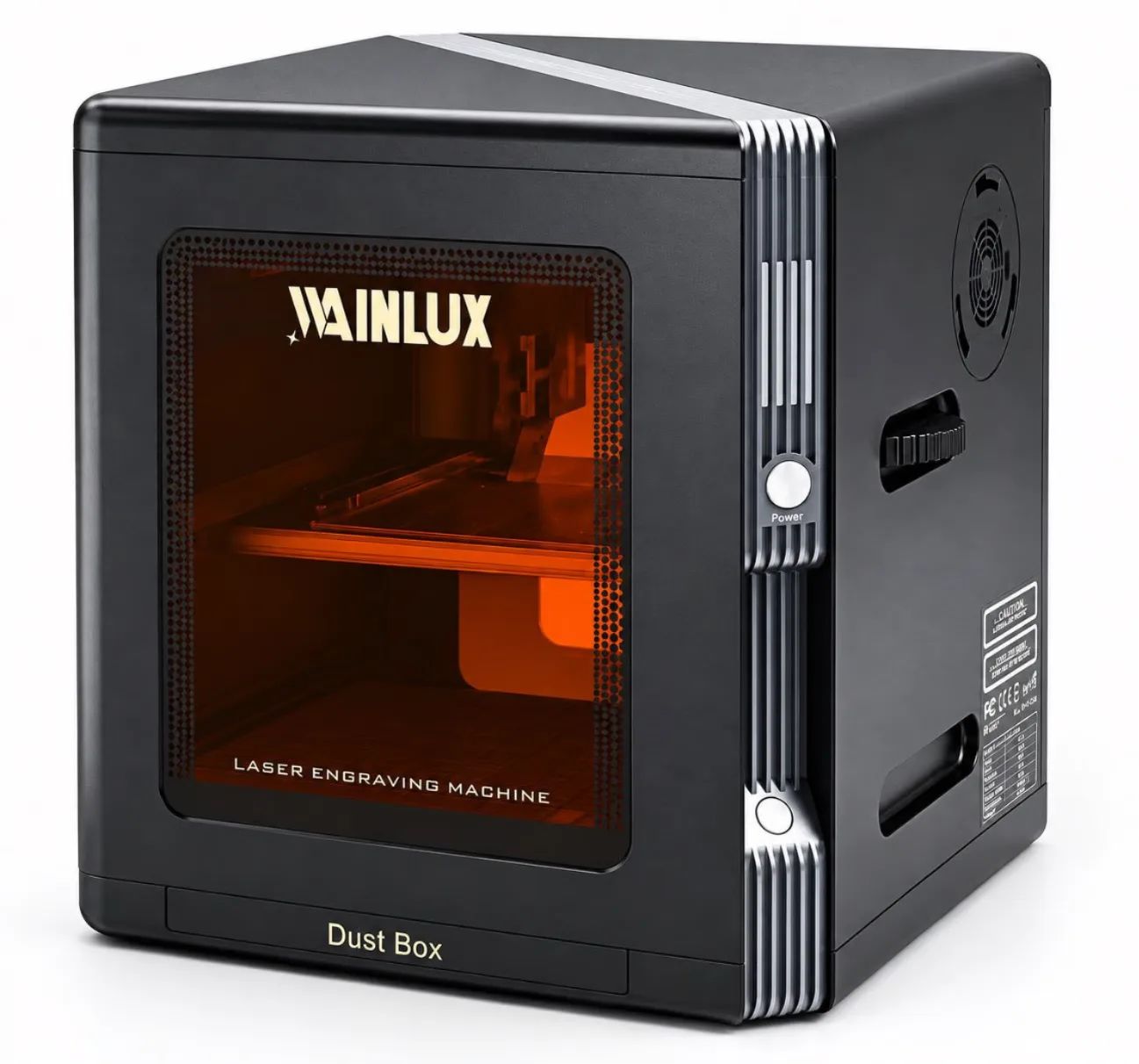
Repeat quality on a benchtop laser engraver comes from frame rigidity, repeatable positioning, motion stability, footprint stability, and job queuing—not from headline power alone. This guide explains which specifications to check and how the WAINLUX K8-1064nm, X1-10W, and X2-10W compare on those points.
A benchtop laser engraver that produces a good first sample is common. One that puts the same mark in the same place on job five hundred is the machine you actually need. Repeat quality is rarely decided by the wattage printed on the box. It is decided by how rigid the frame is, whether the positioning system returns to the same origin, how stable the motion is at speed, whether the machine stays where you put it, and whether you can queue the next job without breaking the setup of the last one.
Key takeaways
Frame material and structure set the ceiling for repeat quality. Aluminum alloy frames resist flex better than plastic under the same gantry loads.
Repeatable positioning depends on smart positioning and, where available, one-touch autofocus—not on the operator's eye.
Connectivity matters for batch work: USB, WiFi, and Bluetooth let you queue jobs instead of re-setting the machine each run.
Footprint and weight tell you whether the machine will hold position on a bench under motion.
Why repeat quality is a specification question
When you engrave one plaque for a customer, small errors are invisible. When you engrave a serial number on a run of identical parts, every deviation stacks: a looser frame lets the head deflect, a positioning system that drifts shifts the origin, and an unsteady motion system changes line width between passes. The buyer's question is not "does it engrave?" but "does it engrave the same way on the two-hundredth piece?" That is answered by a handful of specifications, not by marketing language.
Frame rigidity: aluminum alloy versus plastic
The frame is the reference for every movement the machine makes. If it flexes, the tool path changes and the mark moves with it. The material choice is therefore the first specification to read.
- Plastic or thin composite frames are light and inexpensive. They are fine for occasional hobby work, but under repeated acceleration they can deflect, which shows up as inconsistent edge quality and shifting detail on long jobs.
- Aluminum alloy frames provide a stiffer structure at a similar bench size. Stiffer means less deflection, and less deflection means the same program produces the same geometry run after run.
All three machines referenced in this article use aluminum alloy frames as their structural basis. The WAINLUX K8-1064nm laser engraving machine is built on an aluminum alloy frame in a 190×286×313 mm body weighing 4.4 kg—compact enough for a bench, with a metal structure rather than a plastic shell supporting the motion parts. The WAINLUX X1-10W is specified with a high-strength aluminum alloy frame, and the WAINLUX X2-10W follows the same material approach. When comparing suppliers, ask what the frame is made of and how the gantry is supported, not just how large the work area is.
Repeatable positioning: smart positioning and one-touch autofocus
Even a rigid frame will not repeat if you cannot return to the same starting point. Positioning is where operator error enters the process, so the specifications to look for are the ones that remove the operator from the equation.
Smart positioning
Smart positioning lets the machine establish its own reference rather than relying on the operator to eyeball the workpiece against a mark. On the K8-1064nm, smart positioning is a published feature, and it works alongside a 0.01 mm engraving accuracy specification. For repeat work, the practical benefit is that job setup becomes a repeatable action: the same reference is used each time, so the engraving lands in the same place.
One-touch autofocus
Focus distance is a variable that changes spot size, and therefore line width. If focus is set by hand for each piece, small differences between operators or between sessions change the result. One-touch autofocus is specified on the WAINLUX X1-10W, which removes that manual step from the sequence. Where autofocus is not specified, focus should be treated as a controlled step in your process, with a fixed gauge or fixture to hold the distance consistent.
Motion stability and accuracy at working speed
Motion stability is the ability of the head to move at the commanded speed without vibration that alters the mark. The relevant specifications are maximum speed and stated accuracy, read together.
The K8-1064nm is specified up to 2000 mm/s with 0.01 mm engraving accuracy. Speed tells you how fast the machine can travel; accuracy tells you the resolution the system is designed to hold. A machine that can reach high speed but loses accuracy at that speed is not useful for repeat production, so ask suppliers how the two figures were established and at what conditions.
Depth is the third variable in the same group. The K8-1064nm is specified with a 0.1–1 mm depth range. Depth consistency across a batch depends on keeping speed, power, and focus constant, which brings you back to positioning and focus control rather than to a single number.
Footprint stability: the bench is part of the machine
A benchtop engraver inherits the stability of whatever it sits on. If the machine is light and the bench is flexible, the whole system moves during acceleration.
The K8-1064nm footprint is 190×286×313 mm at 4.4 kg. That is a size most workbenches can support without reinforcement, and the mass is low enough to reposition when needed but high enough to resist walking during normal motion. For the larger WAINLUX X1-10W with its 30×30 cm work area and the WAINLUX X2-10W with its 15×20 cm work area, plan a solid, level surface that fits the full footprint with clearance around it—the work area is not the same as the space the machine occupies.
Connectivity for queued jobs
Repeat quality also depends on how you feed the machine. If every job requires a cable swap or a manual file transfer that interrupts the machine, you introduce opportunities for error between runs.
The K8-1064nm supports USB, WiFi, and Bluetooth and is specified for Windows. In practice, WiFi or Bluetooth lets you send the next file while the current job is running or while the machine is closed in its working position, and it lets several operators feed one machine from their own workstations. For batches of small parts, that queue matters more than a marginal difference in speed.
Three WAINLUX models compared on repeat-quality specifications
| Specification | WAINLUX K8-1064nm | WAINLUX X1-10W | WAINLUX X2-10W |
|---|---|---|---|
| Work area | 8×8 cm | 30×30 cm | 15×20 cm |
| Frame | Aluminum alloy | High-strength aluminum alloy | Aluminum alloy |
| Positioning | Smart positioning | One-touch autofocus | — |
| Engraving accuracy | 0.01 mm | — | — |
| Depth range | 0.1–1 mm | — | — |
| Max speed | Up to 2000 mm/s | — | — |
| Connectivity | USB, WiFi, Bluetooth | — | — |
| Software | Windows | — | — |
| Footprint | 190×286×313 mm | — | — |
| Weight | 4.4 kg | — | — |
| Enclosure | — | — | Protective cover or open frame |
A dash means the specification was not provided for this article. The X1-10W and X2-10W are draft models described here by specification only. Confirm all values with the supplier before ordering.
How to verify repeat quality before you buy
Specifications narrow the field; a test confirms the choice. If you can evaluate a sample machine, run the following steps rather than a single decorative engraving.
- Prepare one file with fine detail and one file with a long continuous path. Use the same material for every run.
- Engrave the same file at least ten times, re-loading the workpiece each time as you would in production.
- Measure the position of a known feature on each piece against a fixed datum with a gauge, and record the values.
- Compare line width and edge quality between the first, middle, and last pieces at the same magnification.
- Run a job at the upper end of the speed range and check whether accuracy holds at that speed.
- Confirm the focus method used in the test and repeat the test using only that method, without manual adjustment.
If a machine cannot be tested in person, ask the supplier for the test conditions behind the published accuracy and speed figures, and for the frame material in writing. Those two answers separate machines designed for repeat work from machines designed for occasional use.
Where the WAINLUX K8-1064nm fits
The K8-1064nm uses a 1064 nm red laser, which suits marking and engraving on a range of materials where that wavelength is appropriate. Its 8×8 cm work area is sized for small, repeatable items—serial plates, small components, jewelry-scale parts—not for full-sheet production. Within that envelope, the combination of an aluminum alloy frame, smart positioning, 0.01 mm accuracy, and USB/WiFi/Bluetooth connectivity is aimed at the same job being produced identically many times.
Xiamen Spring Technology Co., Ltd. was founded in 1998 and has more than 25 years of experience. The company operates an ISO9001 company-level quality management system and provides OEM/ODM services, with products exported to more than 50 countries. For buyers who need a frame specification and positioning method confirmed in writing, that history and the published WAINLUX specifications give a starting point for the conversation.
Frequently asked questions
Does higher wattage improve repeat quality?
No. Wattage affects what the beam can cut or how quickly it marks, but repeat quality comes from rigidity, positioning, motion stability, and consistent focus. A well-built lower-power machine can repeat better than a more powerful machine with a flexible frame.
Is a plastic frame acceptable for repeated jobs?
For occasional use it may be sufficient. For production runs where the same mark must land in the same place every time, an aluminum alloy frame is the safer specification because it resists deflection under repeated motion.
What does 0.01 mm engraving accuracy actually tell me?
It is the accuracy figure the manufacturer publishes for the system, on the K8-1064nm. Read it together with maximum speed and focus method, because accuracy is only meaningful at the conditions under which it is held. Ask the supplier for those conditions.
Do I need WiFi or Bluetooth on a benchtop machine?
For one-off work, USB is enough. For batch work, wireless connectivity lets you queue files and position the machine where it is stable rather than where the cable reaches. The K8-1064nm supports USB, WiFi, and Bluetooth.
Next step
If you are specifying a benchtop laser engraver for repeat production, share the material, the required work area, and how many identical pieces per run you expect. That is enough for a supplier to confirm which frame and positioning configuration suits the job and whether the work area of the K8-1064nm, the X1-10W, or the X2-10W matches your part size.