
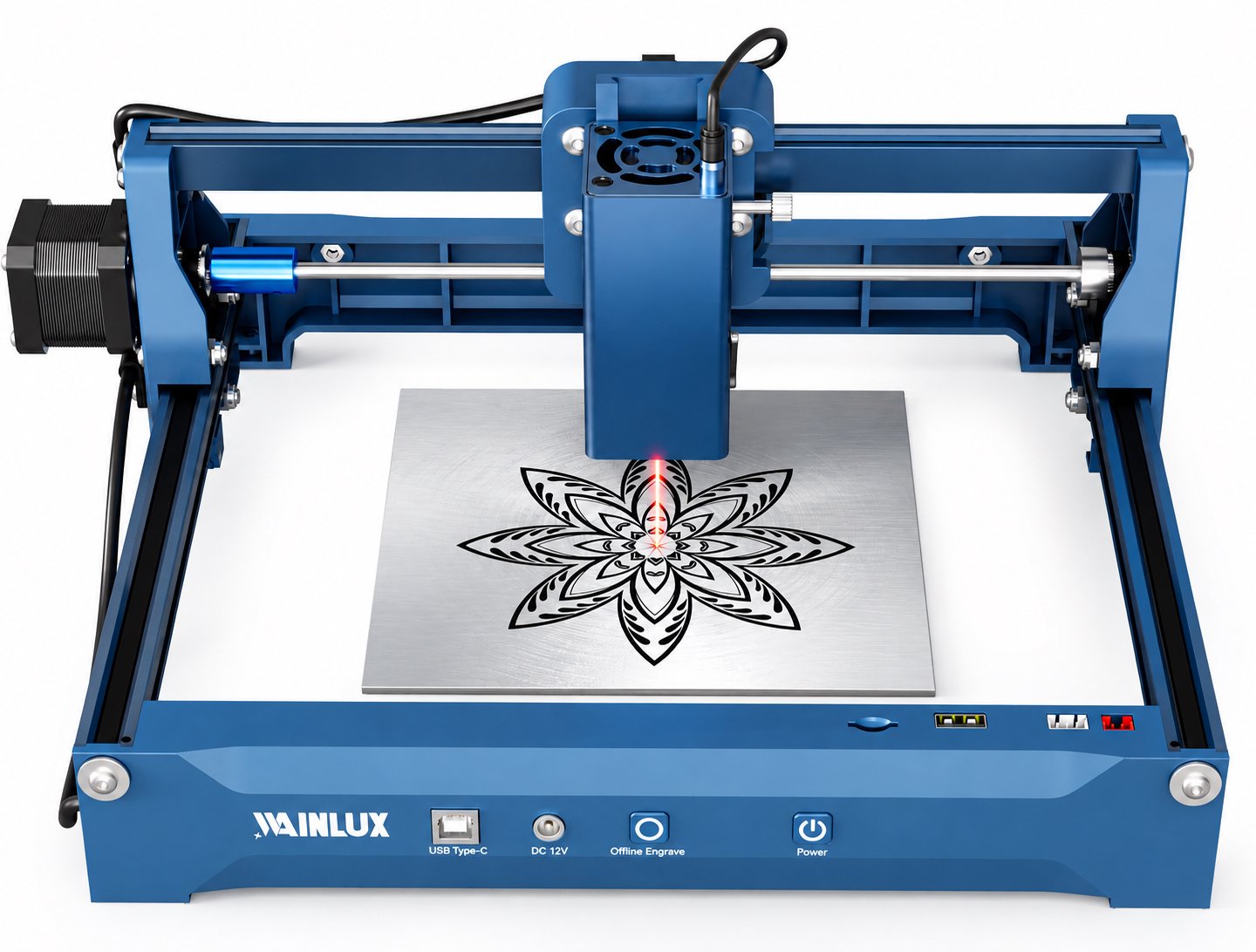
A budgeting companion for buyers who need one laser engraving machine for wood and metal. Work out your wood-to-metal ratio first, then compare three honest paths — 455nm on coated surfaces, a dedicated 1064nm unit, or a dual-head machine — including the maintenance split and the flexibility each one costs you.
Buyer Budgeting Guide
One machine, two materials, and a budget that has to survive both. This is the companion piece to our explanation of how dual-laser machines work — here we skip the optics and go straight to the money question: given your own wood-to-metal mix, which of three paths actually earns its place on your bench?
Start With the Ratio, Not the Machine

Most buyers searching for a laser engraving machine for wood and metal arrive with the same assumption: buy one machine, cover both materials, done. That assumption usually survives until the first month of real jobs, when the wood orders arrive in a steady stream and the metal jobs come in one or two at a time — or the other way around.
Before comparing anything, write down two numbers from your own order history or your pipeline:
- Wood, leather, and acrylic share — engraved or cut, per week or per month.
- Bare-metal or coated-metal marking share — per week or per month.
If the second number is close to zero, a wood-focused machine with the right accessories may already be enough. If the second number is substantial, or if your metal work includes bare metal rather than coated surfaces, the wavelength discussion becomes a budgeting question rather than a technical footnote. That split is the single input that decides everything below.
Why Wavelength Decides Your Material Mix
The two heads behave differently, and that difference is what you are budgeting for.
455nm is the wood-working wavelength in this class: wood, leather, acrylic, and coated metal surfaces. It is the head that handles the bulk of most mixed-material order books. 1064nm is the marking wavelength for bare-metal marking; coated metal surfaces are handled by the 455nm head. If a job involves bare metal with no coating, the 455nm head is not the tool.
This is why the ratio matters more than the spec sheet. A machine that is technically capable of both materials can still be the wrong purchase if your ratio means one head sits idle for weeks while the other one queues. If you want the optical and mechanical explanation of how the two heads are arranged inside a single chassis, that is covered separately — the point here is that the ratio tells you which purchase path to fund.
Write your wood-to-metal ratio down before you read a single quote. A 90/10 mix and a 50/50 mix point to different machines, different maintenance plans, and different total costs of ownership — even when the two buyers are looking at the same catalogue.
Three Honest Paths Against Your Ratio
There are three realistic ways to cover wood and metal work. None of them is universally correct; each one trades something away.
Path 1: 455nm Only, Aimed at Coated Surfaces
A 455nm-focused machine is the cheapest way to get into engraving wood, leather, and acrylic, and it can handle coated metal surfaces. The WAINLUX K10-5W is a 455nm 5W fully enclosed machine that cuts 3-5 mm plywood, which is a sensible reference point for the wood side of a light-production bench.
Where it runs out: bare-metal marking. No amount of practice changes the wavelength requirement. If your metal work is almost entirely coated or painted surfaces, this path is honest and inexpensive. If buyers send you bare aluminium or stainless parts, it is not.
Path 2: A Dedicated 1064nm Unit for Metal Work
If metal is your core work and wood is occasional, a dedicated 1064nm unit is the cleaner purchase. The WAINLUX K8-1064nm marks bare metal with 0.01 mm precision on an 8 x 8 cm work area. It does one job and does it without compromise on wavelength.
What it costs you: flexibility. An 8 x 8 cm field is a marking-sized area, not a cutting bed, and it will not cover the wood and acrylic work your mixed orders may need. Many buyers in this situation keep a second machine, which means two purchases, two bench spaces, and two maintenance routines.
Path 3: A Dual-Head Machine
A dual-head machine puts both wavelengths in one chassis, so the material mix stops being an either/or decision. Two options in this class are worth budgeting around:
- WAINLUX X1-20W dual-laser — 455nm plus 1064nm heads, a 30 x 30 cm work area, WiFi, USB-C, and TF offline operation, covering wood, leather, acrylic, coated metal, and bare-metal marking.
- WAINLUX F1-10W plus 1064nm — dual head on a 10 x 10 cm work area, with WiFi and a built-in screen, covering wood, acrylic, and leather plus bare-metal marking.
The X1-20W suits buyers whose wood-to-metal ratio is genuinely mixed and whose wood work needs a larger bed. The F1-10W suits buyers whose metal marking is frequent but small-format, and who value the built-in screen and compact footprint. Neither replaces a dedicated production machine for each material at high volume, and neither is meant to.
Comparing the Three Paths Against Your Ratio
Read the table with your own ratio in the first column. The right-hand columns describe what each path asks from your budget and what it gives back in flexibility.
| Your wood-to-metal ratio | 455nm only | Dedicated 1064nm unit | Dual-head machine |
|---|---|---|---|
| Heavy wood, metal is coated surfaces only | Best fit. Lowest entry cost, one head to maintain. | Overkill unless bare-metal marking appears later. | Capable, but you are funding a head you rarely use. |
| Heavy wood, occasional bare-metal jobs | Will not mark bare metal. Jobs get outsourced. | Adds a second machine and bench space. | Usually the practical answer: one chassis, both jobs. |
| Balanced mix, both materials weekly | Fails the bare-metal half of the ratio. | Covers metal only; wood goes elsewhere. | Designed for this case, subject to work-area fit. |
| Heavy metal, wood is occasional | Wrong tool for the main workload. | Correct priority. Small 8 x 8 cm field limits wood work. | Works, but check the work area against your metal part sizes. |
Work-area figures referenced above: 30 x 30 cm on the X1-20W, 10 x 10 cm on the F1-10W, and 8 x 8 cm on the K8-1064nm. Match these against your largest recurring part before choosing a path.
The Maintenance Split Nobody Budgets For
Two machines mean two maintenance routines: two lens-cleaning schedules, two sets of consumables, two calibration habits, and two units that can go down independently. A dual-head machine concentrates that into one chassis, one bench footprint, and one maintenance routine — which is a real saving in time even where the purchase price is higher.
The trade is not free. When a dual-head chassis needs service, both materials stop at once, whereas two separate machines let you keep the wood line running while the metal unit is down. Buyers with tight delivery commitments should weigh that risk against the convenience of a single unit.
A practical tip: before choosing between one dual-head machine and two single-purpose machines, count the hours per month you can realistically spend on cleaning, alignment, and consumable swaps. If that number is small, consolidation usually wins. If downtime on either material is unacceptable, separation is the safer budget line.
A Budgeting Exercise You Can Run This Week
Work through these steps with your own numbers rather than a catalogue in front of you.
- Pull the last three months of orders and split them into wood/leather/acrylic versus bare-metal and coated-metal marking. Write the ratio as two percentages.
- Note the largest single part you expect to run repeatedly in each category. Compare that dimension against 30 x 30 cm, 10 x 10 cm, and 8 x 8 cm to see which work areas genuinely fit.
- List every coated-metal job separately from bare-metal jobs. Only bare-metal work requires the 1064nm path; coated surfaces can be served by 455nm.
- Add up the realistic purchase budget for one machine versus two, including bench space, extraction, and fixtures.
- Estimate monthly maintenance hours for one chassis versus two, and decide honestly whether you will actually perform them.
- Match the outcome to a path: 455nm only, a dedicated 1064nm unit, or a dual-head machine such as the X1-20W or F1-10W.
- Keep a written record of the ratio and the decision, so that a shift in your order mix in six months triggers a review rather than a surprise purchase.
Where Budget Buyers Usually Go Wrong
Two mistakes show up repeatedly. The first is buying on capability rather than ratio: a machine that can engrave both materials is not automatically the machine your workload justifies. The second is ignoring the flexibility cost of the cheaper path. A 455nm-only machine is a fine purchase for coated surfaces and wood, but if bare-metal enquiries arrive quarterly, you will be outsourcing them — and that cost rarely appears in the original comparison.
Get the ratio right, and the choice between the three paths usually makes itself. If you would like help matching a machine to your specific mix, send us your material split and largest part dimensions; WAINLUX has been manufacturing laser engraving equipment since 1998, holds an ISO9001 company-level certificate, and supports OEM and ODM projects for buyers in more than 50 export countries.