
Buyers producing pet tags, nameplates and asset labels need a small-format marking tool that holds position across repeat runs. This guide explains why enclosed 1064nm systems with a compact work area suit tag production, what to check before ordering, and how to build a batch workflow around locator fixtures.
Dog tags, engraved nameplates and asset labels share a set of production constraints that larger flatbed machines handle badly. The workpiece is small, often between 20 and 50 mm across. The batch is repetitive. The mark has to land in the same place on tag one and tag five hundred. And the material is usually a metal that a diode laser cannot touch.
That combination is why small-format 1064nm enclosed machines have become a practical starting point for tag work. This guide explains what the format delivers, which materials actually need the 1064nm source, and how to set up a repeatable batch workflow around a locator fixture.
Key Takeaways
- Bare metal tags — stainless steel, gold, silver, copper — need a 1064nm laser source; a diode laser will not mark them.
- Anodized and coated aluminum tags depend on the coating. Verify with a physical sample before committing a production batch.
- Repeat positioning, not raw power, is the limiting factor in tag production. A locator fixture matters as much as the laser head.
- An enclosed cabinet with a dust box keeps fine metal debris contained, which matters for pet tags and food-adjacent labeling.
On This Page
Why bare metal needs a 1064nm source
The decision point on any metal tag project is the laser wavelength, and it is settled before price, speed or brand. Common diode laser modules operate at a much shorter wavelength and are absorbed poorly by bare metal surfaces. Pointing one at an uncoated stainless steel tag produces little or no lasting mark. This is a physics constraint, not a configuration problem.
A 1064nm source is specified for gold, silver, copper and stainless steel — the exact metals most dog tags, nameplates and industrial asset labels are made from. If your incoming material is bare or brushed metal, the 1064nm machine is the one that applies.
Coated and anodized aluminum is the exception that catches buyers out. The mark on an anodized tag is produced by altering or removing the coating layer, so results depend on coating type and thickness rather than on the base metal. Two suppliers selling what looks like the same anodized blank can behave differently under the same settings. The only reliable answer is to run your own tag blank as a sample and inspect it.
Why small work areas suit tag production
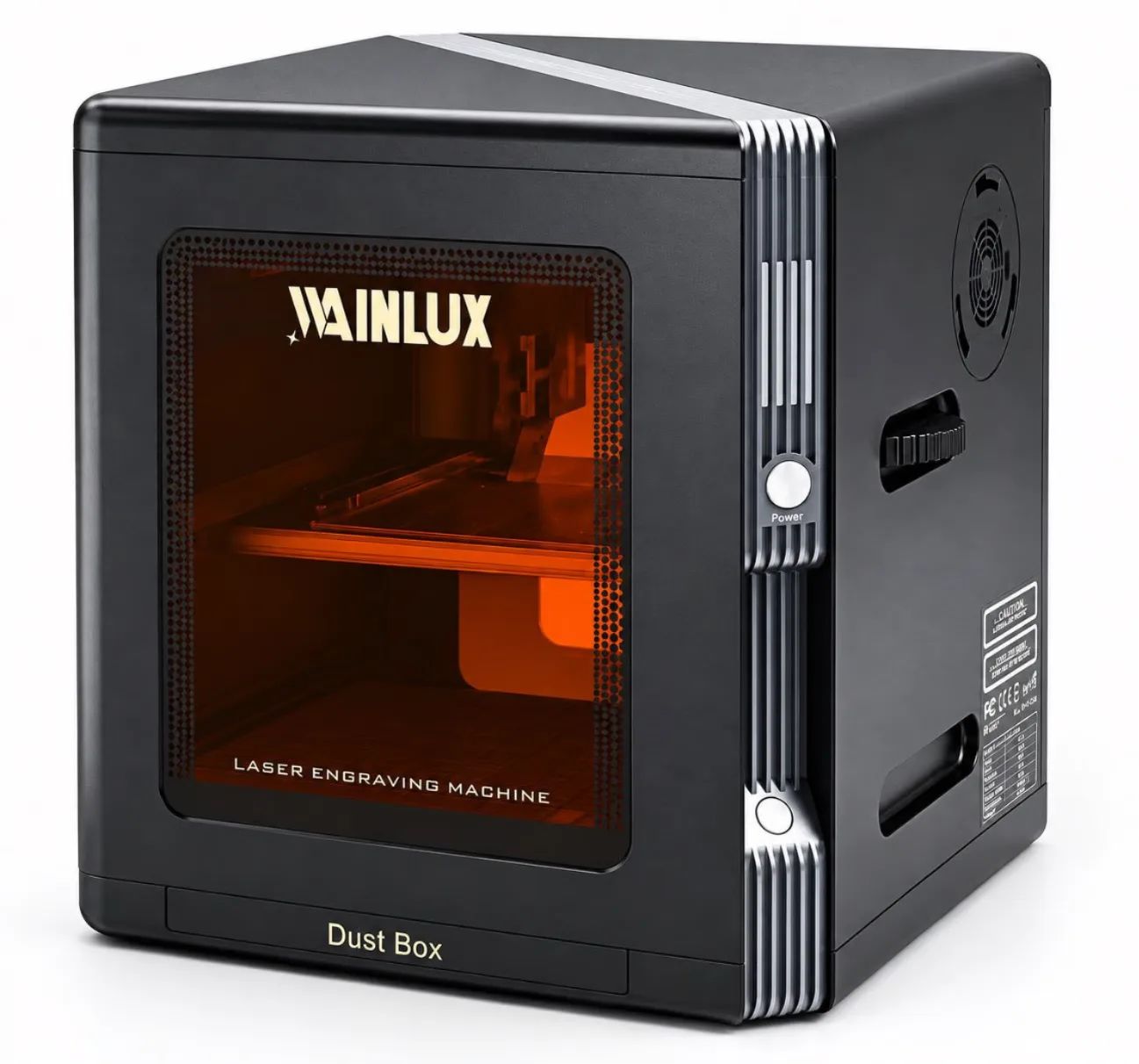
A compact work area is not a compromise for this application. It concentrates positioning accuracy where the marking happens. The WAINLUX K8 1064nm laser engraving machine uses an 8 x 8 cm work area with 0.01 mm precision and speeds up to 2000 mm/s. For tags that rarely exceed 50 mm, an 8 x 8 cm field covers a single tag with margin to spare, or a small grid of tags in one pass.
The enclosure changes how the machine fits into a workshop. Metal marking produces fine debris. A closed cabinet with a dust box contains that material instead of spreading it across the bench, which is relevant when the same space handles pet tags that will be worn against skin, or labels that go onto equipment in clean environments.
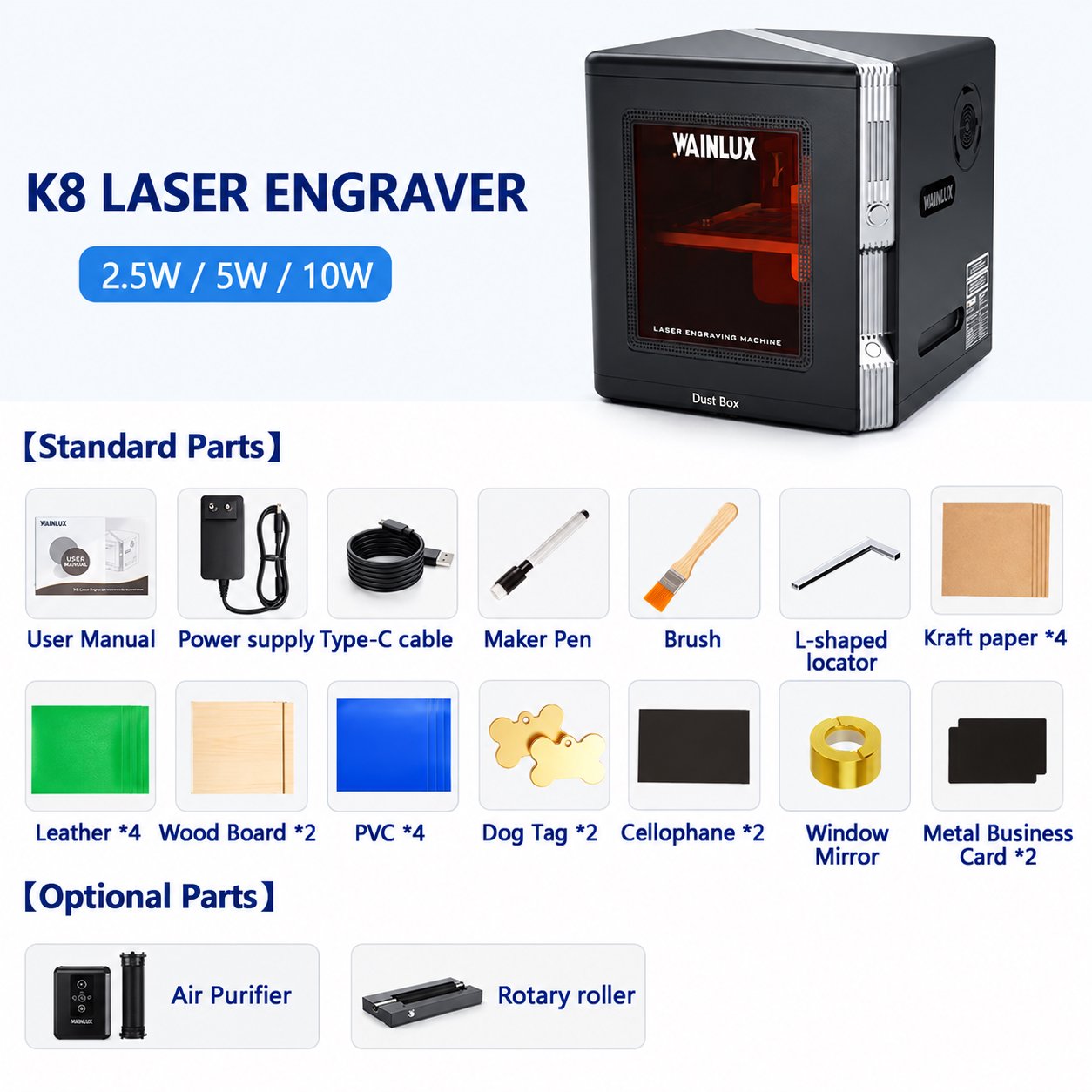
The standard accessory set is worth noting at the quotation stage. The K8 ships with dog tags and metal business cards among its accessories, plus an L-shaped locator for repeat positioning. That combination lets a buyer start producing sellable tag samples before designing custom fixtures.
Shops running a mixed product line — wooden tag blanks or engraved wooden display pieces alongside metal — have a second option in the WAINLUX X1 20W dual-laser machine, which pairs wavelength sources for mixed wood-and-metal work. If your catalogue is entirely metal tags, the single-source K8 format is the simpler specification to buy and maintain.
Specifications that decide tag quality
Three numbers drive the finished mark on a tag, and buyers should read them together rather than in isolation.
- Precision (0.01 mm). This governs how fine the smallest character or logo detail can be reproduced. On a 25 mm dog tag carrying a name, phone number and a graphic, fine control determines whether the text stays legible or fills in.
- Speed (up to 2000 mm/s). Speed affects cycle time per tag. Higher speed settings are typically used for fill and outline passes on simple text; fine graphic detail usually calls for slower passes with more overlap. Treat the maximum as a ceiling for the machine, not a setting you will use on every job.
- Work area (8 x 8 cm). Sets how many tags you can load per pass and, combined with the fixture, how repeatable the placement is.
Note that speed and mark quality trade against each other. When a supplier quotes a maximum speed, the useful question is what speed produces an acceptable mark on your specific tag material at your required level of detail.
Batch workflow and locator fixtures
Once the material and machine format are confirmed, production consistency comes down to fixturing. Every tag in a run must sit in the same position relative to the laser origin, or you will re-position each piece by eye and lose the time advantage of batch work.
The L-shaped locator supplied with the K8 handles the basic case: a straight edge to register tags against a fixed corner. For a defined product line, a custom fixture usually pays for itself quickly. Practical options include:
- Corner-stop jig. A plate with two raised edges, cut to your tag's outer dimensions. Load a tag into the corner, run the job, swap it out. Suitable for single-tag cycles at moderate volume.
- Multi-cavity plate. A plate machined with several tag-shaped pockets so a batch loads into the 8 x 8 cm field at once. Best suited to tags of one standard size.
- Interchangeable inserts. A base plate that accepts swap-in inserts for each tag size in your catalogue, so a single machine covers multiple SKUs without re-levelling.
Whichever route you take, build the workflow so the fixture is the reference and the operator only loads and unloads. Keep one master file per tag design with the origin position locked to the fixture corner. That way a job can be handed to a second operator without re-alignment.
Two practical habits reduce rework: mark a test tag at the start of each batch and keep it with the fixture as a visual reference, and handle tags with tweezers or gloves once cleaned, since fingerprints on polished metal are difficult to remove without dulling the surface.
Material checklist: what to confirm with your supplier
Before ordering any machine, assemble a short sample set that represents your actual catalogue. This is the fastest way to close the specification question.
| Tag material | 1064nm source required? | What to verify |
|---|---|---|
| Bare stainless steel | Yes | Mark contrast and depth on your finish (brushed, polished, matte) |
| Gold | Yes | Mark visibility on polished surfaces at your required text height |
| Silver | Yes | Tarnish behaviour after marking; handling procedure after cleaning |
| Copper | Yes | Mark consistency across the tag surface |
| Anodized aluminum | Depends on coating | Send your own anodized blanks; result is coating-dependent |
| Coated / painted aluminum | Depends on coating | Confirm whether the intended effect removes or alters the coating |
Send physical blanks, not photographs. A photograph cannot show how a coating behaves under the beam, and it cannot tell you whether the mark survives handling, polishing or cleaning.
Reference specifications
| Parameter | WAINLUX K8 1064nm |
|---|---|
| Work area | 8 x 8 cm |
| Precision | 0.01 mm |
| Marking speed | Up to 2000 mm/s |
| Specified metals | Gold, silver, copper, stainless steel |
| Enclosure | Enclosed cabinet with dust box |
| Standard accessories | Dog tags, metal business cards, L-shaped locator |
The manufacturer, Xiamen Spring Technology (WAINLUX), holds ISO9001 and CE certification. Certification documents for the specific model and destination market should be requested with the quotation, since applicable standards vary by market.
Frequently asked questions
Can a diode laser mark stainless steel dog tags?
No. Bare metal tags require the 1064nm source. Diode laser modules do not couple effectively into uncoated metal surfaces, so the mark will be faint or absent.
Will the machine mark my anodized aluminum tags?
It depends on the coating. Anodized and coated aluminum behave differently from bare metal, and results vary with coating type and thickness. Verify by sending your own tag blanks for a sample test.
How many tags can I mark in one pass?
The work area is 8 x 8 cm, so the number of tags per pass depends on your tag dimensions and fixture layout. A multi-cavity fixture is the standard way to load several tags at once.
Do I need a custom fixture or is the supplied locator enough?
The supplied L-shaped locator provides repeat positioning for basic runs. For a defined product line with consistent tag sizes, a custom corner-stop or multi-cavity fixture usually improves both cycle time and placement consistency.
What should I send for a sample test?
Physical blank tags in every material and finish in your catalogue, along with the artwork or text layout you intend to produce. Include the smallest text and finest detail you expect to run, since that defines the quality threshold.
Confirm the machine against your tag catalogue
Tell us your tag materials, finish and required text size, and we can advise whether the 1064nm format covers your range. Request product details and sample testing through the WAINLUX K8 product page.