
Buyers often ask whether a single laser engraver can handle both wood and bare metal. The short answer: not with one wavelength. This article explains why 455nm diode light and 1064nm-class light cover different materials, how dual-source machines such as the WAINLUX X1 combine both in one 20W unit, and when buying two separate machines is the better call.
Laser buying guide
If you run a gift or promotional products workshop, your job list probably mixes materials every week: wooden keyrings, bamboo coasters, leather patches, acrylic plaques — and then a batch of stainless steel bottle openers or anodised aluminium tags. The natural question is whether one machine can cover all of it. Searching for a laser engraver for wood and metal usually turns up two very different answers, and the honest one depends on wavelength.
This article explains why a single light source normally cannot do both jobs well, how a dual-source design solves the problem, and when buying two separate machines is the more sensible purchase.
Key takeaways
- 455nm diode light engraves wood, bamboo, leather, paper and many plastics — but reflects off bare metal.
- 1064nm-class light is what marks bare metals.
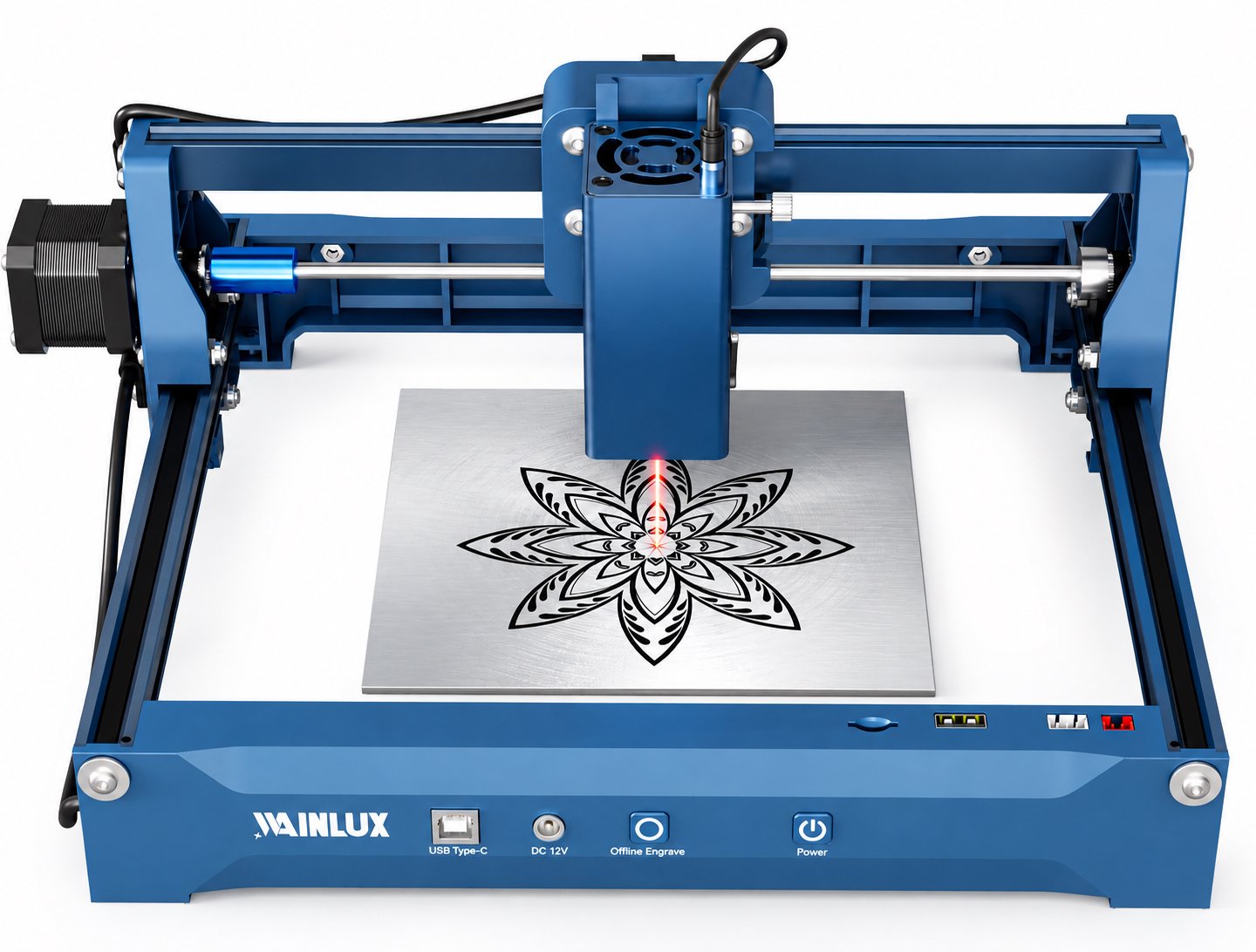
- A dual-source machine carries both wavelengths in one enclosure. The WAINLUX X1 20W dual-laser is one example, with a 30×30 cm work area, TF-card offline engraving and a roller connection port.
- Two separate machines — a diode unit for organics plus a WAINLUX K8 1064nm unit for metals — remain a valid path with its own cost, bench-space and workflow trade-offs.
Why one wavelength cannot do both jobs
Laser engraving is not about raw power alone; it is about how a material absorbs light at a given wavelength. The two material families you care about sit at opposite ends of that behaviour.
455nm diode light: organics and many plastics
A 455nm blue diode beam is absorbed well by wood, bamboo, leather, paper and many plastics. Those materials take the energy in and char, darken or vaporise at the surface, which is exactly what produces a visible mark. Point the same beam at bare metal, however, and the light largely reflects off the surface instead of being absorbed. Reflection is the core problem: the energy does not stay in the material, so no reliable mark forms.
1064nm-class light: bare metals
1064nm-class light behaves differently. Bare metals — stainless steel, aluminium, brass and similar surfaces — interact with this wavelength in a way that leaves a mark. That is why fibre and 1064nm-class sources have long been the standard choice for marking metal parts, tags and tools.
The practical consequence is straightforward: a wood-and-leather workshop needs 455nm; a metal-marking operation needs 1064nm. If you buy only one wavelength, you buy a machine that is good at half your job list — which is precisely why so many buyers conclude they need two machines.
The dual-source answer
A dual-source laser engraver puts both wavelengths inside one enclosure and one control workflow. Instead of deciding which machine to buy, you decide which source to use for the job in front of you — organic materials on one, bare metal on the other.
The WAINLUX X1 20W dual-laser engraving machine is built on this principle. Verified specifications for the model include:
| Specification | Detail |
|---|---|
| Light sources | 455nm diode plus 1064nm-class, combined in one unit |
| Rated power | 20W (combined machine rating) |
| Work area | 30 × 30 cm |
| Offline operation | TF-card offline engraving |
| Accessory port | Roller connection port |
For a promotional products business, the combination matters in a specific way: the same bench, the same enclosure and the same job queue can hold mixed-material orders. A run of wooden coasters and a run of stainless steel tags do not require moving the workpiece to a second machine, and the two batches can be sequenced through one production area.
Two further details are worth noting for workshop planning. The 30 × 30 cm work area determines what fits in a single pass — small promotional items such as keyrings, tags, coasters and plaques sit comfortably inside it. The roller connection port supports rotary work, which is relevant if your product range includes cylindrical items. TF-card offline engraving means the machine can run a stored job without being tethered to a computer, which is useful when one operator supervises several steps.
Two machines instead: when it makes more sense
A dual-source machine is not automatically the right purchase. The alternative is a dedicated diode machine for organics plus a dedicated 1064nm-class unit for metals — for example, a WAINLUX K8 1064nm laser engraving machine alongside your existing wood-capable machine.
That path has real trade-offs, and they cut both ways:
| Consideration | One dual-source machine | Two dedicated machines |
|---|---|---|
| Bench space | One footprint | Two footprints, plus space to move workpieces between them |
| Purchase cost | One capital item covering both material families | Two capital items; total outlay depends on the specific models chosen |
| Workflow | Switch source within one machine and one job queue | Two setups, two job queues, physical transfer of material between stations |
| Throughput on a single material | One unit shared between organic and metal work | Two units can run different materials at the same time |
| Maintenance and spares | One machine to service | Two service schedules and two sets of consumables |
The decisive question is usually volume mix. If metal work is occasional and organic work dominates, a dual-source machine concentrates your investment in one asset and keeps the bench simple. If metal marking is a high-volume, always-on part of production — running in parallel with a steady stream of wood or leather orders — two machines let both jobs proceed simultaneously instead of queueing behind each other.
There is also a specialisation argument. Two dedicated machines let each unit be chosen and set up purely for its material family, without any shared configuration. Whether that advantage outweighs the extra floor space and outlay depends on your order profile, not on a general rule.
What to verify before you buy
Product listings for dual-laser machines often blur three different things: what the machine can mark, how fast it marks it, and what it can cut through. Keep them separate when you evaluate.
- Confirm the material list, not just the wavelength. A 1064nm-class source marks bare metals; whether a specific metal finish (coated, anodised, polished) produces the mark you want is a sample question.
- Check the work area against your largest item. The X1's 30 × 30 cm area is a hard boundary for single-pass work.
- Ask whether the two sources share parameters. Do not assume a power split between the two sources or a cutting depth from a spec sheet; ask the supplier for sample guidance on your actual materials.
- Request test samples. A marked sample on your own wood and your own metal is worth more than any table of claims.
- Confirm the accessory and connectivity profile you need. For the X1 that means the roller connection port and TF-card offline operation — check they match how your workshop actually schedules jobs.
Where WAINLUX fits
WAINLUX machines are produced by Xiamen Spring Technology, with ISO9001 and CE certification. Both models discussed here — the X1 20W dual-laser and the K8 1064nm — serve the same buyer problem from two directions: one machine covering both material families, or dedicated machines for each. For B2B buyers sourcing for gift and promotional product lines, the practical next step is to send your material list and typical item sizes, then evaluate marked samples on your own stock.
FAQ
Can a single diode laser engrave both wood and bare metal?
Not reliably. 455nm diode light is absorbed by wood and many organics but reflects off bare metal, so bare-metal marking needs a 1064nm-class source.
Does a dual-source machine engrave wood and metal at the same time?
No. The two sources are used according to the material in front of you. A dual-source design removes the need for a second machine, not the need to select the right source per job.
Is a dual-source machine cheaper than two separate machines?
It is one capital item instead of two, and it occupies one footprint. The actual comparison depends on which models you would otherwise buy; ask the supplier for a configuration matched to your materials.
What should I send to get an accurate recommendation?
Your material list (including metal finishes), typical item dimensions, whether any items are cylindrical, and your expected mix of organic versus metal work.
Specifications above are limited to verified details for the WAINLUX X1 (20W combined rating, 30 × 30 cm work area, TF-card offline engraving, roller connection port) and the general behaviour of 455nm and 1064nm-class light. Cutting depths, per-material speeds and internal power distribution between the two sources are not stated here; confirm them with the supplier against your own materials and samples.