
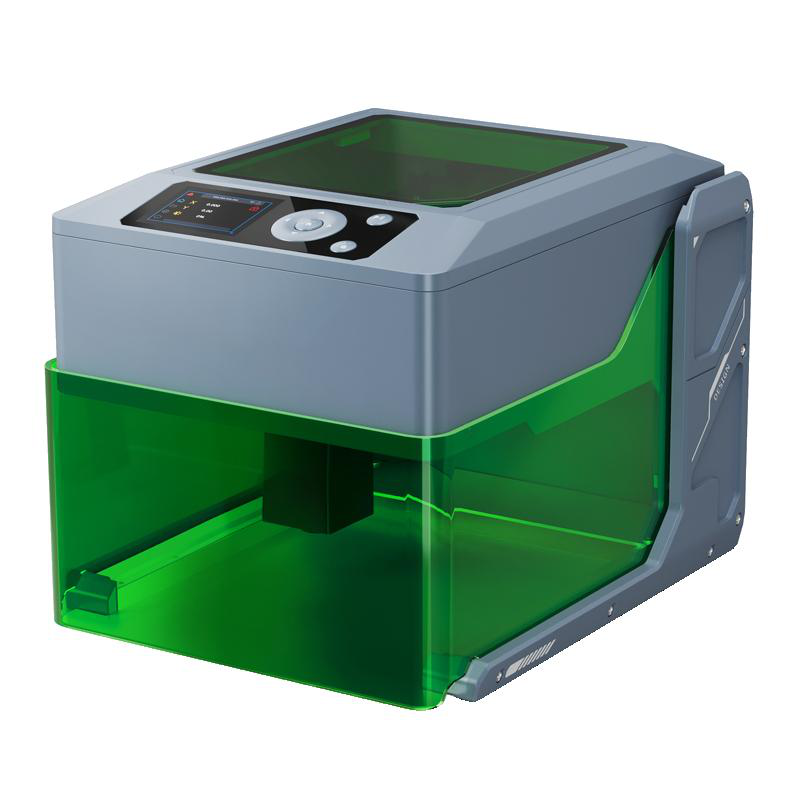
The five mistakes buyers make when purchasing a laser engraver for glass — and the pre-order checklist that prevents each one.
Buying the best laser engraver for glass is less about finding one perfect machine and more about avoiding five mistakes that cost buyers money every month. Each one below is common, predictable and fixable — if you catch it before payment instead of after delivery.
Mistake 1: Assuming Any Laser Marks Bare Glass
The most expensive misunderstanding in glass engraving. Clear glass is transparent at the wavelengths used by desktop machines, so the laser needs something on the surface to interact with. Honest suppliers state this openly: our diode machines engrave glass when painted or covered with color paper. If a listing promises bare-glass engraving from an entry-level diode machine, ask for a demonstration on your own glassware before you believe it.
Mistake 2: Ignoring the Cost of Surface Preparation
Painted or masked glass engraves beautifully — but the preparation step is part of your unit cost. Before choosing a machine, price the full workflow per product: masking or coating, engraving, cleaning, and rework on failures. Some product lines absorb this easily (spray-coated awards); others (thousands of clear tumblers) should reconsider the product or the process. A machine is cheap; a workflow is what you actually buy.
Mistake 3: Buying Power for a Job the Wavelength Cannot Do
Wattage solves cutting depth and speed — not wavelength limits. A 40W diode machine will not mark bare metal, and no amount of diode power marks clear glass without preparation. Meanwhile, 1064nm machines mark gold, silver, copper, aluminum, stainless steel and zinc alloy cleanly, but are the wrong tool for transparent glass. Decide by material list first: if your line mixes glassware with bare-metal items, a dual-laser configuration or a second wavelength-specific machine beats overpaying for wattage you cannot use.
Mistake 4: Choosing a Work Area Smaller Than Your Product Line
Bed size is the one specification you cannot upgrade later. Measure your actual products — flat panels, coasters, award plaques — and compare against the machine's real working area: 8x8cm and 10x10cm units (K8, K10, F1 lines) fit small personalization; 15x20cm (X2) and 30x30cm (X1) cover larger goods; 40x40cm (L8) handles signage and multi-item batches. Buying small to save a little usually ends in a second purchase within the year.
Mistake 5: Skipping the After-Sales Question
Glass engraving runs high volumes of similar jobs; lenses, focus and fixtures do real work. Confirm in writing: warranty length (1 year for spare parts is the baseline we ship with), how faults are diagnosed (video-based), spare-part availability, and support hours across time zones. A supplier who answers these easily before the sale will answer them after the sale too.
The Five-Point Pre-Order Checklist
- Written confirmation that glass requires surface preparation.
- Per-unit workflow cost calculated, not guessed.
- Wavelength matched to your material list before wattage.
- Work area sized to your largest real product.
- Warranty, spare parts and support terms in the proforma invoice.
FAQ
What is the best starter machine for a glass personalization shop?
A 5W–10W diode unit with a bed sized to your products — for example an 8x8cm K10-5W for small goods or a 15x20cm X2-10W for larger pieces. Add 1064nm only when your line includes bare metal.
How do professionals engrave clear glass without coating?
Industrial bare-glass marking uses UV or CO2 laser systems with specialized process control — a different equipment class. For customization businesses, the prepared-surface workflow with a diode machine is the practical standard.
Can I test my own glassware first?
Yes. Reputable manufacturers ship samples from 1–5 units and support sample testing on your materials. Ask for engraved samples of your actual products, not generic demo pieces.
Avoid All Five With One Email
Send your product photos and glass types to [email protected]. Xiamen Spring Technology Co., Ltd. manufactures the WAINLUX line and will tell you which machine fits — and which one you do not need.