
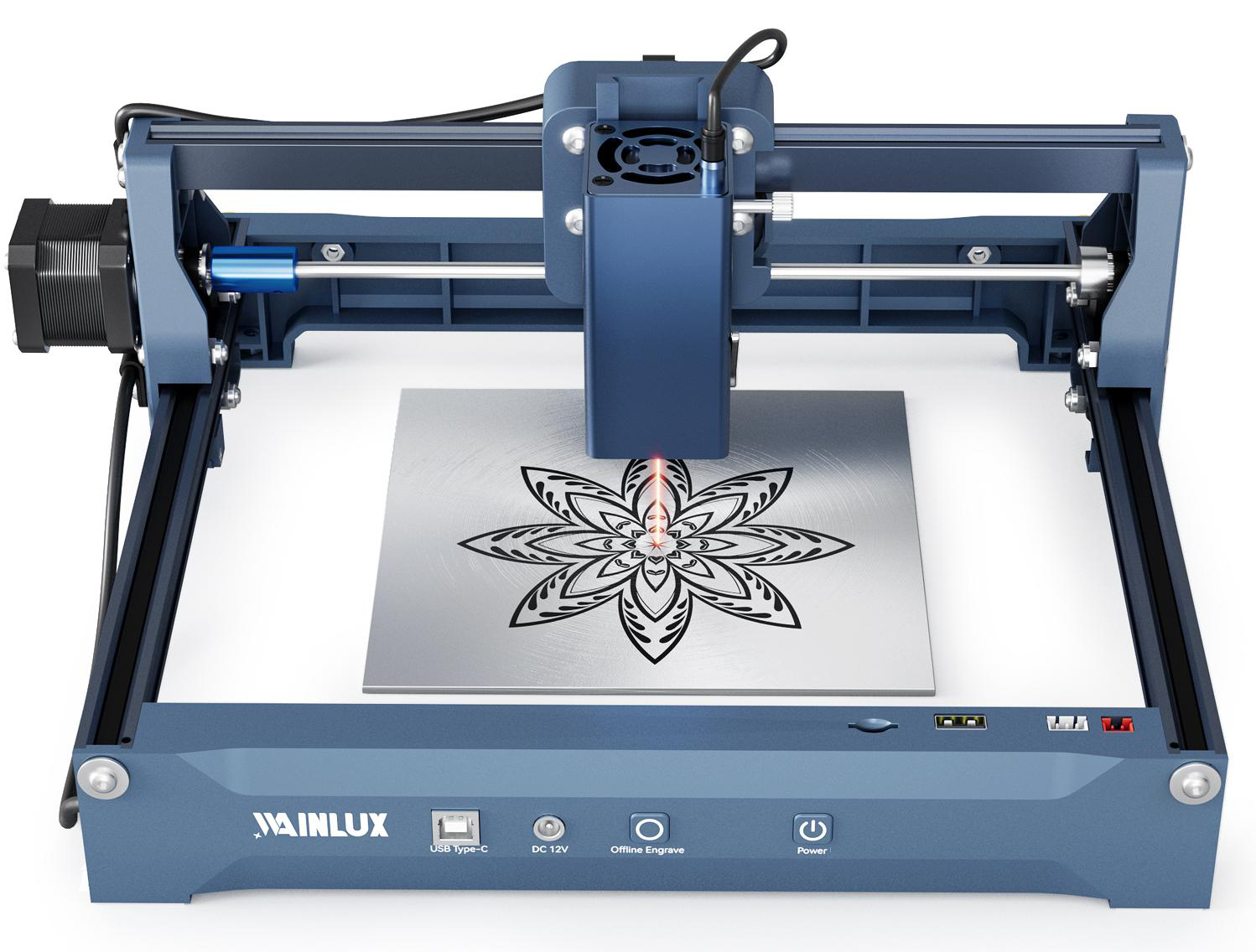
Understand the difference between 455nm blue diode and 1064nm red laser engraving machines, what each engraves, and how to match the laser to your material.
Two laser types, two material ranges
Desktop laser engraving machines use either a 455nm blue diode laser or a 1064nm red laser. The wavelength determines which materials the machine can engrave, so choosing the right one starts with the material you work with.
455nm blue diode lasers
Blue diode lasers engrave wood, leather, acrylic and similar materials, and cut thin plywood. For example, the WAINLUX X2-10W has a 15x20cm work area and engraves stainless steel, while the WAINLUX L8-40W cuts up to 15mm plywood in a 40x40cm area. If your work is mostly wood, acrylic, leather or craft materials, a blue diode machine covers the common range.
1064nm red lasers
A 1064nm red laser is better suited to metal engraving. The WAINLUX X1-1064NM offers a 30x30cm work area for high-speed metal engraving, and the WAINLUX X2-1064NM engraves metal in a 15x20cm area. If your products are metal tags, tools or industrial parts, a 1064nm machine is the relevant choice.
Dual laser machines
Some models combine both heads. The WAINLUX X2-10W+1064NM pairs a 455nm and a 1064nm laser in one 15x20cm machine, so it engraves wood, leather, acrylic and metal without switching machines. This suits workshops that handle mixed materials.
Work area and control
Work area ranges from compact 8x8cm models to 40x40cm machines. Control options include PC, WIFI, Bluetooth APP and offline modes. Choose the work area that fits your largest piece and the control method that matches your workflow.
Confirm your material first
Tell our team the materials and sizes you engrave, and we will recommend the laser type and work area. We offer OEM and ODM customization for your branding and packaging.