
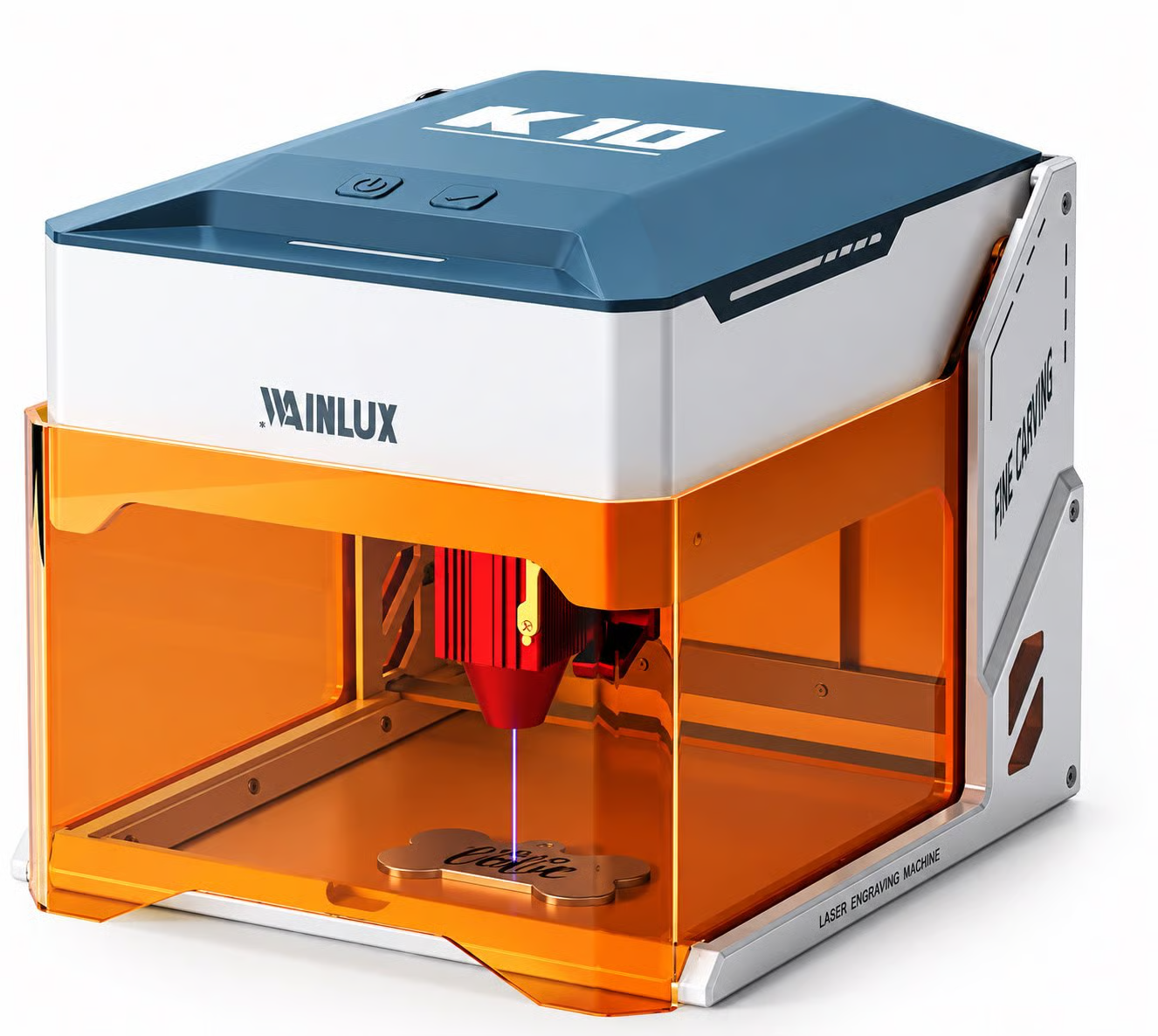
The process requirements behind batch laser marking on glass — surface preparation, fixturing and throughput — and the machine selection map that follows.
Laser marking on glass at batch scale — hundreds of tumblers, bottles or panels per week — is a process problem before it is a machine problem. Buyers who spec the machine first usually rediscover the process requirements mid-production, when rework is expensive. This guide lays out the process first, then the machine selection that follows from it.
Process Requirement 1: Surface Preparation Is Part of the Job
Clear glass is transparent at the wavelengths of desktop machines, so the laser must interact with something on the surface. In practice this means one of two workflows:
Painted/coated glass: the glass arrives or is treated with a coating; the laser ablates the coating to a clean, high-contrast mark.
Color-paper masking: the surface is covered with color paper; the laser engraves through it, and the mark is cleaned afterward.
Both are proven, repeatable production workflows — but each adds a preparation and cleaning step per unit. Cost it into your per-piece price before quoting customers. Any supplier who does not mention surface preparation when discussing glass marking is describing a machine, not a process.
Process Requirement 2: Fixturing and Focus Consistency
Batch glass marking lives or dies on repeatability. Plan for:
Fixed fixtures per product family, so every unit lands in the same position relative to the beam.
Consistent focal distance across the batch — smart positioning or autofocus features (F1 and X1 lines) remove per-unit adjustment.
Edge-margin rules for rims and handles, where curvature distorts the mark.
For cylindrical items (bottles, round tumblers), rotation during engraving is required — confirm with your supplier which rotary accessories are available and tested for the machine you are buying, before planning that product line.
Process Requirement 3: Throughput Architecture
Batch production rewards the right machine architecture more than raw power:
High-repetition small formats: a galvo machine (Z3-5W) steers the beam without moving the head, so identical repeat jobs run fastest.
Repeat-job setup: built-in screens and smart positioning (F1 line) shorten changeovers between SKUs.
Larger flat panels and nested layouts: large-format gantry beds (X1 30x30cm, L8 40x40cm) process more units per cycle.
Mixed glass + metal orders: dual-laser configurations keep both product families on one workflow.
Machine Selection Map for Batch Glass Marking
Coasters, small flat glass, gifts: 5W–10W diode units (K10-5W, K8-10W, X2-10W) with fixed fixtures.
Medium panels and batches: X1-10W (30x30cm) with autofocus for repeat alignment.
Signage-scale flat glass: L8 line (40x40cm) when workpieces are large.
Batch promotion items in small format: Z3-5W galvo for maximum pieces per hour.
Product line that includes metal components: add a 1064nm unit (K8-1064nm) or choose a dual-laser machine.
Quality Control for Batch Runs
Build three checks into the workflow: a first-article inspection after setup, a mid-batch contrast check against a golden sample, and a final visual pass before packing. Document the settings (power, speed, passes, focal position) per product family so any operator reproduces the result — this documentation, not the machine, is what makes a glass marking operation scalable.
FAQ
Can any laser mark glass permanently?
Desktop diode machines mark glass through prepared surfaces (coating or masking), producing durable results when the surface itself is durable. Industrial bare-glass subsurface marking is a different equipment class (UV/CO2) with different costs.
How do I cost surface preparation into my quote?
Time one full cycle — mask or coat, engrave, clean, inspect — and multiply by labor cost. Compare it against buying pre-coated glass from your glassware supplier.
What throughput should I expect per hour?
It depends on mark size, resolution and handling. Ask suppliers for realistic cycle time on your artwork and fixture it properly — setup time, not beam speed, is usually the constraint.
Spec Your Batch Process With Us
Send your glass products, artwork and target volume to [email protected]. Xiamen Spring Technology Co., Ltd. manufactures the WAINLUX diode, galvo, 1064nm and dual-laser lines, supports sample runs of 1–5 units, and will help you build the process — not just sell the machine.