
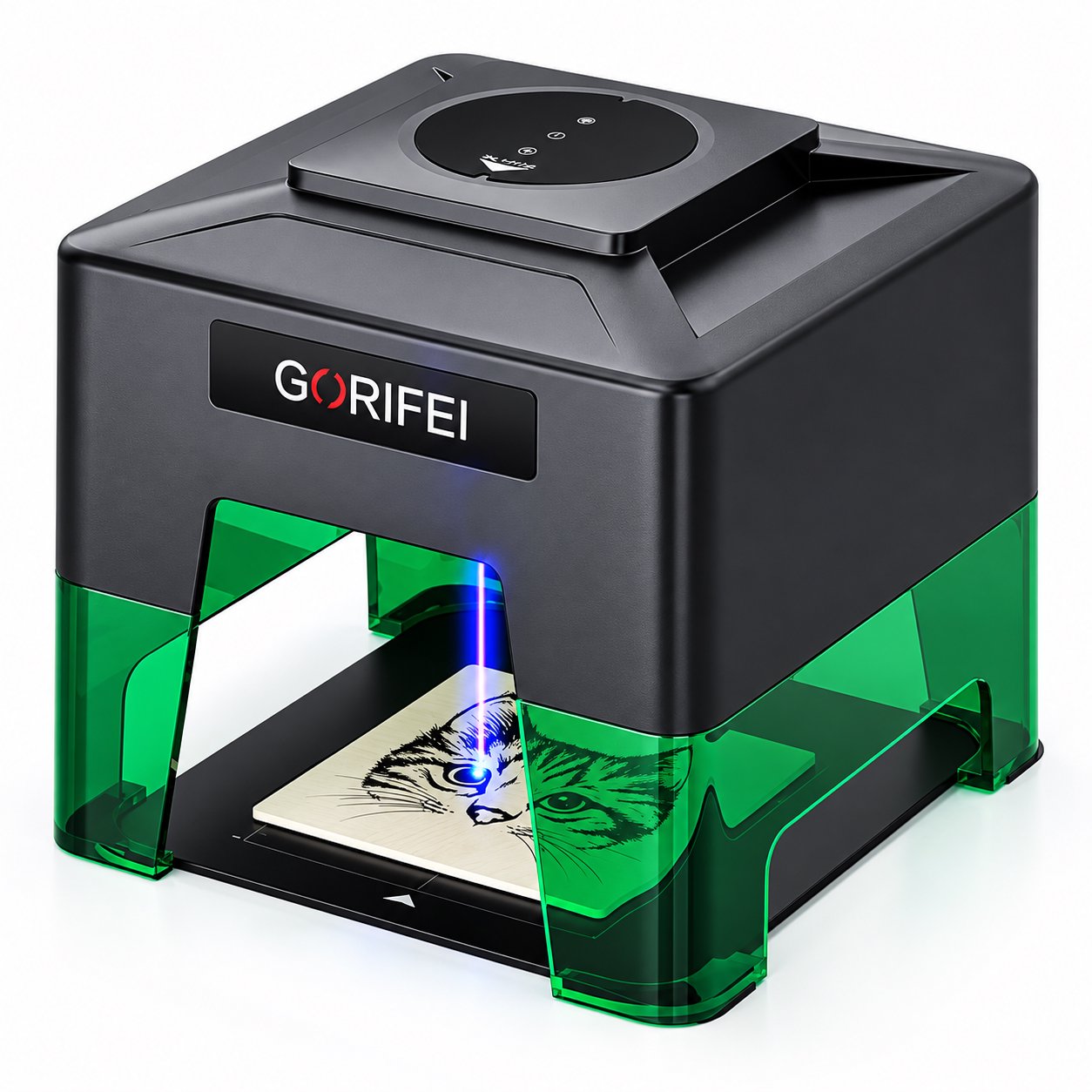
The business case for a portable laser engraver — event personalization and sampling it excels at, production limits it cannot escape, and how to combine it with a desktop machine.
A portable laser engraver is one of the most searched — and most misunderstood — machines in the customization business. The honest answer: a portable unit can open revenue streams a desktop machine cannot reach, and it will disappoint you if you expect it to replace one. Here is what the format can and cannot do, from the perspective of a customization shop deciding where it fits.
What a Portable Engraver Actually Is
The current generation of portable machines is exemplified by the WAINLUX XN001-3W: a foldable 455nm diode unit with a 9.8x8.8cm work area that runs on a power bank. It is a real laser engraver — wood, bamboo, acrylic and DIY materials — not a toy. But its design priorities are weight, setup speed and power independence, and every specification follows from that.
What It Can Do for a Business
- On-site personalization at markets, fairs and events: engrave while the customer watches — the format's killer application. No wall outlet needed; a power bank runs the job.
- Live demos and pop-ups: set up on a table, fold out, engrave a keepsake in front of foot traffic.
- Sampling before production: test artwork on customer materials without booking the shop machine.
- Second-station overflow: handle small flat items during peak hours instead of queuing behind large jobs.
- Low-risk entry: a 3W unit is the cheapest way to validate a product idea before investing in a production machine.
What It Cannot Do — Plan Around These
- It does not cut production material. A 3W output is engraving-only; plywood production cutting needs 10W–40W tiers.
- It does not mark bare metal. Like all diode machines, it works on painted/coated metals, not raw steel or jewelry — that is 1064nm territory.
- Small work area (9.8x8.8cm). Flat, small items only; no signage, no panels, no batch nesting.
- Modest throughput. It wins on flexibility, not speed; high-repetition volume belongs to galvo or large-format machines.
- Glass needs surface preparation, as with any diode machine — painted or color-paper masked surfaces.
The Right Business Model for a Portable Unit
Portable machines earn money as a revenue-side tool, not a production tool: they take personalization to where customers already are. The strongest configuration we see in customization shops is a two-machine stack — a portable unit for events and overflow, plus a desktop production machine (K10/K8 for small goods, X2/X1 for larger items, L8 for cutting) for the daily order book. The portable unit pays for itself in event revenue the desktop machine never had access to.
Buying Checklist for Portable Units
- Confirmed power-bank operation and real battery life per engraving session.
- Work area you have measured against your event products.
- Written confirmation of what 3W can and cannot engrave — including the glass preparation requirement.
- Same warranty and spare-part terms as the supplier's desktop machines.
FAQ
Is a portable engraver profitable for a small shop?
As an event and sampling tool, yes — margins on live-personalized keepsakes are strong and the machine cost is low. As your only production machine, no.
Can it run all day at a market stall?
With adequate power banks and duty-cycle breaks, yes. Plan battery capacity against your real engraving time per item, not the brochure's maximum.
Does portable mean lower quality engraving?
Resolution on small flat items is comparable to desktop diode machines; the limits are area, speed and material capability, not mark quality.
Try One at Your Own Event
Order 1–5 XN001-3W samples from [email protected] and test it at a real event before scaling. Xiamen Spring Technology Co., Ltd. manufactures the full WAINLUX portable-to-production range and will help you build the two-machine stack.