
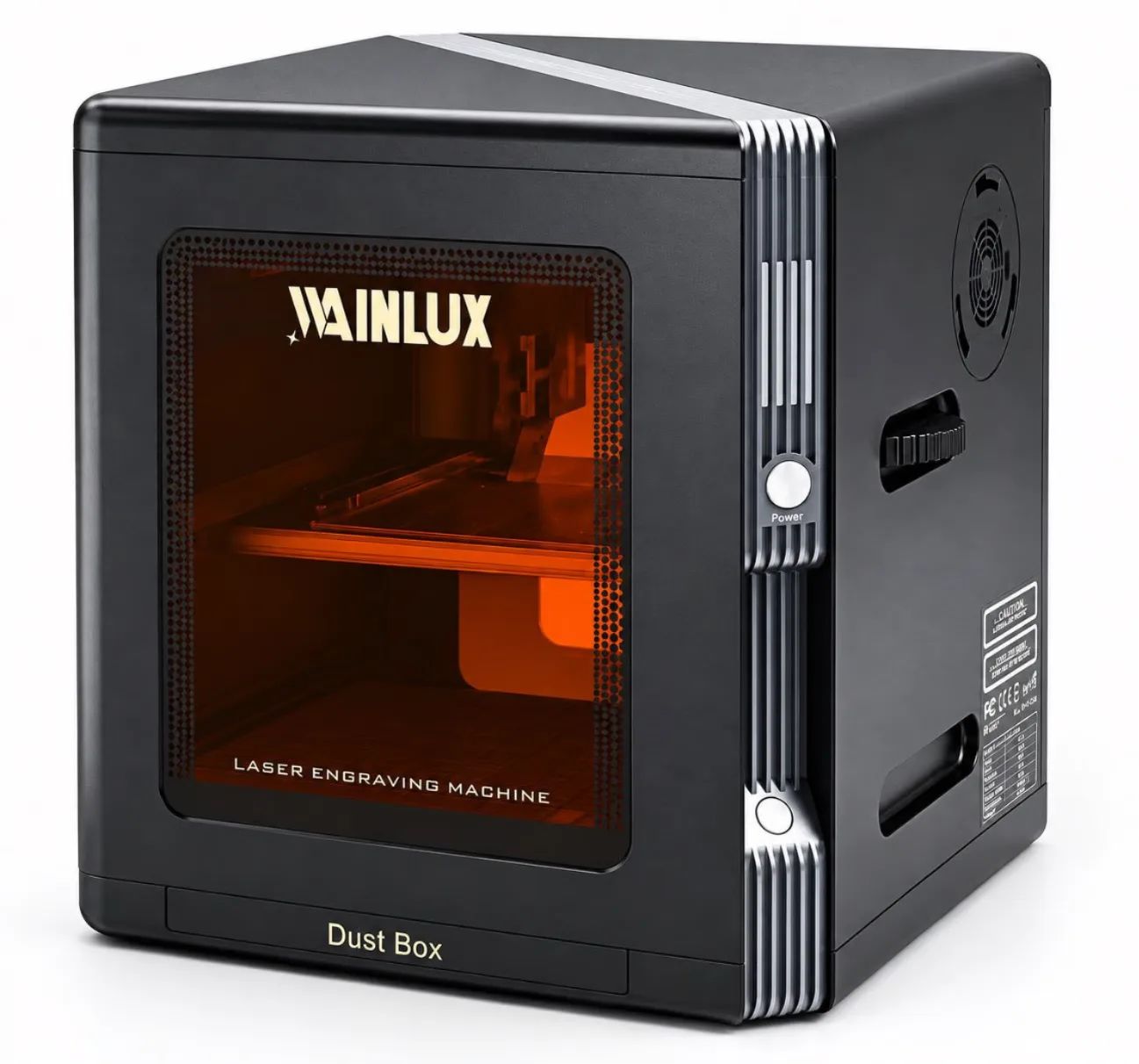
A six-point pre-order checklist for jewelry workshops and importers evaluating a laser cut jewelry machine for sale. Covers metal-marking wavelength, work area versus batch layout, accuracy and depth, workflow, after-sales configuration, and supplier verification, with WAINLUX K8-1064nm and X2-1064nm specifications as reference points.
Buying Checklist
Searching for a laser cut jewelry machine for sale usually means one of two situations: a workshop that hand-finishes every piece and needs to add metal marking capacity, or an importer building a lineup and comparing suppliers. Both need the same answers before money moves. This checklist covers the six points that most often decide whether a unit fits the bench or sits unused.
Key Takeaways
- Confirm the wavelength first. A 1064nm laser is well absorbed by bare metal; a blue diode laser cannot mark bare metal.
- Work area drives batch layout more than it drives single-piece size.
- Accuracy figures and depth ranges need units and conditions attached before you compare them.
- Enclosure, rotary attachments and air purification affect whether the machine can run inside your workshop.
Why Six Checks, in This Order
The order matters. Wavelength decides whether a machine can do the job at all. Work area and accuracy decide whether it fits your parts and volume. Workflow features decide whether it fits your floor. Supplier background decides whether you can rely on parts and documentation after delivery. Skipping ahead to price before settling the first two points is how buyers end up with equipment that marks the wrong material.
-
Check the wavelength against your metal, not the marketing name
A 1064nm wavelength is well absorbed by bare metal. That is the basic reason 1064nm machines can mark gold, silver, copper and steel, while blue diode lasers cannot mark bare metal. If your product line includes bare metal tags, clasps, blanks or sheet, this single spec filters your candidate list faster than any other line item.
The WAINLUX K8-1064nm is built on this principle: a 1064nm red laser that marks gold, silver, copper and steel, and also handles wood, leather and acrylic. If your work also includes iron, aluminum, stainless steel or zinc alloy, the WAINLUX X2-1064NM draft model covers those metals, marks them without smoke, and additionally works on opaque acrylic and hard plastics.
Note that the K8 and X2 specifications refer to different models and different material lists. Do not assume one model's capability transfers to the other.
If you want the K8 specification sheet in front of you while deciding, the WAINLUX K8-1064nm laser engraving machine page lists the full parameters.
-
Check work area against your batch layout
Work area is often misread as "the largest piece I can make." In jewelry work it more often decides how many pieces you can fixture at once. A necklace pendant and a run of twenty small tags are different production problems.
The K8-1064nm offers an 8x8cm work area. The X2-1064NM is listed at 15x20cm. If your typical order is a single pendant or a ring blank, the smaller bed is workable. If you fixture sheets of tags, run batches of charms, or want to nest parts, the larger bed reduces repositioning between runs.
Measure your actual fixtures, not just your finished pieces. The fixture usually takes more space than the part.
-
Check accuracy and depth with units and conditions attached
Two numbers get quoted loosely in this category. The K8-1064nm is listed at 0.01mm accuracy and a 0.1–1mm depth range, with a maximum speed of 2000mm/s. Read them as a set, not individually.
| Parameter | What it tells you | What to ask before ordering |
|---|---|---|
| 0.01mm accuracy | Positioning precision for fine detail such as small text, serial numbers and fine line work | Accuracy under what fixture and material? Ask for a sample on your own blank. |
| 0.1–1mm depth | The range of mark depth available for a given setup | Which depth is achievable at production speed, and on which metal? |
| 2000mm/s max speed | The upper speed limit of the motion system | At what power and depth setting is that speed used in real jobs? |
-
Check the workflow: how the file gets to the machine and how the machine sits on your floor
Connection method and enclosure decide whether the machine fits the way your workshop actually runs. The K8-1064nm supports USB, WiFi and Bluetooth, and ships with an enclosed dust box. Optional additions include a rotary roller and an air purifier.
The rotary roller matters if you mark rings, bangles or any cylindrical surface. Without it, those jobs need a different fixture or a different process. The air purifier matters if the machine will run in a room where people work. Confirm with the supplier which options are included in the base configuration and which are ordered separately — the answer changes the total landed cost even when the machine price looks comparable.
-
Check how the machine is programmed and supported after delivery
Ask what file formats the control software accepts, what computer it runs on, and what happens when a parameter needs adjusting in the middle of a production run. For an importer, add a second layer: what documentation ships with the unit, and in what language.
Because these are marking and engraving parameters rather than fixed settings, the practical test is whether the supplier can help you dial in a setting for your specific material. Request that as a sample job before you commit to a volume order, not after.
-
Check the supplier behind the machine
The equipment is one transaction; service is a multi-year relationship. Xiamen Spring Technology Co., Ltd. was founded in 1998, has 25 years of manufacturing experience, operates an ISO9001 company-level quality management system, and exports to more than 50 countries under the WAINLUX brand. The company offers OEM/ODM work.
A company-level ISO9001 QMS certificate covers the management system; it is not a product certification and does not by itself certify any individual unit. Ask separately for whatever product-level documentation your market requires.
Useful questions at this stage: Can you supply a spare-parts list and a consumables list? What is the recommended maintenance interval for the lens and the motion system? Which parts are user-replaceable? If you are importing, ask who handles technical questions in your time zone.
Quick Reference: Two Reference Points
| Item | WAINLUX K8-1064nm | WAINLUX X2-1064NM (draft model) |
|---|---|---|
| Laser type | 1064nm red laser | 1064nm |
| Work area | 8x8cm | 15x20cm |
| Accuracy | 0.01mm | Not stated in the supplied specification |
| Depth range | 0.1–1mm | Not stated in the supplied specification |
| Max speed | 2000mm/s | Not stated in the supplied specification |
| Connectivity | USB / WiFi / Bluetooth | Not stated in the supplied specification |
| Metals marked | Gold, silver, copper, steel | Gold, silver, copper, iron, aluminum, stainless steel, zinc alloy — without smoke |
| Other materials | Wood, leather, acrylic | Opaque acrylic, hard plastics |
| Enclosure / options | Enclosed dust box; optional rotary roller and air purifier | Not stated in the supplied specification |
The X2-1064NM is described here as a draft model. Treat the X2 column as reference only and confirm final specifications with the supplier before ordering.
What to Send the Supplier Before You Ask for a Quote
Suppliers quote more accurately when they can see the job. Useful material to prepare: a photo of the finished piece with a scale reference, the base metal and any plating, the target mark depth and whether it is a surface mark or a cut-through, the daily or monthly piece count, and whether rings or other cylindrical parts are involved.
With those items, a supplier can tell you which model applies and where your job sits relative to the stated accuracy and depth ranges — instead of guessing from a product name alone.
FAQ
Can a blue diode laser mark bare metal?
No. A 1064nm wavelength is well absorbed by bare metal; a blue diode laser cannot mark bare metal. This is why metal jewelry work generally points toward 1064nm equipment.
Is the 8x8cm work area large enough for jewelry?
For single pendants, ring blanks and small tags, yes. For fixtured batches of many small parts or nested sheets, the 15x20cm area of the X2-1064NM reduces how often you reposition work.
Do I need the rotary roller and air purifier?
These are listed as optional on the K8-1064nm. The rotary roller is relevant if you mark cylindrical surfaces such as rings or bangles. The air purifier is relevant if the machine runs in an occupied workspace. Confirm which options are included in your configuration.
Does the ISO9001 certificate apply to the machine?
The ISO9001 certification at Xiamen Spring Technology Co., Ltd. is a company-level quality management system certification. It is not a product certification. Request product-level documentation separately if your market requires it.