
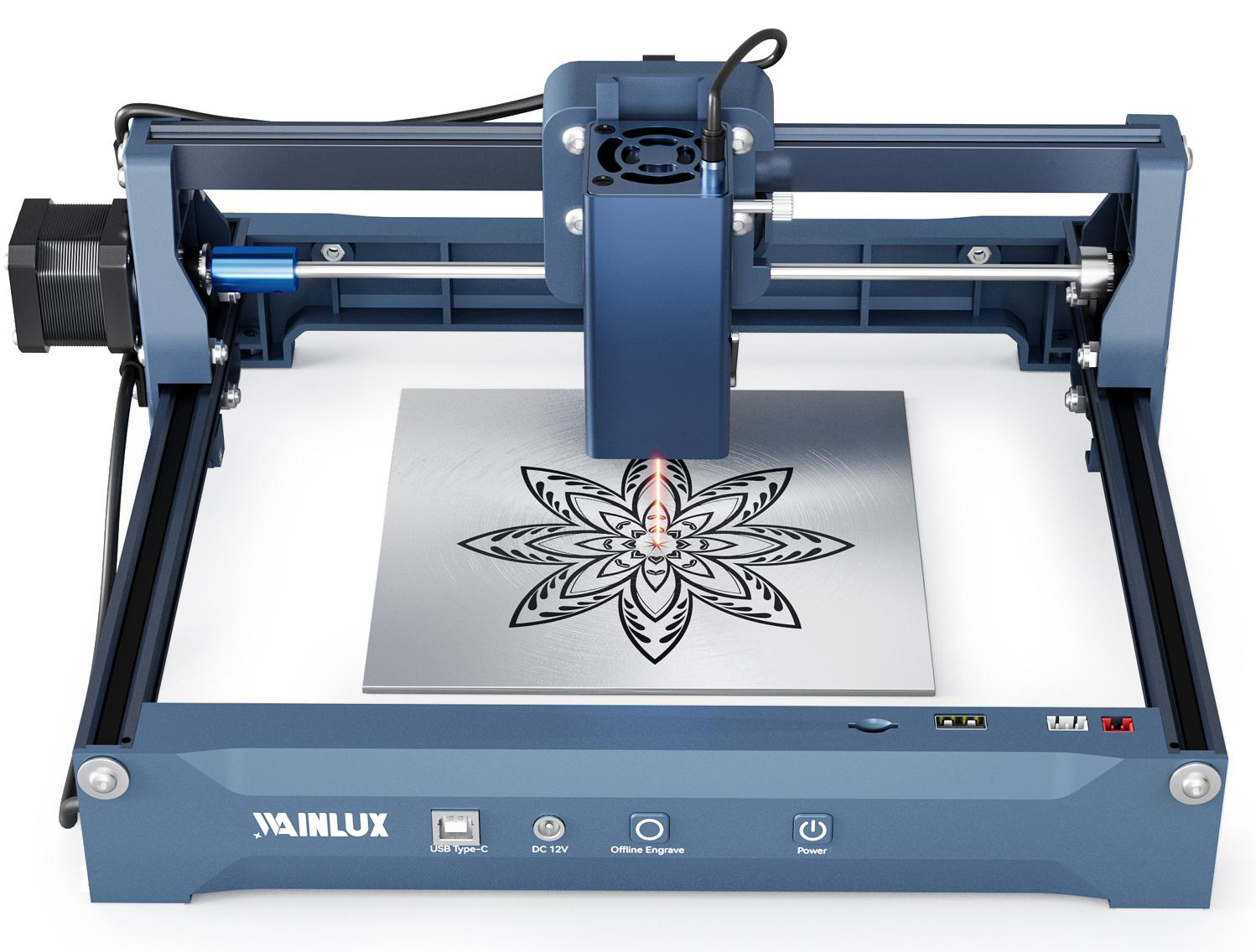
A 10W blue diode laser is not a universal cutter. This guide maps its real capability boundaries: which materials it engraves, which it cuts, and where it fails. We use WAINLUX X2-10W, X1-10W, and K8-10W specifications to show exactly what a 10W laser can and cannot do.
10 Watt Laser Engraver: What It Can and Cannot Do
A 10W blue diode laser is a focused light source, not a universal cutting tool. Buyers searching for a "10 watt laser engraver" often assume the number tells them everything. It does not. The 10W rating describes optical output power at the diode, and its real-world capability depends on wavelength, material absorption, and whether you are engraving or cutting. This article maps the actual boundaries using WAINLUX 10W systems as reference points: the X2-10W, X1-10W, and K8-10W. No invented specs, no exaggerated claims.
Key takeaways
- All WAINLUX 10W models use a 455nm blue diode laser — this wavelength determines what works.
- Engraving is possible on wood, paper, fabric, leather, and blackened stainless steel.
- Bare reflective metal cannot be marked with 455nm blue light — no exceptions.
- Cutting is limited to thin materials: the K8-10W cuts 5–8mm plywood, while the X1-10W is not recommended for cutting.
- Surface preparation (blackening) is required before any stainless steel engraving.
On this page
The wavelength boundary: why 455nm blue matters
The WAINLUX 10W series all operate at 455nm, which sits in the blue part of the visible spectrum. Material absorption at this wavelength is the single biggest factor in whether a laser will mark a surface. Organic materials — wood, paper, leather, fabric — absorb blue light efficiently and heat up quickly enough to char, vaporize, or discolor. That is why a 10W blue diode engraves these materials reliably.
Metals behave differently. Polished or bare metal reflects most 455nm light instead of absorbing it. Without absorption, there is no heat buildup, and without heat buildup, there is no mark. This is not a limitation of power; it is physics. The same 10W beam that burns a clean line into oak will bounce off a bare stainless steel plate with no visible effect. Understanding this boundary prevents wasted material and unrealistic expectations.
What a 10W blue diode can engrave
Across the WAINLUX 10W lineup, the following materials are within the engraving envelope:
- Wood — solid boards, plywood faces, and MDF take clean, dark marks at normal engraving speeds.
- Paper and cardstock — light engraving and scoring work without burning through.
- Fabric — cotton, canvas, and similar natural fibers discolor predictably.
- Leather — both natural and most finished leathers accept detailed engraving.
- Blackened stainless steel — the surface must first be coated with a blackening agent (commonly a marking spray or film). The blue laser then binds to the coating and transfers a permanent mark. The key phrase is after blackening the surface. Without that step, the stainless steel will not mark.
The WAINLUX X2-10W and X1-10W both confirm this capability. The X2-10W offers a 15x20cm work area, the X1-10W a larger 30x30cm bed with one-touch autofocus. Neither spec changes the wavelength, so the material rules remain identical.
A practical test for buyers: if a material is organic or has a matte, light-absorbing surface, a 10W blue diode can likely engrave it. If it is metallic and shiny, prepare the surface or expect no mark.
What a 10W blue diode can cut
Cutting is a different operation from engraving. It requires the beam to fully penetrate the material, which demands more energy density and often multiple passes. The 10W rating gives limited cutting headroom:
- WAINLUX K8-10W cuts 5–8mm plywood. This is the most capable cutting configuration in the 10W series, paired with an 8x8cm work area.
- WAINLUX X2-10W cuts thin wood boards, paper, fabric, and leather — materials measured in millimeters rather than centimeters.
- WAINLUX X1-10W is not recommended for cutting at this configuration. The 30x30cm bed is optimized for engraving, and using it as a cutter falls outside recommended practice.
For production cutting of thicker stock, a 10W diode is the wrong tool. A CO2 laser or higher-power diode would be required, and those sit outside this article's scope. Buyers who need both engraving and moderate cutting should match the model to the task: K8-10W for small-format cutting, X2-10W for thin material cutting plus engraving, X1-10W for large-area engraving only.
What it cannot do: reflective and bare metals
The most common misunderstanding is expecting a 10W blue diode to mark bare metal. It cannot. This includes:
- Polished stainless steel without blackening
- Aluminum, brass, copper, and chrome in their bare reflective states
- Any surface that acts as a mirror to 455nm light
Reflective materials cannot be engraved because the light never converts to heat at the surface. The laser may leave a faint burnish or nothing at all. Attempting it risks damaging the lens or wasting time.
Stainless steel can be engraved, but only after applying a blackening compound. This is a two-step process: coat, then engrave. The resulting mark is durable, but it is a surface treatment rather than a direct metal mark. Buyers should treat "stainless steel engraving" as "blackened stainless steel engraving" when evaluating a 10W blue diode machine.
Model comparison: X2-10W, X1-10W, K8-10W
| Model | Wavelength | Work area | Engraving | Cutting | Stainless steel | Autofocus |
|---|---|---|---|---|---|---|
| WAINLUX X2-10W | 455nm blue diode | 15x20cm | Wood, paper, fabric, leather, blackened stainless steel | Thin wood boards, paper, fabric, leather | After blackening only | Not specified |
| WAINLUX X1-10W | 455nm blue diode | 30x30cm | Wood, paper, fabric, leather, blackened stainless steel | Not recommended at this configuration | After blackening only | One-touch |
| WAINLUX K8-10W | 455nm blue diode | 8x8cm | Wood, paper, fabric, leather, blackened stainless steel | 5–8mm plywood | After blackening only | Not specified |
All three models share the same 455nm blue diode wavelength and the same material absorption rules. Differences lie in work area, cutting capability, and focus automation. The K8-10W is the cutting-oriented choice for small parts. The X1-10W is the large-format engraving choice with autofocus. The X2-10W sits between them with a modest bed and thin-material cutting.
Neither the X2-10W nor the X1-10W nor the K8-10W can mark bare reflective metal. That boundary is universal across the 10W blue diode category.
FAQ
Can a 10W laser engraver cut 10mm plywood?
The WAINLUX K8-10W cuts 5–8mm plywood. Thicker material sits outside its rated range. The X2-10W handles only thin wood boards. The X1-10W is not recommended for cutting.
Why does my 10W laser not mark stainless steel?
If the stainless steel is bare and reflective, the 455nm blue light is reflected rather than absorbed. You must blacken the surface first.
Can I engrave aluminum with a 10W blue diode?
Bare aluminum is reflective and cannot be engraved with a 455nm blue diode. No WAINLUX 10W model lists aluminum as an engraving material.
What materials are safe for a 10W laser engraver?
Wood, paper, fabric, leather, and blackened stainless steel. Avoid reflective metals, PVC, and any material that releases toxic fumes when heated.
How do I choose between the X2-10W, X1-10W, and K8-10W?
Choose the X1-10W for large-area engraving with autofocus. Choose the K8-10W for small-part cutting of 5–8mm plywood. Choose the X2-10W for a middle ground of engraving and thin-material cutting.
Where WAINLUX fits
Xiamen Spring Technology Co., Ltd. has manufactured laser equipment since 1998. The company holds ISO9001 company-level certification, offers OEM/ODM services, and exports to more than 50 countries. The WAINLUX 10W series is part of that lineup, built for buyers who need a clear, honest understanding of what a 10W blue diode can and cannot do. If your application falls within the boundaries described here, a 10W laser engraver is a practical, cost-effective tool. If it requires marking bare metal or cutting thick stock, the specifications above show why a different machine class is the right conversation.
To discuss which WAINLUX model matches your material and workflow, contact our team with your substrate list and thickness range.