
Space planning drives this comparison of compact laser engravers. We show how to measure bench depth, clearance, and ventilation, then compare four machines on footprint, bed size, enclosure, and control method. The goal: help you pick a small laser engraver that fits your workspace and your material list.
Buyer's guide for tight workspaces
A small laser engraver is often described by its machine footprint alone. That is the wrong starting point. In a real workshop, the machine must sit on a bench deep enough to hold it, leave clearance for the gantry and cables, and let you reach the workbed without moving the unit. If ventilation and power are missing at that spot, the machine is not small enough for that location—no matter how little floor space it uses.
This guide compares compact machines the way a buyer actually plans: first by the physical space required, then by enclosure, connectivity, and material range. It is not a ranked list. It is a fitting exercise.
Key takeaways
- Measure bench depth, wall clearance, and ventilation path before comparing wattage or brand.
- Enclosure changes where you can place a machine: open frames need a dedicated area; enclosed units reduce stray light and smoke spread.
- Control method matters in a shared shop: offline buttons avoid tying up a PC or phone.
- WAINLUX has manufactured laser engraving machines since 1998, holds an ISO9001 company-level certificate, and offers OEM/ODM with export to 50+ countries.
In this article
What small should mean in your workspace
In buyer terms, "small" is a set of limits, not a marketing adjective. Define it with four numbers:
- Footprint: the length and width of the machine base, including any protruding knobs or cable exits.
- Bed size: the work area you can actually engrave in one pass. A compact frame with a tiny bed can be less useful than a slightly larger machine that holds a standard blank.
- Weight: what one person can lift or what the bench can support. A 4.4 kg unit is easy to reposition; heavier enclosed units stay put.
- Storage: where the machine lives when not in use—on the bench, on a shelf, or in a case. Foldable or compact designs reduce idle footprint.
These four numbers determine whether a machine fits the place you have, not the place you wish you had. The sections below use them to compare actual compact models.
Space planning math for a tight bench
Before choosing a machine, measure the bench. The calculation is straightforward arithmetic, but the clearance rules are where most buyers get caught.
- Check bench depth against machine depth. The listed depth is often the body only. Leave room at the rear for cable bend and ventilation, and enough at the front to reach the workbed comfortably. On a shallow bench, that extra clearance often decides whether the machine fits, not the listed body size alone.
- Check width against side clearance. Leave open space on the side where the control panel or USB port sits. On a narrow bench, that side space is often the deciding factor.
- Check vertical clearance. Open-frame machines need room above the bed for the gantry and for lifting the workpiece. Enclosed units need enough overhead space to open the lid fully. Measure from bench surface to shelf or cabinet above.
- Verify power and data reach. A machine that runs from USB, Bluetooth app, or offline button does not require a dedicated PC at the bench. A power-bank-compatible unit can be placed where a wall outlet is not available, but check that the cable still reaches without crossing the work area.
- Plan the ventilation path. Engraving produces fumes and smoke. Place the machine near a window, fume extractor, or ducting route. An enclosed unit concentrates exhaust at one point, which is easier to vent than an open frame. If no vent path exists, the machine cannot operate continuously in that spot.
- Measure the storage position. If the machine is moved after each session, measure the shelf or cabinet as well. A foldable unit such as the XN001-3W, with a 9.8 x 8.8 cm engraving area, can be stored compactly and set up where the work is.
Tip: Use painter's tape to mark the machine footprint, rear clearance, and lid swing on the bench. If the tape overlaps a wall, shelf, or walkway, the machine is too large for that spot—regardless of its listed size.
Comparing four compact machines
The table below compares compact WAINLUX models on the dimensions that affect placement: bed size, physical size, enclosure type, and control method. It is not a ranking; each machine suits a different bench and material list.
| Model | Engraving area | Machine size and weight | Enclosure | Control |
|---|---|---|---|---|
| WAINLUX XN001-3W | 9.8 x 8.8 cm | Compact, foldable; weight not listed | Open frame | USB, Bluetooth app, offline button; power-bank compatible |
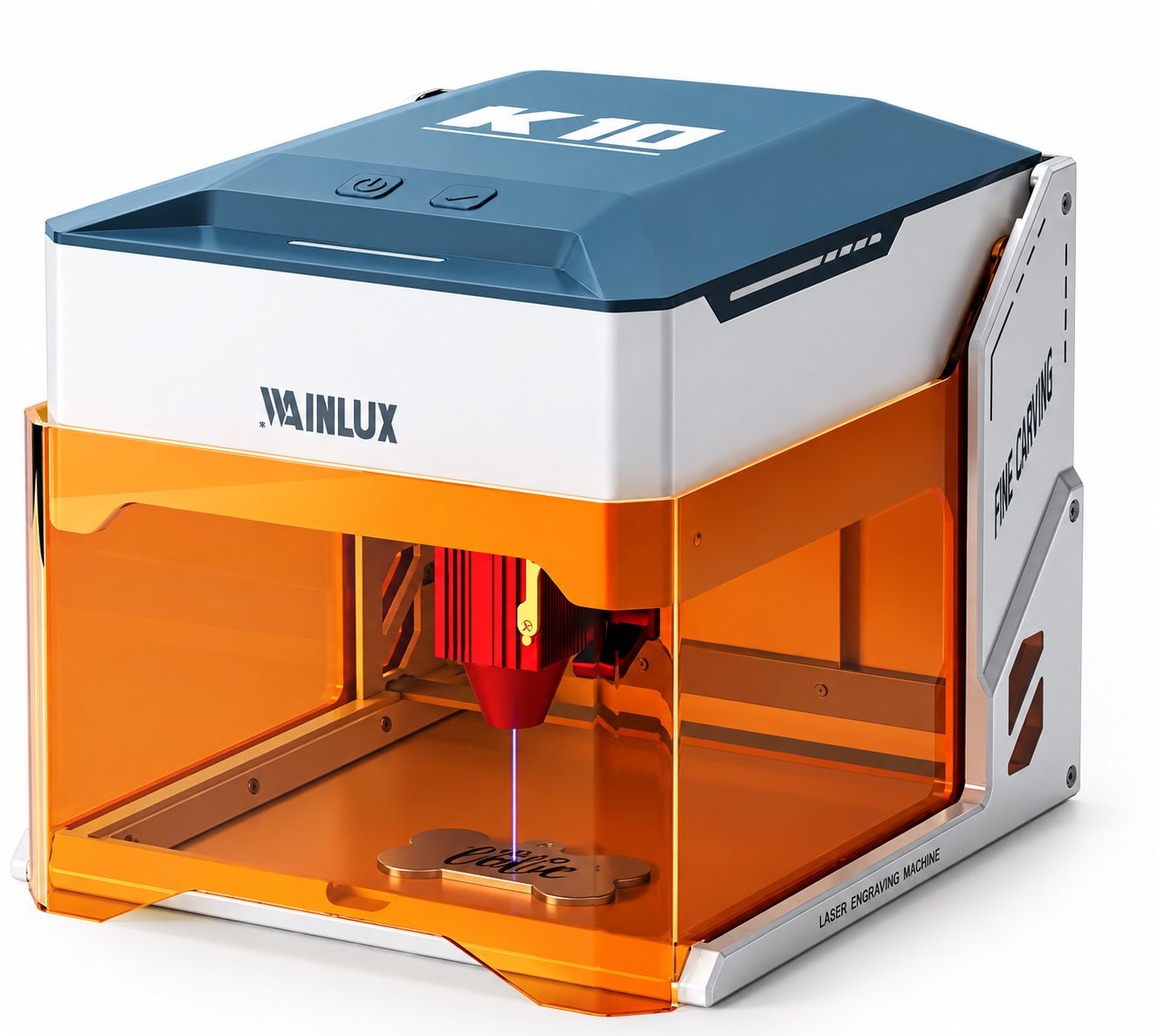
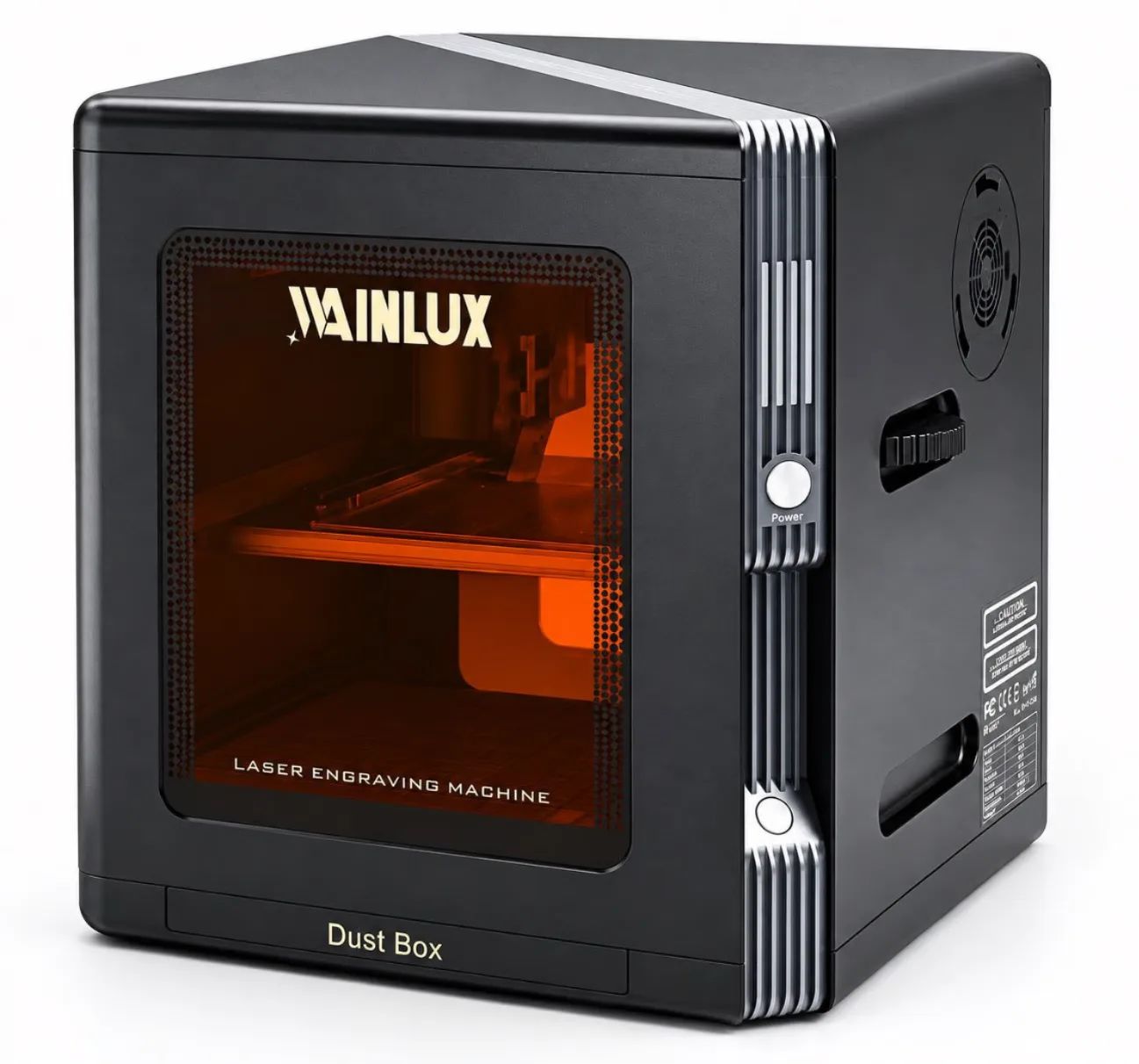
| WAINLUX K10-5W | Not specified in source | Fully enclosed; weight not listed | Fully enclosed, 455 nm 5W | WiFi, PC, offline |
| WAINLUX K8-1064nm | 8 x 8 cm | 190 x 286 x 313 mm; 4.4 kg | Not specified in source | Not specified in source |
| WAINLUX F1-10W+1064nm | 10 x 10 cm | Not specified in source | Not specified in source | Dual head; built-in screen |
The XN001-3W is the smallest on bed size, but it runs from a power bank and offers an offline button—useful where a bench outlet is occupied or where the machine moves between locations. The K10-5W is the only fully enclosed unit in this group, which changes where it can sit. The K8-1064nm has the largest listed body at 190 x 286 x 313 mm and 4.4 kg, making it a bench-top machine rather than a shelf-stored one. The F1-10W+1064nm offers the largest bed at 10 x 10 cm and a built-in screen, so it can operate without a separate computer.
Enclosure, connectivity, and material range
Enclosure type is a placement decision. An open frame like the XN001-3W is easy to store and light to move, but it needs a dedicated area away from walkways because the laser path and smoke are open. A fully enclosed machine such as the K10-5W contains the work area and can be placed closer to other equipment, provided the exhaust is routed. In a shared shop, that difference often matters more than a few centimeters of bed size.
Connectivity decides how the machine fits the workflow. Offline buttons and built-in screens allow operation without a PC, which is practical when the bench has no computer or when several people share one laptop. WiFi and Bluetooth app control add flexibility for file transfer, but they require a stable network or a charged phone. Power-bank compatibility on the XN001-3W means the machine can run from a portable battery where mains power is not available—useful for craft fairs or temporary setups, though continuous use depends on the power bank capacity.
Material range is where buyers should read the facts carefully. The K10-5W is listed as cutting 3–5 mm plywood with its 455 nm 5W laser. The K8-1064nm and F1-10W+1064nm use a 1064 nm wavelength, which is a different laser type commonly used for marking metals—but this article does not compare metal performance; that is a separate topic. For wood, leather, paper, and similar organics, the 455 nm machines are the relevant group. If your material list includes both wood and metal, a dual-head machine like the F1-10W+1064nm covers both in one frame, at the cost of a larger footprint than the tiny XN001-3W.
For buyers who need a compact unit with a specific bed size, see the WAINLUX XN001-3W for foldable storage and power-bank operation, or the WAINLUX K8-1064nm for an 8 x 8 cm work area in a 190 x 286 x 313 mm body.
Buyer questions
How much bench depth does a compact laser engraver need?
Start from the listed body depth, then add rear clearance for cables and ventilation and front access to the bed. Confirm the working clearance with the supplier for your model, since cable routing varies.
Can I run a small laser engraver without a computer?
Some models support offline operation. The XN001-3W has an offline button, and the F1-10W+1064nm has a built-in screen. This suits shared benches or locations without a PC.
Is a fully enclosed machine safer for a small workshop?
An enclosure contains the laser path and helps concentrate exhaust, which is easier to vent. The K10-5W is fully enclosed. Open-frame machines can still be used in small shops if the area is controlled and ventilation is adequate. Confirm local safety requirements with the supplier.
What is the smallest practical bed size?
It depends on your blanks. The XN001-3W offers 9.8 x 8.8 cm, the K8-1064nm offers 8 x 8 cm, and the F1-10W+1064nm offers 10 x 10 cm. Measure your largest standard workpiece before choosing.
WAINLUX has been manufacturing laser engraving machines since 1998, with more than 25 years of production experience, an ISO9001 company-level certificate, OEM/ODM support, and exports to 50+ countries. For buyers comparing compact models for a specific bench, the next step is to measure the space and send the dimensions along with your material list.
Need help matching a compact engraver to your bench?
Send your bench depth, available width, and the materials you plan to engrave. We will recommend a compact model and confirm the clearance figures for your space.
Request product details