
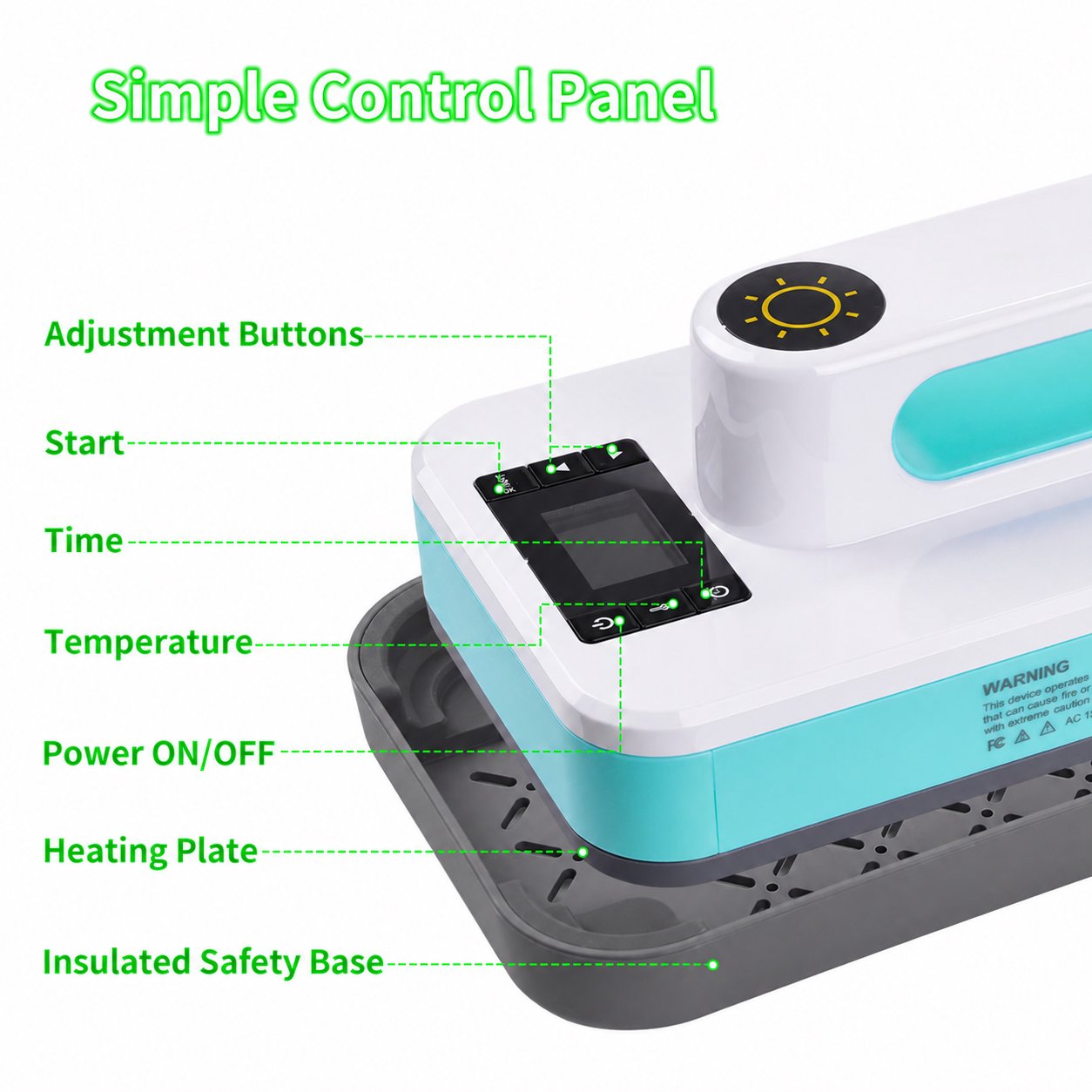
A clamshell press trades floor space for a fixed arc of travel. This article explains what that hinge geometry means for loading speed, sightlines, and material thickness, and helps you decide which jobs suit a clamshell and which do not.
Heat Press Selection
A clamshell press opens and closes on a single hinge. The upper platen swings up and away from the lower platen in an arc, and you load the garment from the front or the side while the top stays raised. Xiamen Spring Technology Co., Ltd. has built heat presses since 1998, and its C03 model is a desktop clamshell with a 9×9 in (25×25 cm) platen, 900 W / 1000 W heating, and an 85–205 °C range. But before comparing wattage or platen size, it helps to understand what the hinge itself decides for you: how much bench you give up, how fast your hands can load, and what you can see and fit under a closing top.
- A clamshell saves bench space because the top swings up rather than sliding back.
- Loading becomes a repeatable two-hand motion, which supports muscle memory at small platen sizes.
- The hinge fixes the sightline and limits how thick an assembly can sit under the top.
- Clamshells suit flat, single-layer work on small platens; they are less suited to thick stacks or jobs needing a clear view of the whole platen.
What the hinge geometry actually changes
A clamshell press is defined by its motion. The upper heat platen is fixed to an arm that pivots on a hinge at the rear of the machine. Opening it lifts the platen through an arc; closing it lowers the same arc onto the work. Nothing slides, and nothing needs clearance behind the machine beyond the swing of the arm.
That single mechanical fact produces four practical consequences: footprint, loading rhythm, sightline, and thickness tolerance. They are connected, and they matter more on a small desktop press than on a large one.
Smaller footprint on the bench
On a swing-away or sliding press, the upper platen has to travel backward or sideways, which means the bench or stand must be deep enough to receive it. A clamshell keeps that travel vertical. The machine occupies roughly its own base footprint, plus the raised arm when open. For a workshop that shares bench space with a cutter, a sewing machine, or a computer, that is the main reason to choose a clamshell.
The C03 is built as a desktop unit with a 9×9 in platen. At that size the machine is intended to sit on a work surface rather than a dedicated floor stand, so the bench layout can be planned around it. The trade-off is that the platen is small — 25 cm square — which suits heat-transfer work sized to that area, not large-format panels.
Faster loading through muscle memory
Clamshell loading is a fixed sequence: lift the arm, place the garment on the lower platen, position the transfer, lower the arm, press. Because the lower platen never moves and the top returns to the same position every cycle, an operator can repeat the motion without looking for a moving bed. That repetition is what people mean by muscle memory, and it is strongest when the platen is small enough that the hands can reach both edges without repositioning the body.
At 9×9 in, the C03 fits that description. The operator loads from the front, and the platen edge is close enough for a seated or standing worker to align a transfer by feel after a few cycles. On a much larger platen, the same loading motion becomes a reach, and the speed advantage narrows.
Sightline under a closing hinge
Here is where the clamshell geometry imposes a limit. When the top is lowered, the upper platen and its arm sit between the operator's eyes and the work surface. On many clamshell designs, the raised arm also blocks part of the view when open, depending on the angle of the hinge and the height of the operator.
For flat work this is usually acceptable: the transfer is positioned before the top comes down. But for jobs where you need to watch registration during the press cycle — aligning a second color, checking that a small piece has not shifted, or working near the edge of the platen — the hinge can get in the way. A press that opens on a different axis may give a clearer view of the whole platen. That is a viewing geometry question, not a quality question, and it should be judged against the actual work.
Thickness limits of a hinge closing on the work
A clamshell closes through a fixed arc until the upper platen meets the lower platen or the work between them. The hinge does not adjust itself to the stack. If you place a thick assembly — a folded garment, a padded item, a multi-layer stack, or a substrate with a raised edge — the upper platen has to stop higher, and the pressure applied across the surface may not be even.
The practical result is that clamshell presses are best suited to relatively flat, single-layer or lightly layered work that fits within the platen's closing range. Thick or highly uneven assemblies are a poor match for the geometry, regardless of the temperature setting. If your production routinely includes thick stacks, measure the total thickness and confirm with the supplier how the press behaves at that height before ordering.
Which jobs suit a clamshell press
- Small-format heat transfer: flat textile transfers and similar work sized to a 9×9 in platen.
- Bench-based production: workshops where the press shares a surface with other equipment and cannot give up floor depth.
- Repetitive single-operator loading: runs where the same motion is repeated and speed comes from rhythm rather than reach.
- Flat substrates: work that sits within the closing range of the hinge without a thick stack.
Which jobs do not
- Large-format panels: a 25 cm platen is smaller than most wide-format transfer work.
- Thick or padded assemblies: the fixed arc of the hinge limits how much material can sit under the top.
- Close visual monitoring during the press: if the operator needs an unobstructed view of the whole platen while the top is down, the hinge is in the way.
- Work that needs a sliding bed: some processes depend on moving the work into and out of the press along a bed; a clamshell does not offer that motion.
Quick comparison by geometry
| Consideration | What a clamshell gives you | Where it constrains you |
|---|---|---|
| Bench space | Upper platen swings up, so little depth is needed behind the machine | Raised arm needs vertical clearance when open |
| Loading | Fixed lower platen supports fast, repeatable hand motion | Small platen keeps reach short; large platen reduces the advantage |
| Sightline | Transfer is placed before closing | Top and arm can block the view of the work during the cycle |
| Thickness | Works well with flat, lightly layered material | Fixed arc limits how thick a stack can be pressed evenly |
What to check before buying
Because the hinge fixes these limits, the buying decision is mainly a fit check. List the work you will actually run: the largest flat piece, the thickest stack, and whether the operator needs to watch the platen during the press. Then compare that list with the machine's platen size and closing range.
For the C03, the listed platen is 9×9 in (25×25 cm), heating is 900 W / 1000 W, and the working range is 85–205 °C. Those figures tell you what the press is built to do. They do not tell you whether your thickest assembly will press evenly — that depends on the hinge arc and the stack, and it is worth asking the supplier directly. You can review the model here: C03 9×9 in clamshell heat press.
Supply terms for buyers
Xiamen Spring Technology Co., Ltd. has manufactured heat presses since 1998 and offers OEM/ODM work. Samples of 1–5 units are supplied at 100% prepaid. Official orders start at 50 pieces with 70/30 T/T terms, and the machine carries a 1-year spare parts warranty. These terms are worth confirming against your own order size and destination when you request a quotation.
FAQ
Is a clamshell press always faster to load than other press types?
Not always. The speed advantage comes from repeating a fixed motion on a platen small enough to reach without repositioning. On a large platen, the reach grows and the advantage narrows.
Can a clamshell press handle thick garments?
The hinge closes through a fixed arc, so a thick stack raises the upper platen and can affect how evenly pressure is applied. Measure your thickest assembly and confirm the closing range with the supplier.
Why does sightline matter on a clamshell?
When the top is down, the upper platen and arm sit between the operator and the work. If a job needs continuous visual checking during the press, that geometry is a real constraint.