
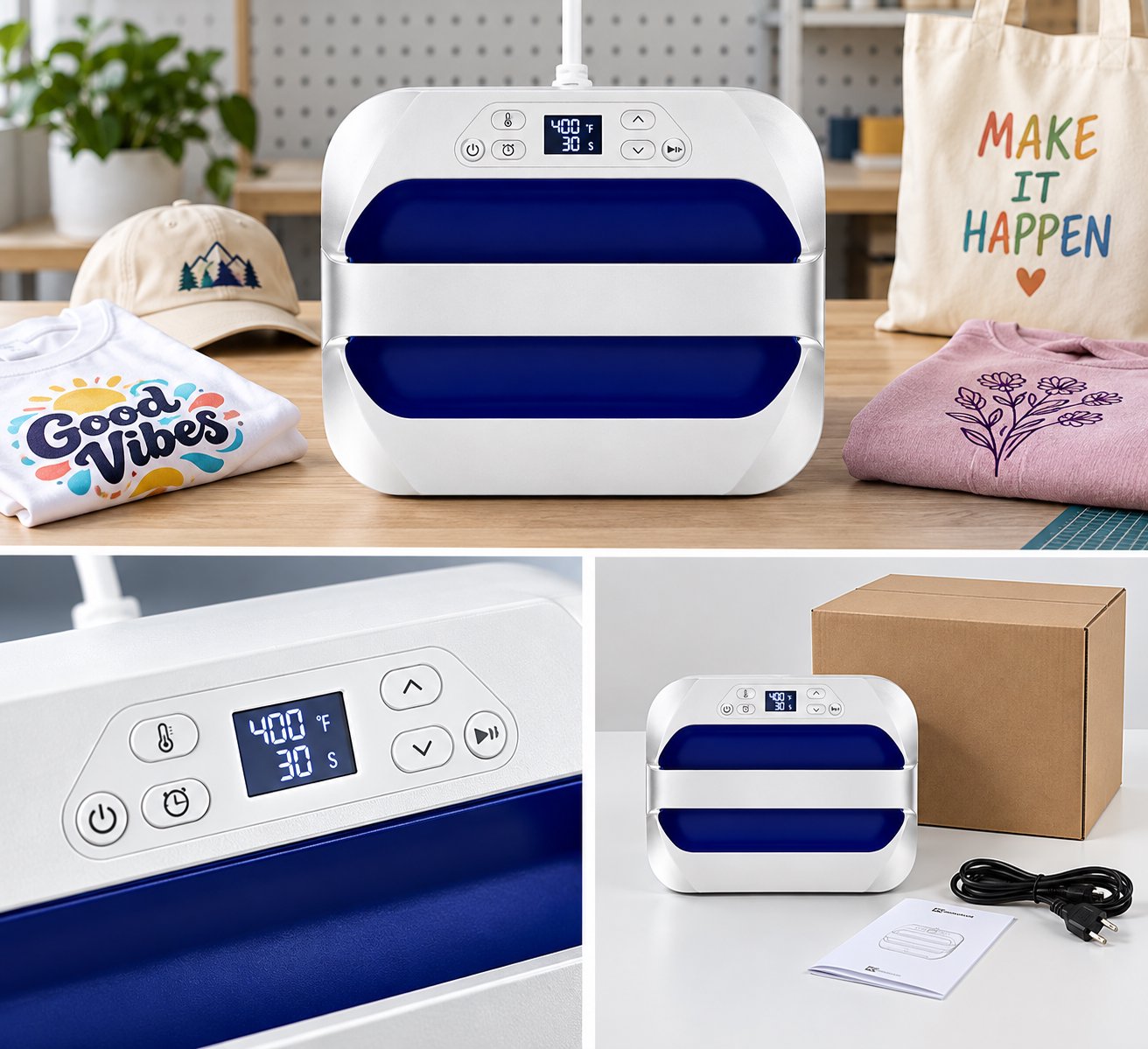
For commercial heat press buyers, production math matters more than feature lists. This article explains how to estimate output per shift, what duty cycle to expect from desktop manual presses, and how OEM, payment, and MOQ terms shape a commercial order—using Xiamen Spring Technology's C05 and C10 models as examples.
Commercial Heat Press Guide
Commercial Heat Press: Sizing Output, Duty Cycle and OEM Terms
If you are sourcing a commercial heat press for a production environment, the decision usually comes down to three practical questions: How many pieces can one machine turn out per shift? How hard can I run it without compromising reliability? And what do the OEM, payment, and MOQ terms look like when I move from a sample to a bulk order? This article works through those questions using the current desktop manual press lineup from Xiamen Spring Technology Co., Ltd. (est. 1998) as a concrete example. The goal is not to recommend one model over another, but to give you a framework for estimating output and negotiating terms that fit your production plan.
Key takeaways:
- Output per shift depends on platen size, load/unload time, and press cycle—not just on wattage.
- Desktop manual presses have a duty cycle that suits small-to-medium batch work; continuous high-volume runs may require multiple units or a different class of machine.
- Xiamen Spring Technology offers samples (1–5 units, 100% prepaid) and official orders from 50 pcs at 70/30 T/T, with a 1-year spare parts warranty.
- OEM/ODM is available, but clarifying artwork, packaging, and labeling requirements early keeps the commercial order on schedule.
On this page:
Estimating output per shift
Production math starts with the press cycle. For a manual heat press, the cycle time includes loading the substrate, closing the platen, applying heat and pressure for the dwell time, opening, and unloading. The dwell time depends on the material and transfer type—typically 10 to 30 seconds for common heat transfer applications—but you should confirm the exact dwell and temperature for your specific substrate and transfer. The load/unload time is often the larger variable: a simple flat garment might take 5–10 seconds to position and remove, while a thicker or awkward item could take longer.
To estimate pieces per hour, use this formula:
Pieces per hour = 3600 / (load time + dwell time + unload time + handling overhead)
For example, if load and unload together take 15 seconds and dwell is 20 seconds, the cycle is 35 seconds, giving roughly 103 pieces per hour in theory. In practice, add handling overhead—placing transfers, checking alignment, occasional repositioning—and a realistic sustained rate might be 70–90 pieces per hour. Over an 8-hour shift with breaks, that translates to roughly 500–650 pieces per shift per machine.
Platen size directly affects how many pieces you can process in one cycle. A 12x10-inch platen (like the C05 and C10) can accommodate small to medium graphics; for larger designs you may need multiple presses or a larger platen. The C03 model has a 9x9-inch platen, which suits smaller items such as sleeves, pockets, or tags.
Keep in mind that these are estimates based on typical manual operation. Your actual output will vary with operator skill, substrate type, and workflow organization. Use the formula with your own time studies to build a reliable capacity plan.
Duty cycle expectations for desktop manual presses
Duty cycle refers to how long a machine can run within a given period without overheating or excessive wear. Desktop manual heat presses are generally designed for intermittent use—cycle on, cycle off—rather than continuous industrial operation. The heating element and mechanical components need time to recover between presses, especially at higher temperatures.
For the Xiamen Spring Technology models, the listed temperature ranges give a clue: the C05 operates from 85°C to 205°C, the C10 from 100°C to 205°C, and the C03 from 85°C to 205°C. Running at the top of the range for extended periods will naturally generate more heat in the platen and surrounding components. A sensible approach is to plan for a duty cycle that includes short pauses between cycles—for example, 30–60 seconds of idle time per 10–15 minutes of pressing—to allow the machine to stabilize. This is not a hard specification from the manufacturer, but a practical guideline based on the design of desktop manual presses.
If your production plan requires continuous pressing for hours without breaks, you should consider whether a single desktop manual press is the right tool. Many commercial operations use multiple units in parallel or schedule operator breaks that align with machine cool-down periods. Alternatively, you may need to look at higher-duty machines, but that is outside the scope of this article.
Wattage also plays a role: the C05 is listed at 1250W/1350W (depending on voltage), the C10 at 1200W, and the C03 at 900W/1000W. Higher wattage generally means faster heat-up and better temperature recovery, but it also draws more current. Ensure your electrical supply matches the machine's voltage (110V or 220V for the C05; check the C10 and C03 specifications).
OEM, payment, and MOQ terms that change a commercial order
When you move from evaluating a sample to placing a commercial order, the terms of the deal become as important as the machine specs. Xiamen Spring Technology has been manufacturing heat presses since 1998 and exports to over 60 countries, so they have a established process for OEM/ODM projects. Here is what you need to know about their standard terms, based on the information provided.
Samples
Samples are available for 1–5 units, 100% prepaid. This allows you to test the machine in your own facility before committing to a bulk order. Keep in mind that sample units are typically standard models; if you require OEM branding or custom modifications, clarify that with the supplier during the sample stage.
Official orders
Official orders start at 50 pieces, with payment terms of 70/30 T/T (70% deposit, 30% before shipment, or as agreed). This MOQ applies to standard models; OEM orders may have different minimums, so confirm with the supplier. The 70/30 split is common in international trade, but you should verify the exact payment schedule and shipping terms in your proforma invoice.
Warranty
Xiamen Spring Technology offers a 1-year spare parts warranty. This covers replacement parts for defects in materials or workmanship, but not consumables or damage from misuse. Clarify what is included—for example, heating elements, thermostats, and control boards—and how claims are handled (who pays for shipping).
OEM/ODM
OEM and ODM services are available. For OEM, you provide the branding and specifications; for ODM, the supplier can help design or modify the product. Typical OEM requirements include logo printing, custom packaging, and labeling. Be prepared to provide artwork files and approve pre-production samples. The lead time for OEM orders will be longer than for standard models; discuss this with the supplier when requesting a quotation.
These terms are a starting point. Every commercial order is negotiable to some extent, but understanding the standard framework helps you plan your budget and timeline.
Comparing the C05 and C10 for commercial use
The C05 and C10 are both 12x10-inch desktop manual heat presses, but they differ in features. Here is a side-by-side comparison based on the listed specifications.
| Feature | C05 | C10 |
|---|---|---|
| Platen size | 12x10 in | 12x10 in |
| Wattage | 1250W/1350W | 1200W |
| Temperature range | 85–205°C | 100–205°C |
| Platen coating | Ceramic-coated | Not specified |
| Voltage | 110V/220V | Not specified |
| Display | Not specified | Digital LED |
The C05 offers a ceramic-coated plate, which can provide durability and even heat distribution, and it is available in both 110V and 220V. The C10 features a digital LED display for precise temperature control, but its voltage options are not listed. For commercial buyers, the choice may come down to voltage compatibility, temperature range, and the need for a ceramic-coated plate. Both models share the same platen size, so output per cycle is similar.
If you need a smaller platen for specialized work, the C03 (9x9 in, 900W/1000W, 85–205°C) is an option. But for most commercial garment decoration, the 12x10 size is a versatile choice.
For more details, visit the product pages: C05 12x10in Heat Press Machine and C10 12x10in Heat Press Machine.
FAQ
Can I run a desktop manual press continuously for 8 hours?
Desktop manual presses are designed for intermittent use. For continuous production, you should incorporate short breaks to allow the machine to cool slightly, or use multiple machines in rotation. Check with the supplier for specific duty cycle recommendations.
What is the typical lead time for an OEM order?
Lead time depends on the complexity of the customization and the order quantity. Request a quotation with your specific requirements to get an accurate lead time.
Do you provide spare parts after the warranty period?
Xiamen Spring Technology offers a 1-year spare parts warranty. After the warranty period, spare parts are available for purchase. Confirm availability and pricing when you place your order.