

A practical guide for B2B buyers on how to write an RFQ that gets comparable, useful quotes from a laser engraving machine supplier. Covers what to include, what a serious reply looks like, and the red flags that signal a copy-paste answer. Written from the supplier side by a factory-direct manufacturer with 25+ years of OEM and ODM experience.
A poorly written RFQ is the single most common reason a buyer gets quotes they cannot compare. We receive laser engraving machine inquiries every week, and the pattern is always the same: the first email that says only "please quote your laser engraving machine" gets a generic reply or nothing at all, while the email that lists materials, thickness, sizes, and monthly volume gets a real answer within a day. This article is not another checklist of how to evaluate manufacturers — it is about how to brief one so the replies you get back are actually usable.
Key takeaways
- A brief with materials, thickness, sizes, volume, and target market turns a vague quote into a buildable one.
- A serious supplier replies with sample blanks, a machine recommendation tied to your stated materials, clear lead times, and warranty and spare-parts terms.
- Red flags are usually structural: no questions asked, no sample offer, and a price that arrives before anyone knows what you are engraving.
Why the Brief Matters More Than the Supplier List
Buyers often start by collecting a list of laser engraving machine manufacturers and then sending the same one-line request to all of them. That approach produces incomparable answers because each supplier fills the gaps with its own assumptions. One quotes a 20W diode machine for wood, another quotes a fiber unit for metal, and a third quotes a price with no machine model at all. You end up comparing guesses, not offers.
The fix is simpler than it sounds. Treat the RFQ as the specification, and the quote as the response to that specification. When your brief is complete, every reply can be read against the same set of requirements, and the supplier that asks the sharpest questions is usually the one that has actually built machines for your application.
What Belongs in Your RFQ
The fields below are the ones we ask for first when an inquiry arrives. Even if you do not have firm answers for all of them, a range is better than silence.
| RFQ field | Why it changes the answer |
|---|---|
| Materials to be engraved | Wood, acrylic, leather, coated metal, and bare metal respond to different wavelengths and power levels. This single line decides whether a diode or a 1064nm machine suits your work. |
| Material thickness | Thickness affects whether you need cutting capability as well as engraving, and how the machine is configured. |
| Typical engraving area and part sizes | Determines the working area you need, and whether you must batch small parts on a fixture or handle large flat panels one at a time. |
| Monthly volume or target output | Tells the supplier whether you need one unit or a repeat-order relationship with OEM or ODM support. |
| Target price band | Keeps the conversation in the right product tier instead of returning a machine that is far above or below your budget. |
| Certifications or documentation required | Affects which configuration and paperwork the supplier can prepare for your market. State what you need; the supplier confirms what it can provide. |
| Destination market and shipping terms | Changes voltage, plug type, packaging, and delivery terms. It also tells the supplier which export documentation matters. |
| Whether you want OEM or ODM | OEM and ODM work add steps such as branding, enclosure changes, or software setup, and they need to be quoted from the start. |
How to Prepare the Brief in Practice
- List every material you expect to process, and mark which ones are current production and which are future plans.
- Measure the largest and smallest parts you will engrave, and note the thickness of each.
- Estimate monthly volume honestly, even if it is a range such as pilot quantities first and a larger repeat order later.
- Write down your target price band and your target market, including any certification or documentation you must have to import and sell.
- State whether you need standard units, OEM branding, or full ODM development.
- Ask for a sample blank to be engraved with your own material or artwork, and ask what the sample will demonstrate.
- Send the brief as one document, and invite the supplier to ask questions before quoting.
A vendor that never asks a question before quoting is quoting a machine, not your job. The questions are the product.
What a Serious Supplier Reply Looks Like
Once your brief is clear, the quality of the reply becomes easy to judge. Here is what we consider a complete answer, and what we send when the brief is good enough to work from.
A machine recommendation tied to your stated materials
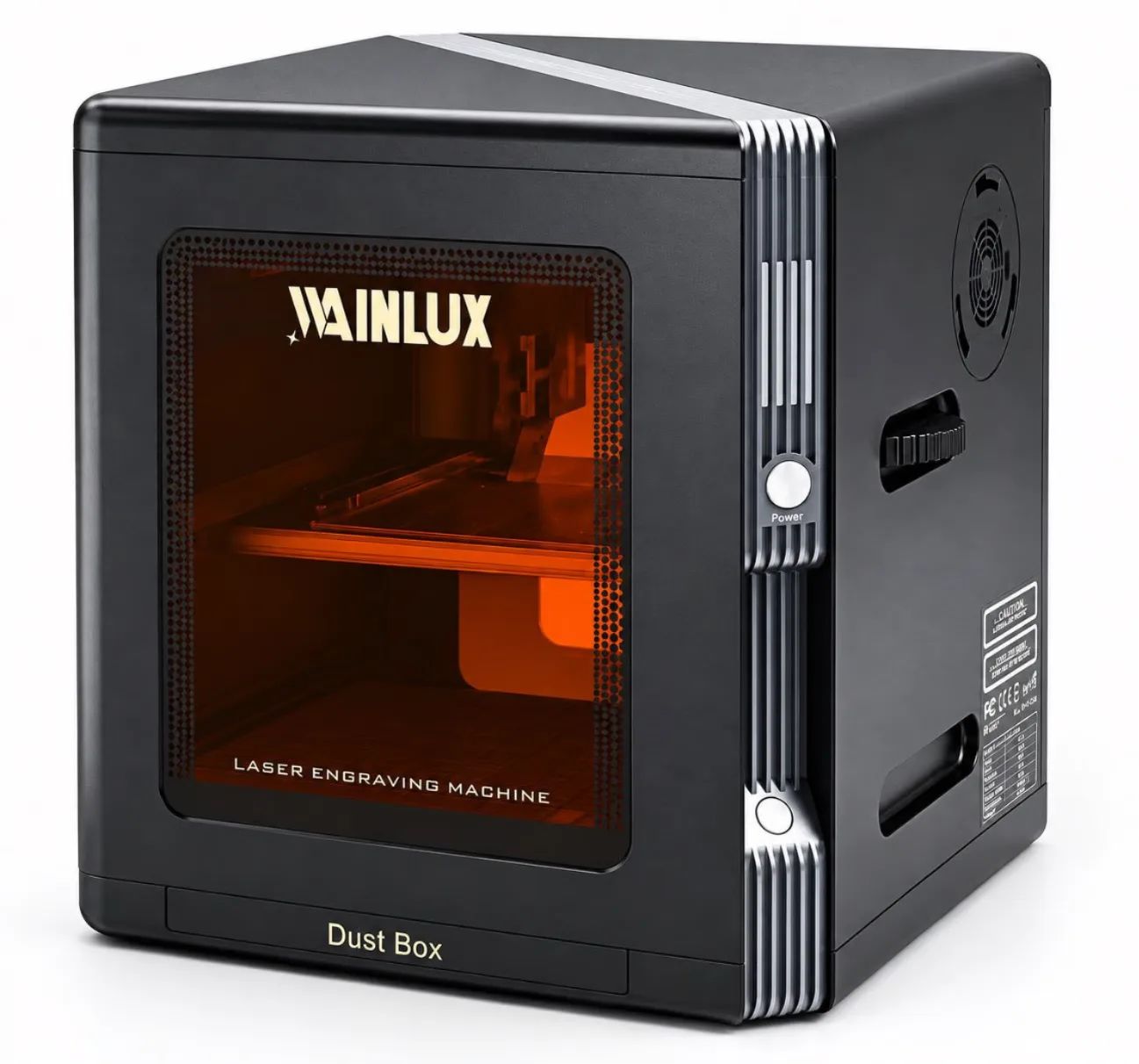
The reply should name a specific model and explain why it fits. For buyers marking bare metal, we may recommend the WAINLUX K8-1064nm laser engraving machine because the 1064nm wavelength marks bare metal directly; coated metal surfaces can be marked by a 455nm head working through the coating. For mixed workshops that also need finer detail on organics, the WAINLUX X1 20W 1064nm dual laser engraving machine combines a dual-laser setup in one unit. A supplier that cannot connect a model to your material list has not read your brief.
Options that match your workflow
Accessories should be offered because they solve a stated problem, not because they are on a price list. A rotary roller matters if you engrave cylinders such as cups or tubes, and an air purifier matters if the machine runs in an enclosed or occupied space. If neither applies, a good supplier will say so rather than pad the quote.
Sample blanks and what they prove
We ship sample blanks with the K8 so buyers can see the engraved result on a real piece before committing to a production run. Ask what the sample is made of, ask for the parameters used, and test it against your own acceptance criteria when it arrives.
Lead times, warranty, and spare parts
A usable quote states the production lead time, the shipping method, the warranty period, and what consumables or spare parts you should plan to keep. Vague phrases such as "fast delivery" do not help you schedule anything. Ask for the terms in writing.
Company grounding you can verify
We have manufactured laser equipment factory-direct since 1998, with 25+ years of OEM and ODM experience and exports to 50+ countries, and we hold an ISO9001 company-level certificate. Ask any supplier for the specific documents that apply to the model you are buying rather than accepting a general claim.
Red Flags in Supplier Replies
Most weak replies fail in predictable ways. Watch for these when you compare responses:
- No questions at all. If the supplier quotes without asking about materials or thickness, the number is a placeholder.
- Price before specification. A price that arrives with no model, no configuration, and no lead time is not a quote.
- No sample offer. A supplier confident in its machines will offer a sample blank or a clear path to one.
- Warranty and spare parts left vague. "Standard warranty" without a period or scope tells you nothing about your risk.
- Certifications claimed but not documented. Ask which certificate applies to which model and request the document for your market.
- Identical replies from multiple suppliers. Copy-paste answers usually mean nobody is engineering your application.
- No OEM or ODM discussion. If you asked for branding or customization and the reply ignores it, the supplier may not actually offer it.
Comparing Quotes Side by Side
When every supplier answers the same brief, comparison becomes mechanical. Line up the model, the wavelength and power, the working area, accessories, sample terms, lead time, warranty, spare parts, and documentation. Any cell left empty is a question to send back before you decide. This is also where a supplier's willingness to answer follow-up questions separates a transactional quote from a working relationship.
Buyers who send a complete brief usually report that the process moves faster in both directions. The supplier spends its time on engineering rather than guessing, and you spend your time comparing real options instead of chasing missing details.
Send Your Material List and Volume for a Quote
Tell us what you engrave, the thickness and part sizes, your monthly volume, your target market, and whether you need OEM or ODM. We will reply with a specific machine recommendation, sample options, lead time, and warranty terms you can compare with any other offer.
Send your inquiry with your material list and monthly volume, and we will prepare a quotation for your application.