
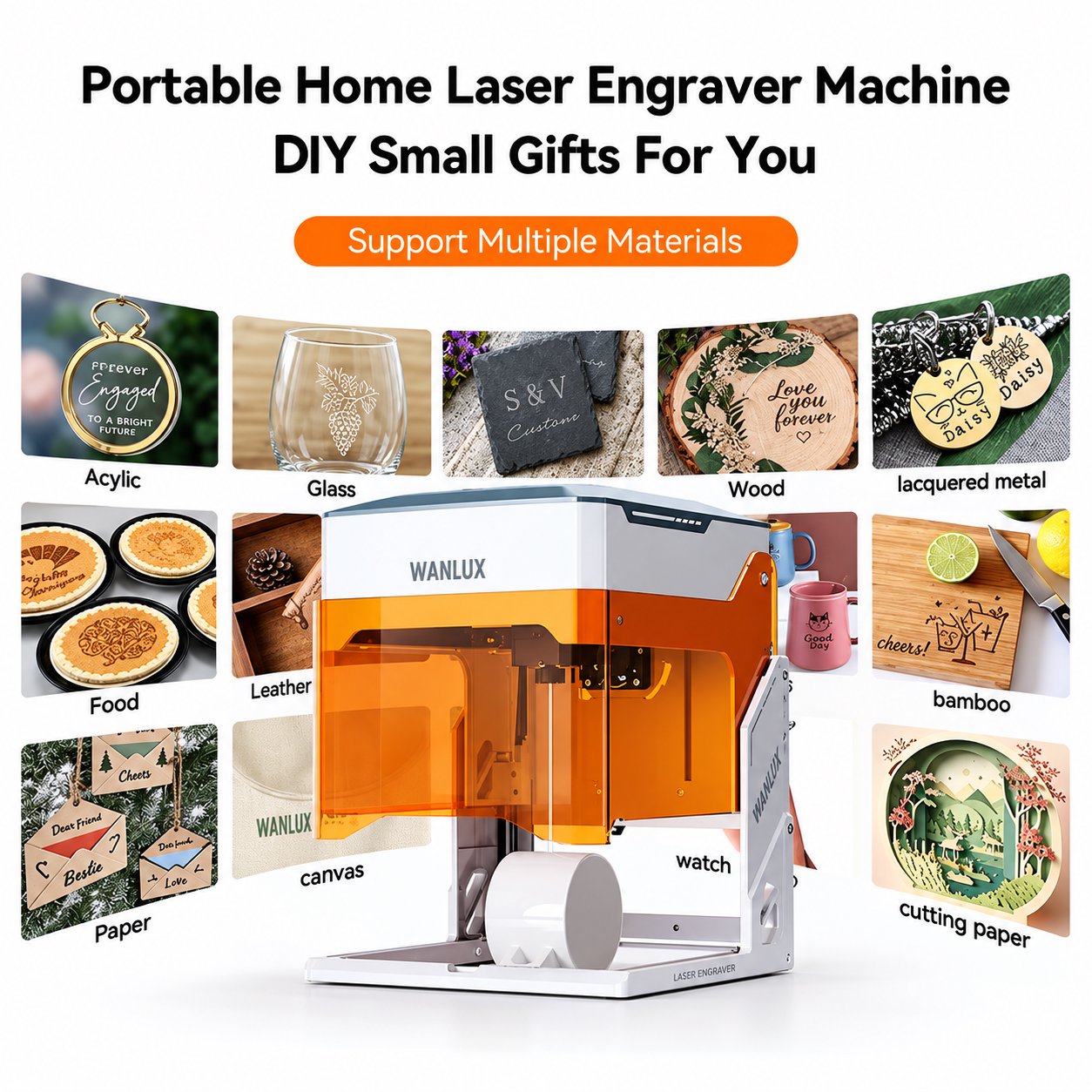
Curved drinkware fails on a flat-bed laser because the focal distance changes across the surface. This guide explains why cylindrical tumblers need a rotary roller attachment, how work-area size narrows the machine choice, how finish type decides the laser source, and which accessories to confirm with your supplier before you order.
Machine Selection Guide
A rotary attachment is not an upgrade you add later if the budget allows. For cylindrical drinkware it is the part that makes the job possible at all. This guide covers why flat-bed machines fail on tumblers, how to match a machine to your batch, how work area narrows the choice, and the accessories to confirm with your supplier before you place the order.
On this page
Why Curved Surfaces Need a Rotary Attachment
On a flat workpiece, the distance from the laser lens to the material stays constant across the whole engraving area. The beam is focused at one plane, and every point of the design is marked at that focus.
A cylindrical tumbler breaks that assumption. The surface curves away from the lens as it moves toward the sides, so a stationary head working across a cylinder would mark the center of the design at proper focus and the edges out of focus. The mark goes from crisp to soft to invisible, and on a narrow cylinder the usable band is often too small for a logo.
A rotary roller attachment solves this by rotating the tumbler as the job runs. The roller holds the cylinder and turns it in step with the engraving pass, so the surface is presented to the lens progressively instead of all at once. That is why cylindrical items need a rotary roller attachment rather than being treated as a flat job with a different fixture.
There is a second benefit buyers often overlook. A rotary gives repeatable positioning around the circumference, so a design that wraps partway around a tumbler can be indexed to a consistent starting point from piece to piece. For promotional orders where several hundred identical cups carry the same wrap, that repeatability is what a flat fixture cannot provide at all.
Not all drinkware behaves the same way
Tumblers, mugs, and cans are cylindrical families, but the parts that need the roller are the cylindrical bodies. Handles, tapered bases, and lids are a separate question. Where a tumbler or mug is tapered rather than straight-walled, the roller still does the work, but the focus changes along the length of the part as the diameter changes. That is the kind of thing to confirm on a sample with your supplier rather than assume, because it affects what portion of the surface can carry an even mark.
Choosing a Machine for Tumbler Work
The starting point for a tumbler shop is a machine that offers a rotary path, not a machine with the largest flat bed. Two WAINLUX models illustrate the two ways that requirement is met.
WAINLUX K8 with the optional rotary roller
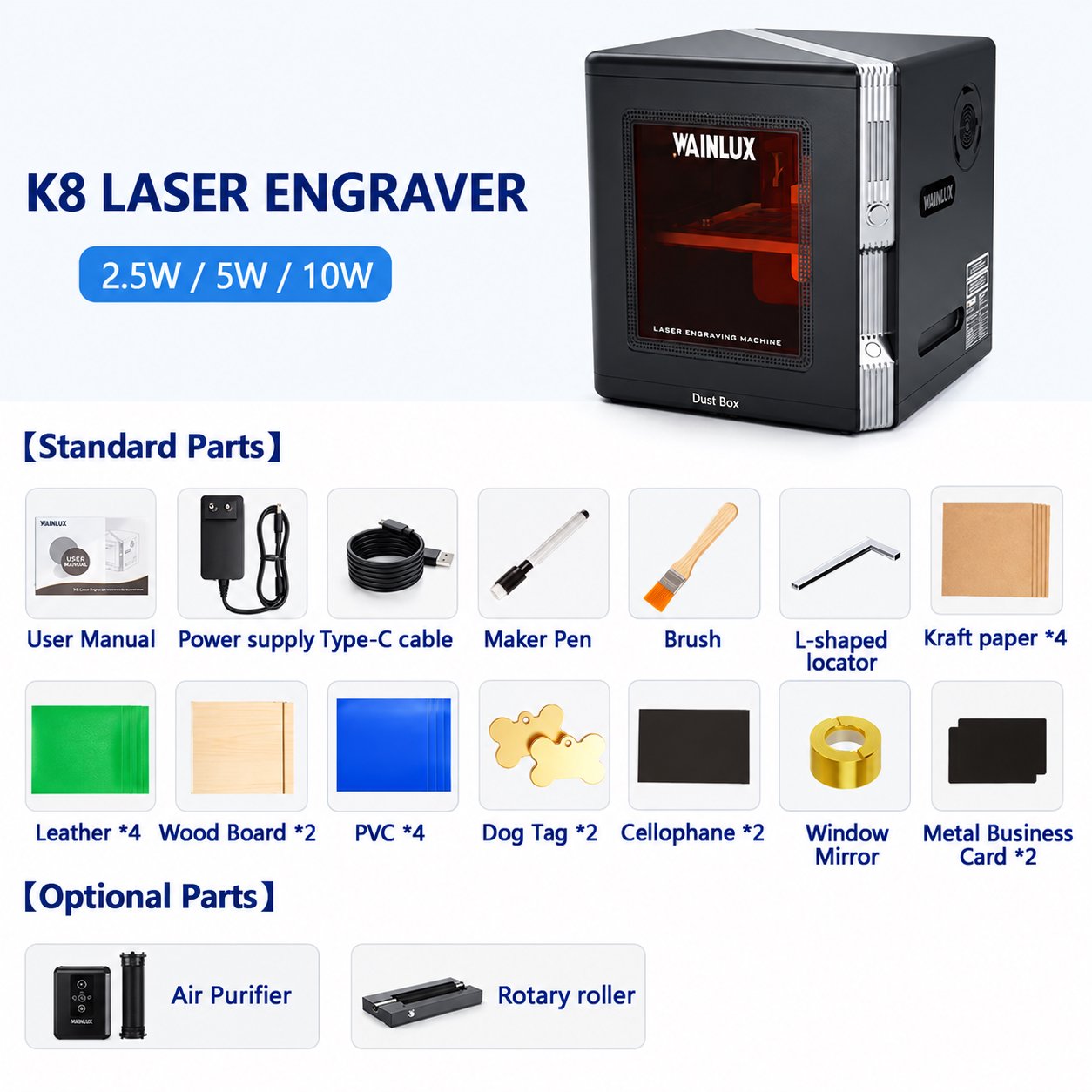
The WAINLUX K8 is offered with an optional rotary roller, which is the configuration you want if tumblers are part of the plan. Because it is an optional item, it has to be named on the order; a machine quoted without it will not turn a cylinder.
The K8 carries a 1064nm-class laser source. That matters for the finish question below, because bare stainless steel needs that class of source to mark, while coated surfaces can be worked by a 455nm diode machine.
An optional air purifier is also available for the K8. Engraving coated drinkware removes material from the surface, and the fumes that produces are a real consideration if the machine sits in a room with people in it. If you run tumbler orders indoors, decide on the purifier at the same time as the roller rather than treating it as a later purchase.
WAINLUX X1 20W and the roller connection port
The WAINLUX X1 20W provides a roller connection port. That port is the interface a rotary roller uses, and it tells you the machine is designed to accept rotary work. A buyer comparing the two models should read that port the same way they read the K8's optional roller: as confirmation that cylindrical jobs are supported rather than improvised with a homemade jig.
Which model fits depends on what else you run. A shop that engraves mostly tumblers wants the compact, rotary-ready configuration. A shop that splits its time between drinkware and flat items such as tags, keychains, or small signage will weigh the two differently.
Work Area: How Small Is Too Small
Work area determines what the machine can mark in a single pass and how much of a design can be laid out at once. On cylindrical work the relevant question is whether the engraved region you need fits the machine's working envelope.
For cup-scale items, the K8's compact 8x8 cm area is sized for this class of work. The K10 sits in about the 10x10 cm class, giving more room for designs that need to run longer or wrap further around the part.
The practical buying decision is not "bigger is better." A larger envelope on a machine that lacks proper rotary support does not help a tumbler order. Match the area to the largest mark you actually need, then confirm the rotary path on the same machine.
| Item | Rotary support | Notes for tumbler work |
|---|---|---|
| WAINLUX K8 | Optional rotary roller | 1064nm-class source; compact 8x8 cm work area suited to cups; optional air purifier available |
| WAINLUX X1 20W | Roller connection port | Dual-laser platform; rotary roller connects through the provided port |
Finish Type Decides the Laser Source
This is where most tumbler buyers get their machine choice wrong, and it has nothing to do with size or price. It is about what the tumbler is made of on the outside.
Two broad cases cover most custom drinkware:
- Coated stainless tumblers. The body is stainless steel with a powder coat, paint, or similar finish on top. The laser works the coating. Coated surfaces can be worked by 455nm diode machines.
- Bare metal stainless. The visible surface is the steel itself, with no coating to remove. Bare stainless needs a 1064nm-class source, which is the class the K8 carries.
The phrase to remember is short: finish type decides the source. A diode machine and a coated tumbler are a normal pairing. The same machine pointed at bare stainless will not produce the mark the buyer expects, no matter how the settings are adjusted, because the interaction between the beam and the material is different.
Because the finish on a supplied tumbler is a property of that specific product, and because suppliers change coatings between batches, the correct move is to confirm with your supplier which source the blank requires. Send the actual blank, or at least the exact product reference, rather than describing it as "a stainless tumbler." Those two cases lead to different machines.
Before you order
- State the blank material and finish, not just "tumbler."
- Name the rotary attachment explicitly on the order line.
- Confirm the work area against the largest mark you need.
- Ask whether an air purifier is needed for your room and volume.
- Ask for a sample mark on your own blank before the full run.
The Quotation Checklist
When you request pricing on a tumbler laser engraver, a short list of specific questions gets you a quotation you can actually compare against another supplier's.
- Rotary included or separate? For the K8, the rotary roller is an optional accessory. Ask for it as a line item so it does not disappear between a rough quote and the final order.
- Roller connection confirmed. On the X1 20W, ask the supplier to confirm the roller connects through the provided roller connection port and to state which roller fits that port.
- Source class matched to your blank. Say plainly whether your tumblers are coated or bare stainless, and ask the supplier to confirm which machine class suits that blank.
- Work area against your largest design. Give the dimensions of the biggest mark you plan to produce. The K8's compact 8x8 cm area and the K10's roughly 10x10 cm class serve different design sizes.
- Fume control. Ask whether the optional air purifier is recommended for your installation, particularly for coated drinkware run indoors.
- Sample before volume. Ask for a marked sample on the exact blank you will use in production, so the finish question is settled on real material rather than on a specification sheet.
- Compliance documents. Ask which certificates apply to the machine you are buying and request the relevant documents for your market.
Xiamen Spring Technology (WAINLUX) holds ISO9001 and CE. Which documents your customs or retail channel requires is a separate question from which certificates the manufacturer holds, so request the specific paperwork for your destination rather than assuming a general certificate covers it.
Frequently Asked Questions
Can I engrave tumblers on a laser without a rotary attachment?
No. A cylindrical surface curves away from the lens, so a flat-bed job loses focus toward the edges of the design. Cylindrical items need a rotary roller attachment to rotate the tumbler during the pass and keep the surface presented to the lens.
Can a 455nm diode laser mark a stainless tumbler?
It depends on the finish. Coated surfaces can be worked by 455nm diode machines. Bare stainless steel needs a 1064nm-class source, such as the one in the K8. Confirm the finish of your actual blank with your supplier before choosing a machine.
Do I need an air purifier?
An optional air purifier is available for the K8. Engraving coated drinkware produces fumes, so whether you need one depends on your room and your production volume. Decide this with your supplier at the quotation stage.
How do I compare two machines for tumbler work?
Compare three things: whether the rotary is included or optional, whether the source class matches your blank's finish, and whether the work area covers your largest design. Price alone will not tell you whether the machine can do the job.
Next Step
The fastest way to get a useful answer is to send your blank's material and finish, the largest design dimensions you need, and your expected order pattern. That is enough for a supplier to recommend a machine configuration and to say whether the rotary roller, the roller connection port, and fume control apply to your setup.