
A process-control guide for buyers running vinyl shirt production: why stable platen temperature drives adhesive activation, how even pressure stops edge lifting, how hot and cold peeling change your workflow, and how to run a small test matrix on samples before committing to an order.
Process Control for Heat Transfer Vinyl
Pressing vinyl shirts is a repeatability problem, not a creativity problem. Once the artwork, film and garment are fixed, the only variables you control at the machine are temperature, pressure, dwell and peel timing. This guide looks at each one from a buyer's point of view: what it does to the adhesive, how it fails on the edge of a graphic, and how to test it on a small sample before you commit to a production order.
- Temperature is set by the HTV manufacturer for its adhesive, not by the press. The press must hold that setpoint steadily across the whole platen.
- Even pressure matters as much as pressure magnitude; edge lifting is usually a pressure-distribution or edge-cooling problem, not a temperature problem.
- Hot peel and cold peel are workflow choices that change takt time and finish; you should test the one your production line will actually use.
- A 1–5 unit sample run with a documented test matrix is cheaper than discovering a peeling defect on order 50.
Why the vinyl shirt press deserves a process sheet
Most printing shops already have a supplier-supplied time and temperature recommendation for the vinyl they buy. What they often do not have is a written record of how their press actually delivers that recommendation. Two presses set to the same number can behave differently at the platen surface, at the corners, and during recovery after a lid is opened. If your production plan depends on a 260/mo search term like "vinyl shirt press" being solved once, the solution is documentation: a short process sheet per vinyl/garment combination, verified on the machine that will run the job.
Xiamen Spring Technology Co., Ltd. has built heat press machines since 1998 and supplies them under OEM/ODM arrangements. The models relevant to shirt decorating are compact and controllable rather than large-format, which suits shops that need a defined, repeatable platen footprint.
Temperature: stable activation, not just a peak number
Heat transfer vinyl adhesive is a thermoplastic. It flows and bonds within a temperature window defined by the film manufacturer, and it re-solidifies as it cools. The press therefore has two jobs: bring the adhesive above its activation point for the required dwell, and keep it there long enough for the bond to form without scorching the garment or the carrier. A platen that cycles hot and cold around the setpoint delivers a shorter effective activation window than the dial suggests.
Steady temperature matters for three reasons in day-to-day shirt production:
- Adhesion consistency across a run. Shirts pressed early in a shift and late in a shift should behave the same. A press that recovers slowly after each opening will produce a drift you can measure as peeling failures at the end of a batch.
- Repeatability between operators. If the controller holds the setpoint, a new operator does not need to compensate with feel.
- Comparability with your vinyl supplier's data. You can only follow a temperature recommendation if your machine reports and holds the temperature you set.
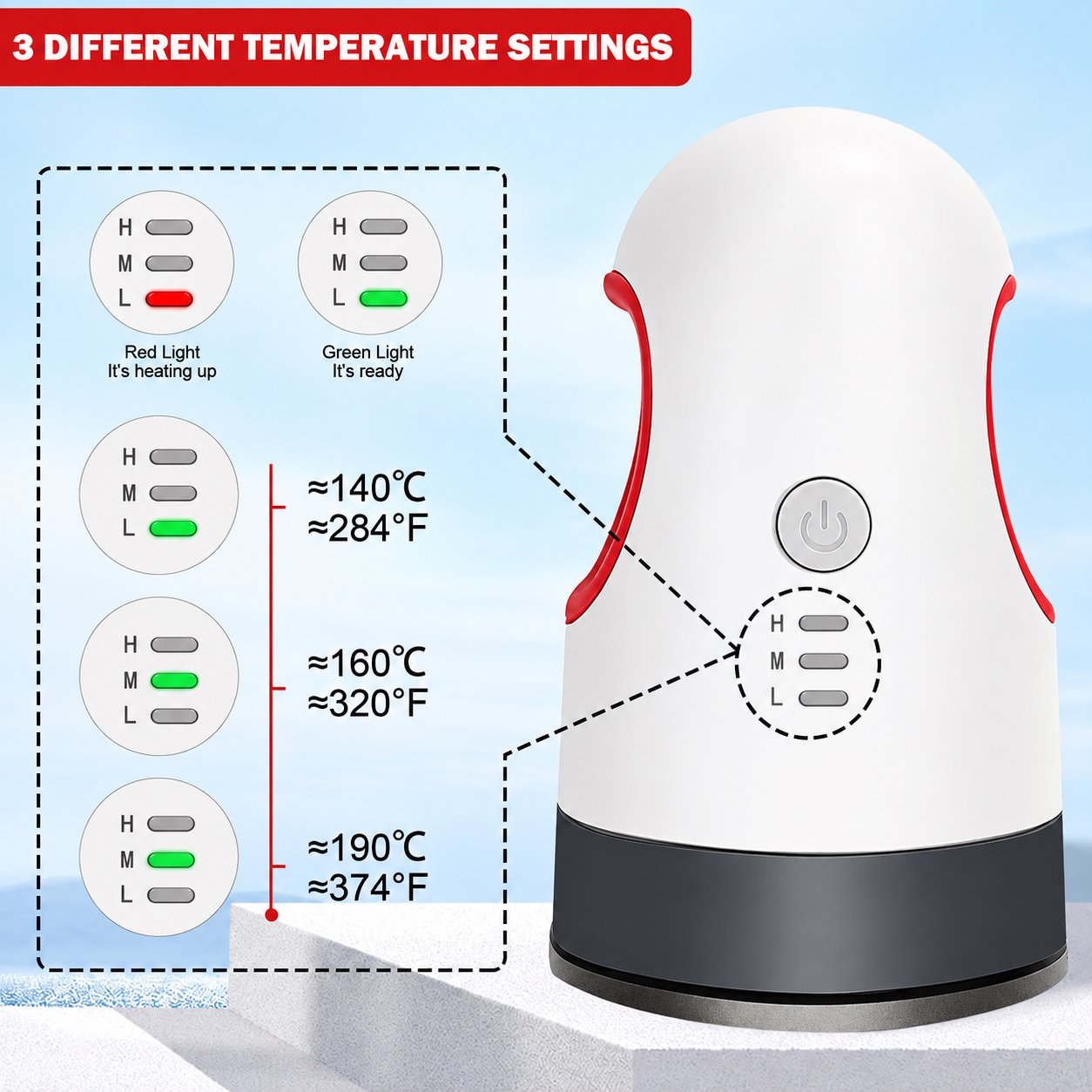
The Spring C02 mini heat press machine uses a three-step temperature arrangement at 140 °C, 160 °C and 190 °C. Fixed steps simplify operation and reduce set-up errors, but they also mean your vinyl and garment combination must fit one of those three levels. Before ordering, check that your film supplier's recommended range contains at least one of them, and confirm the dwell you will use at that step.
For a wider range, the Spring C05 12×10 in heat press machine is adjustable from 85 °C to 205 °C with a ceramic-coated platen. An adjustable range lets you match a specific film recommendation rather than working around three fixed levels, and the 12×10 in platen size sets how large a single transfer can be. Ceramic coating is a surface property of the platen; keep it clean and free of adhesive residue, because residue changes the contact between platen and carrier.
Pressure: how uneven force turns into edge lifting
Edge lifting — a graphic that stays bonded in the middle and curls at the border — is a common complaint on shirt presses, and it is rarely solved by turning up the temperature. The mechanism is usually mechanical. The edge of a transfer has less material above it to absorb pressure, it cools faster after the press opens, and it sits closest to the seam or the curve of the garment. If the platen is not parallel to the pressing surface, or the pressure is set by feel rather than measurement, the edge receives less force than the centre.
Practical checks that catch most of this before it reaches a customer:
- Confirm the pressing surface is flat and the garment is not bunched. A seam or a fold under the transfer creates a low-pressure zone directly above it.
- Check platen parallelism once, then leave it alone. Most presses have an adjustment for this; use a consistent method and record it.
- Set pressure by a repeatable indicator, not by arm strength. Whatever the machine provides — a pressure dial, a stop position, a lock feel — write the value down and use the same one for the same garment weight.
- Watch the first 10 pieces of a new combination. Edge lifting that appears immediately tells you about pressure or alignment; lifting that appears after washing tells you about adhesion and cure.
For small graphics, tags and sleeve work, the Spring C08 5×7 in manual heat press with LCD is a compact option. An LCD display is useful in a process-control context because it gives the operator a readout to compare against the process sheet, rather than a guess.
Hot peel vs cold peel: a workflow decision, not just a habit
Peel timing is set by the vinyl manufacturer, and getting it wrong produces two different failure modes. Peeling too early on a cold-peel film can stretch the adhesive before it has set. Peeling too late on a hot-peel film can leave adhesive bonded to the carrier instead of the garment. Within the manufacturer's instruction, however, you still have a workflow choice, and it affects throughput.
| Aspect | Hot peel | Cold peel |
|---|---|---|
| When the carrier is removed | Immediately after the press opens, while the shirt is still hot | After the shirt has cooled completely |
| Effect on takt time | Shorter — the shirt leaves the press area sooner | Longer — shirts accumulate in a cooling area |
| Space needed | Minimal holding area | Flat, clean cooling rack per batch |
| Operator risk | Contact with a hot platen and hot shirt | Lower immediate heat exposure |
| Where it usually fits | High-volume simple graphics where the film is specified for hot peel | Multi-layer or detail work where the film is specified for cold peel |
The table describes workflow consequences, not a recommendation. The film datasheet decides which method is permitted; your production layout decides whether you can afford the cooling step. If your line is built around cold peel, size the cooling area before you buy the press, because the press cycle time is only part of the total time per shirt.
Running a test matrix on a sample before production
A structured sample test converts a supplier's recommendation into a number you trust for your own garments, your own film and your own press. Xiamen Spring Technology supplies samples at 1–5 units on a 100% prepaid basis, which is enough to run a controlled matrix on the model you intend to buy. Official orders of 50 pcs or more are quoted at 70/30 T/T, and machines carry a one-year spare parts warranty.
Building the matrix
Keep the number of variables deliberately small. Change one factor at a time and record every combination, even the ones that work, so the result is a reference rather than a memory.
| Factor | What to record | Why it matters |
|---|---|---|
| Press model and platen size | Model number, platen dimensions, temperature range | Defines what the result applies to |
| Temperature step | Exact setpoint used, and the readout during the press | Ties the sample to a reproducible setting |
| Pressure setting | The indicator value used, not "medium" | Removes operator feel from the record |
| Dwell | Seconds, measured with a timer | Dwell is a controlled variable, not an estimate |
| Peel method and timing | Hot or cold, and elapsed time before peel | Separates adhesion failures from peel-timing failures |
| Garment and film | Fabric composition, colour, film product code | Dark garments and blends behave differently |
| Result | Edge lift at 0 h, 24 h, after wash, after stretch | Immediate and aged results are different findings |
Reading the results
If every combination fails, the problem is probably not the press — check that the film and garment are compatible and that the temperature step you used is inside the film's recommended range. If only the edges fail, revisit pressure distribution and garment flatness. If pieces pass immediately but fail after washing, look at dwell and cooling rather than peak temperature. If results vary between operators on the same setting, the press controller or the recovery behaviour is the place to look.
A sample run is a record of what happened under the conditions you set. It does not guarantee that a full order will behave the same way, and it does not replace the film manufacturer's specification. What it does give you is a documented starting point that a new operator can follow, and a reference to check against when a defect appears.
What to confirm with the supplier before ordering
Most of the variables above are decided by your vinyl and garment, not by the press. The remaining questions are specific to the machine you plan to buy:
- Which temperature steps or range does the model offer, and does it cover your film's recommended window?
- What platen size do your largest transfers need, including bleed?
- What pressure adjustment method does the machine use, and is it measurable?
- What does the one-year spare parts warranty cover, and which parts are consumable?
- For OEM/ODM, what branding and documentation changes are possible at the 50 pcs order level?
Put these questions in writing alongside your test matrix results. A supplier reply that answers them in specifics is more useful than a general assurance, and it gives you a basis for comparing quotes on equal terms.
FAQ
Can I use one temperature setting for all vinyl shirts?
Only if every film and garment combination you run shares a recommended window that includes that setting. In practice most shops keep a short list of approved combinations with a recorded setpoint for each, rather than a single setting for everything.
Is a hotter press always better for adhesion?
No. Temperature above the film's recommended range risks damaging the garment and the carrier, and it does not fix a pressure or cooling problem. Adhesion failures that appear after washing are more often a dwell, pressure or cooling issue than a peak-temperature issue.
How many samples do I need to run a useful test?
Enough to cover each garment and film combination at least once, ideally twice so you can see whether the result repeats. Xiamen Spring Technology supplies samples at 1–5 units, which is the scale at which a small matrix is practical.
Does the press model change the peel method?
No. Peel timing is specified by the vinyl manufacturer. The press determines how consistently you can deliver the temperature, pressure and dwell that the peel method assumes.