
A pre-purchase verification checklist for household buyers comparing home laser engravers. Covers enclosure and shielding, real working area versus desk space, control methods, spares and support, and airflow, with a comparison table of four machines.
Pre-Purchase Verification Checklist
Key Takeaways
- Enclosure and shielding decide what you can safely run indoors and who can watch the machine work.
- Working area is not desk footprint - measure the footprint, the clearance, and the fume path before you buy.
- Control method (WiFi, PC, app, offline button) determines how the machine fits your daily workflow.
- Spares and support are part of the purchase decision, not an afterthought.
- Airflow needs a real extraction path, not just an open window.
Why This Is a Verification Checklist, Not a Buying Guide
You have already decided a laser engraver belongs in your home workshop. The remaining question is which machine actually fits your room, your workflow and your safety expectations. The best at home laser engraver for one buyer is the wrong one for another because the constraints differ: a flat with no balcony cannot host an open-frame machine, and a buyer who wants to engrave metal needs a different light source than one cutting plywood.
This article walks through five checks to run before you pay. Each check turns a vague product claim into a measurable question about your own space and habits.
Check 1 - Enclosure and Shielding
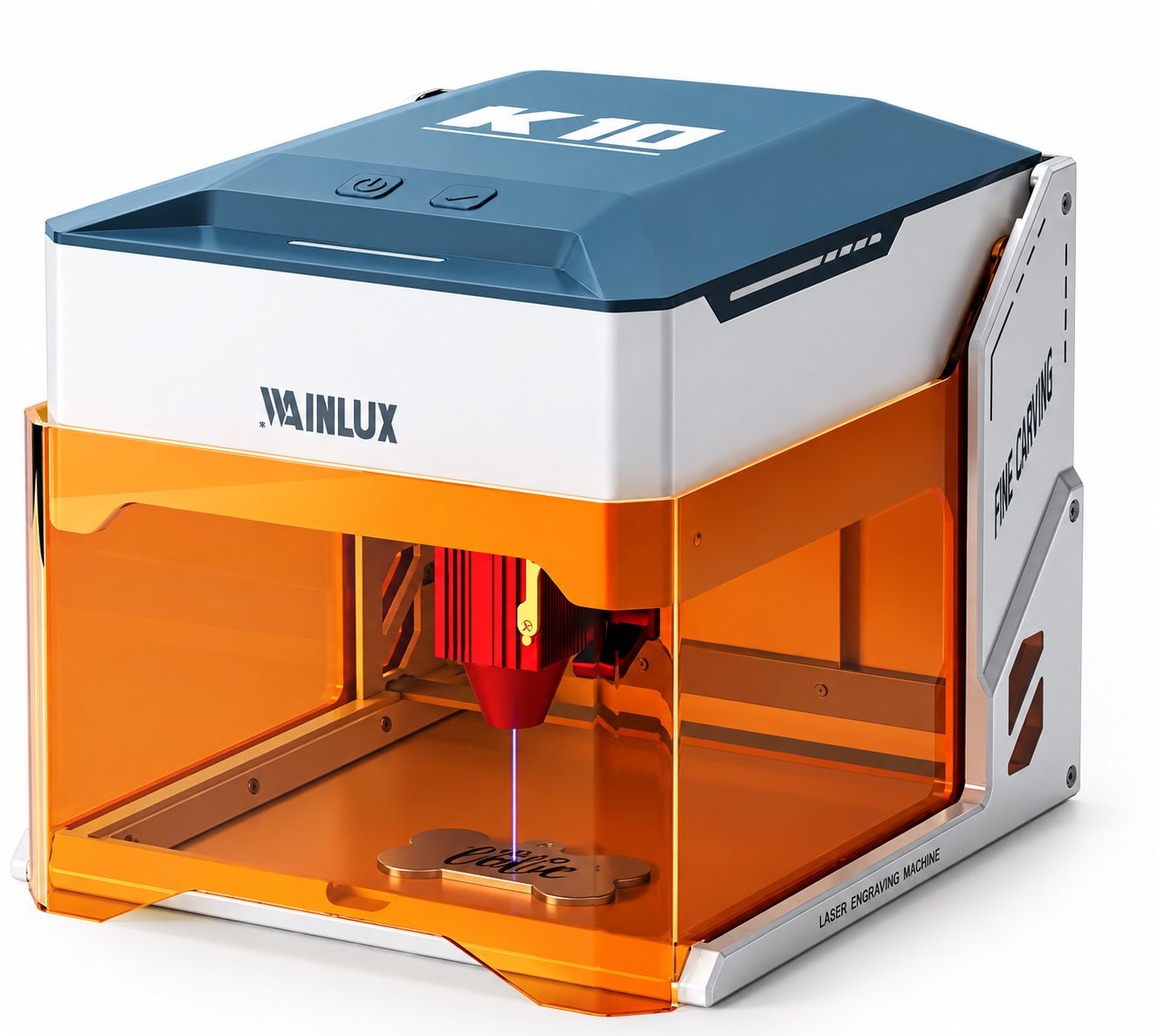
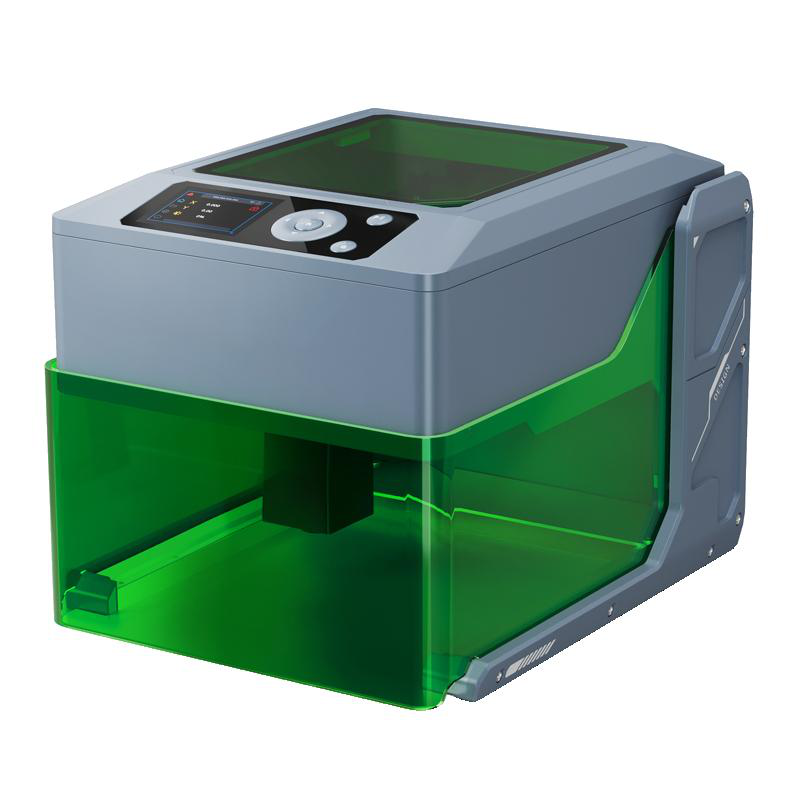
An enclosure is not decoration. It separates the laser area from the room where you, your family or your pets spend time. When you compare machines, ask three things: is the laser path physically covered, does the viewing window filter the light, and can the machine run while closed?
Fully enclosed machines are the simplest answer for a shared living space. A model like the WAINLUX K10-5W ships fully enclosed with a tinted shield, and it uses a 455 nm 5 W blue diode. The enclosure keeps the beam inside the cabinet, and the tinted shield lets you watch the work without staring directly at the spot. That matters because a 455 nm diode is visible light - you want it filtered, not reflected into the room.
Open-frame machines still exist and still work, but they put the burden on you to build a screen, a booth or a dedicated room. If you are comparing on price alone, model the cost of that enclosure. A cheap frame plus a homemade box is often more expensive than an enclosed unit, and the homemade box rarely has a tinted window rated for the wavelength.
Before buying, hold a sheet of paper at the viewing window of a demo unit and look at the spot through the shield. If the spot is uncomfortable to watch, the shield is not doing its job for your eyes.
Check 2 - Real Working Area Versus Desk Space
Marketing pages quote working area. Your desk measures footprint plus clearance. These are different numbers, and confusing them is the most common mistake in home laser purchases.
The working area is the largest rectangle the laser head can reach. For the XN001-3W, that is 9.8 x 8.8 cm. The F1-10W+1064nm covers 10 x 10 cm. The K8-1064nm covers 8 x 8 cm and weighs 4.4 kg. If your project is a 9 cm wooden coaster, the XN001-3W fits it; if your project is a 12 cm sign, none of these three fit it in one pass.
Then add clearance. You need room behind the machine for cables and airflow, above it for loading material, and in front for your hands. A 4.4 kg desktop unit is easy to move, but you still need a stable surface that does not wobble while the head moves. Measure your bench, subtract the footprint, and check that what is left is enough to load and unload the largest piece you plan to make.
| Model | Working Area | Control | Material Notes |
|---|---|---|---|
| WAINLUX K10-5W | Not stated in supplied facts | WiFi, PC, offline | 455 nm 5 W blue diode; cuts 3-5 mm plywood; fully enclosed with tinted shield |
| XN001-3W | 9.8 x 8.8 cm | USB, Bluetooth app, offline button | Foldable; can run from a power bank; marks coated metal only |
| WAINLUX F1-10W+1064nm | 10 x 10 cm | WiFi and built-in control screen | 455 nm 10 W head and 1064 nm head; marks bare metal with the 1064 nm head |
| K8-1064nm | 8 x 8 cm | Not stated in supplied facts | 4.4 kg |
The table reveals the real trade-off. A larger working area usually means a larger machine, and a larger machine means more desk space and more material to move through the room. Decide which limit hurts more before you compare prices.
Check 3 - How the Machine Is Controlled
Control method affects every session. A machine that only runs from a PC ties you to a laptop on the same desk. A machine that runs from WiFi, a phone app or an offline button fits a different rhythm.
The K10-5W runs from WiFi, a PC or offline. That flexibility covers three situations: sending a job from your phone, changing a design on a laptop, and running a saved file without any network. The XN001-3W works from USB, a Bluetooth app or an offline button, and it can be powered from a power bank, which is unusual and useful if you want to work away from a wall socket. The F1-10W+1064nm adds a built-in control screen alongside WiFi, so you can check status without opening a browser.
Ask yourself where the design files live. If they live on your phone, prioritise app or WiFi control. If they live on a workshop PC, USB and PC control matter more. If you want the machine to run a repeat job with no screen at all, an offline button is the feature to look for.
Write down your last three craft projects and where the files were stored. The control method that matches those three projects is the one you will actually use daily.
Check 4 - Spares and Support
A laser engraver is a tool, and tools wear. Lenses get dirty, belts stretch, and diode modules eventually dim. Before paying, confirm that the seller stocks the parts you are likely to need and that support answers questions in your language during your working hours.
Company background is a proxy for how long support will exist. WAINLUX has been manufacturing since 1998, holds an ISO9001 company-level certificate, and works through OEM/ODM with customers in more than 50 export countries. Those facts do not guarantee a specific spare part, but they indicate a supplier that has been shipping and supporting machines for over 25 years rather than a storefront that appeared last season.
Ask three concrete questions: what is the replacement lens part number, how is the diode module replaced, and what is the support channel for a machine bought in my country. If the seller cannot answer, treat that as a signal about long-term ownership.
Check 5 - Airflow and Where the Fumes Go
Every laser process produces smoke and particulate. The machine you choose determines how easy it is to route that away from the room.
An enclosed machine gives you a single exhaust point, which is easier to duct than an open frame. The K10-5W enclosure means you can attach a hose to one outlet and direct it to a window or filter. An open-frame machine puts fumes directly into the room, so you need a larger extraction setup.
Plan the path before you buy. Measure the distance from the machine to the nearest window or vent, and check that a duct can reach it without sharp bends. If the machine sits in a closed room with no vent, no enclosure will solve the problem on its own. Factor in the cost of a fan and ducting, and check whether the machine has a port sized for a standard hose.
Model Comparison at a Glance
The F1-10W+1064nm is worth a separate look because it carries two heads in one frame. The 455 nm 10 W head handles wood and similar organics, while the 1064 nm head marks bare metal. Both heads share a 10 x 10 cm working area and the machine runs from WiFi with a built-in control screen. If your projects mix wood and metal, this is the configuration that avoids buying two machines.
The XN001-3W and K8-1064nm sit at the portable end. The XN001-3W folds, runs from a power bank, and marks coated metal, which suits small personalised items. The K8-1064nm covers 8 x 8 cm at 4.4 kg, a size that fits a shelf when not in use. Neither is a substitute for a larger cutter, but both fit homes where the bench is also a dining table.
Frequently Asked Questions
Can I run a 5 W diode laser indoors without a window?
You can run the machine, but you still need a fume path. Enclosed models concentrate exhaust at one point, so a filter or a duct to another room is the practical answer. An open frame in a sealed room is the configuration to avoid.
Do I need the 1064 nm head if I only cut plywood?
No. The 455 nm head handles organic materials such as 3-5 mm plywood. The 1064 nm head matters when you want to mark bare metal.
Is a larger working area always better?
Not always. A 10 x 10 cm area costs less desk space than a larger bed and suits most small home projects. Buy the size that matches your largest real project, not the largest number on the page.
How do I verify spares before paying?
Request the part numbers for the lens and the diode module, and ask how the module is replaced. A supplier with a long manufacturing history can usually answer this directly.
One More Check Before You Order
Run the five checks against your own room: enclosure, working area versus desk, control method, spares and support, and airflow. Score each machine against those five, and the shortlist usually narrows to one or two models.
For a fully enclosed desktop machine with WiFi, PC and offline control, start with the WAINLUX K10-5W. For a dual-head machine that handles both wood and bare metal, review the WAINLUX F1-10W+1064nm. Both come from a manufacturer with 25+ years of production experience, ISO9001 company-level certification, and OEM/ODM support across 50+ export countries.
Still comparing? Tell us your room size, the materials you plan to work with, and how you want to control the machine. We will recommend the configuration that fits your checklist and confirm the spare parts available for your country.
See the K10-5W enclosed laser engraver or review the F1-10W+1064nm dual-head model.