
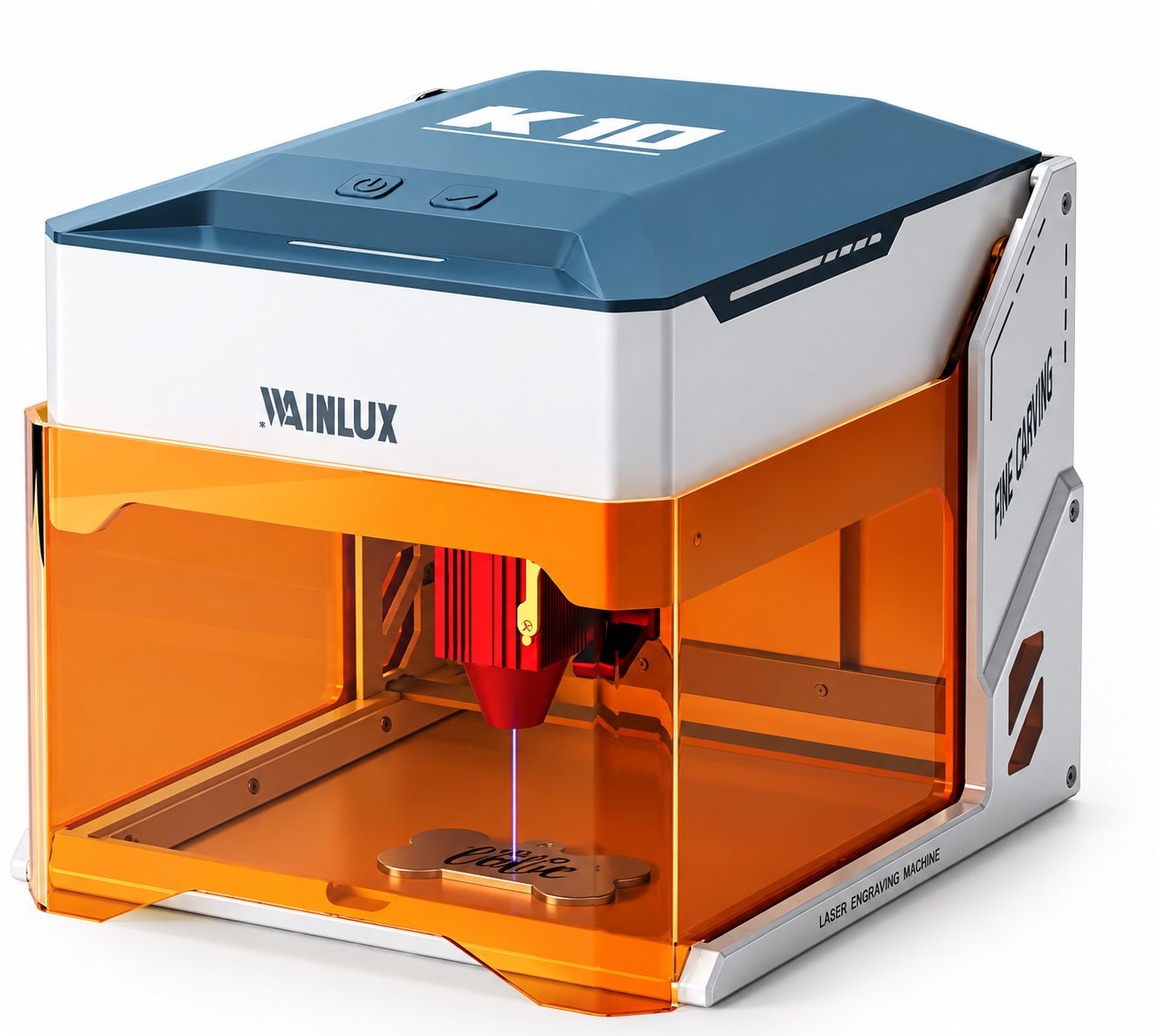
Wood isn't one material. Grain direction, moisture, resin and surface finish change how a laser engraves, so the best wood engraving machine for your work is the one whose power head matches the species and finish you run. This buyer's guide explains how 5W, 10W and dual-laser heads behave across hardwoods, softwoods and engineered boards, and gives a repeatable species-and-finish test you can run before you commit to a machine.
Buyer's Guide
Two buyers compare the same engraving job and reach opposite conclusions about the same machine. One is engraving birch plywood with a sealed, sanded face; the other is engraving oak with an open, raised grain. The laser is identical, but the wood is not, and the result diverges before power settings even come into play. That is why the best wood engraving machine for your shop cannot be chosen from a power number alone. Grain direction, moisture, resin and surface finish decide how a laser couples with the material, and each of them changes what a 5W, 10W or dual-head system can realistically deliver.
Key takeaways

- Wood type and finish set the ceiling on engraving quality; power only moves you toward or away from that ceiling.
- Closed-grain and sealed boards reward low power; open-grain and resin-rich species demand tighter control, not automatically more watts.
- Dual-head machines matter when one job needs two wavelengths or two very different surfaces, not simply because they carry more power.
- Run a species test on your own stock before you commit to a production machine.
Why wood type changes what a laser can do
Every wood surface is a mix of earlywood and latewood, and the two behave differently under a beam. Latewood is denser and chars more slowly, so it holds fine detail. Earlywood is softer and burns faster, so it tends to widen the mark. A species with strong contrast between the two produces visible grain patterns in the engraving. A species with uniform density produces flatter, more even fills.
Grain direction adds a second variable. Along the grain, heat travels through the wood fibers and the mark elongates. Across the grain, the beam meets cut fiber ends and the mark stays tighter. For any text, logo or fine line work, the orientation of the workpiece to the beam path matters as much as the power setting.
Moisture content
Wood that has not been dried evenly engraves unevenly. Moisture absorbs laser energy and turns to steam, which lifts fibers and leaves a fuzzy edge. It also shifts apparent darkness from one area of the board to another, so a single test square does not represent the whole panel. For consistent output, work with stock that has been acclimated to the shop and check the surface feel before running a production batch.
Resin and extractives
Resinous species such as pine and some tropical hardwoods deposit sticky residue at the engraving point. That residue can build on the lens or the work surface over a long run and change results partway through a job. Oily extractives in some dark hardwoods also interact with the beam differently from dry, pale species, producing darker contrast at lower power. Neither is a defect in the machine; both are reasons to test the actual species you plan to run.
Surface finish
A sanded, sealed board presents a consistent surface to the beam. A rough-sawn or wire-brushed board presents peaks and valleys, and the laser focuses on whichever plane the machine is set to. Engraving across a raised texture produces broken, uneven marks. Where finish matters, prepare the surface first, then decide on power.
Matching power heads to wood behavior
Power head choice is really a question of control. Higher power gives you more material removal per pass, but on wood it also gives you a narrower window between a clean mark and a scorched one. The right head depends on the species, the finish and how much detail the job needs.
5W heads: fine detail on prepared surfaces
A 455nm 5W head suits engraving on closed-grain or sealed boards where the goal is fine line work, text or shallow fills. The WAINLUX K10-5W laser engraving machine is fully enclosed, uses a 455nm 5W source, cuts 3-5 mm plywood, and can be driven over WiFi, from a PC or offline. The 5W head gives you a wider margin for detail work on prepared stock, which is exactly where wood engraving quality is decided.
10W and dual-head systems: contrast and mixed materials
A 455nm 10W head brings more energy to the surface, which helps when you need deeper contrast on dense hardwoods or when the job includes darker fills. A dual-head machine adds a second wavelength for work that a single 455nm head handles less predictably. The WAINLUX X1-20W dual-laser engraving machine covers a 30 x 30 cm area with both a 455nm and a 1064nm head, and the F1-10W pairs a 455nm 10W head with a 1064nm head in a 10 x 10 cm area. The XN001-3W covers 9.8 x 8.8 cm.
Where the second wavelength is useful on wood, it is usually for surfaces that the 455nm beam cannot mark cleanly at the same setting, or for mixed-material pieces where part of the job is wood and part is another material. For a shop that engraves wood only, on consistent stock, a single 455nm head may be the simpler and more repeatable choice.
Wood type versus engraving behavior
The table below summarizes how common wood categories tend to behave under a 455nm laser. It describes general tendencies, not guaranteed results; always confirm on your own stock.
| Wood type | Grain and density | Typical engraving behavior | Power head that fits |
|---|---|---|---|
| Birch plywood, sealed face | Uniform, closed grain | Even fills, clean edges, consistent contrast | 5W for detail; 10W for darker fills |
| Pine, spruce (softwood) | Wide earlywood/latewood contrast, resinous | Visible grain, uneven burn, resin buildup on long runs | 5W or 10W, with cleaning between runs |
| Oak, ash (open-grain hardwood) | Dense, open pores | Strong texture, variable depth, detail can blur | 10W for contrast; 5W only on prepared stock |
| Walnut, cherry | Medium density, oily extractives | Dark, rich contrast at lower power | 5W or 10W, with test passes |
| MDF, particleboard | Uniform, no grain | Very even fills, dusty residue | 5W or 10W, with extraction |
| Rough-sawn or wire-brushed stock | Raised texture | Broken, uneven marks across the texture | Prepare surface first, then choose |
A species-and-finish evaluation method
Before you buy any wood engraving machine, run the same test on the species and finish you actually sell. This method gives you a comparison you can defend, rather than a single impressive sample.
- Collect real stock. Get at least three boards of each species and finish you plan to run, from the supplier you normally buy from, and let them acclimate to the shop.
- Cut identical test coupons. Use the same dimensions and the same sanding or sealing routine for each coupon, so the only variable left is the wood itself.
- Fix one reference design. Use a graphic with fine lines, solid fills and small text, so the test shows both detail and contrast at once.
- Run an ascending power series. On each coupon, run the same design across a controlled range of power and speed settings, and label every square.
- Record grain direction. Run one set along the grain and one across it, and note where the mark elongates or blurs.
- Inspect under consistent light. Photograph each coupon under the same light and compare edge sharpness, fill evenness and contrast side by side, not one at a time.
- Re-test after a long run. Run a longer job and check whether resin buildup or focus drift has changed the result, then note how often cleaning is needed.
- Repeat on the other candidate machines. Keep the design, settings range and lighting identical so the comparison is meaningful.
Tip: the setting that looks best on a small test square is often not the setting that holds across a full board. Judge your candidates on a full-size run, not a single coupon.
What to confirm with a supplier
When you shortlist a machine, ask the supplier to confirm the working area, the wavelength and power of each head, and how the drive software handles multiple passes. For a dual-head system, ask which head is intended for which material and how the two are switched. Where a supplier cannot answer a specific question about your species and finish, ask for a test on samples you provide; that is more useful than a generic sample in a catalog.
WAINLUX has manufactured laser equipment since 1998, holds a company-level ISO9001 certificate, works with OEM and ODM projects, and exports to more than 50 countries. Those facts describe the company, not a promise about how any specific wood will engrave; your species test is still the deciding evidence.
Frequently asked questions
Do I need more power to engrave hardwoods?
Not necessarily. Dense hardwoods often show more contrast at moderate power, while too much energy blurs fine detail. Test both a 5W and a 10W setting on your stock before deciding.
Is a dual-head machine always better for wood?
No. A dual-head machine is most useful when your work mixes materials or needs a second wavelength. If you engrave one wood type consistently, a single 455nm head can be the more repeatable choice.
Why does the same wood engrave differently board to board?
Moisture content, grain direction and resin content vary between boards, and each of those changes how the beam couples with the surface. That is why a species test on multiple boards matters more than a single sample.
Next step
If you are comparing machines for wood engraving, send us the species, surface finish and part size you plan to run, and we will help you match the right power head to your job. Request product details for the model you are considering, or ask for a configuration recommendation based on your stock.