
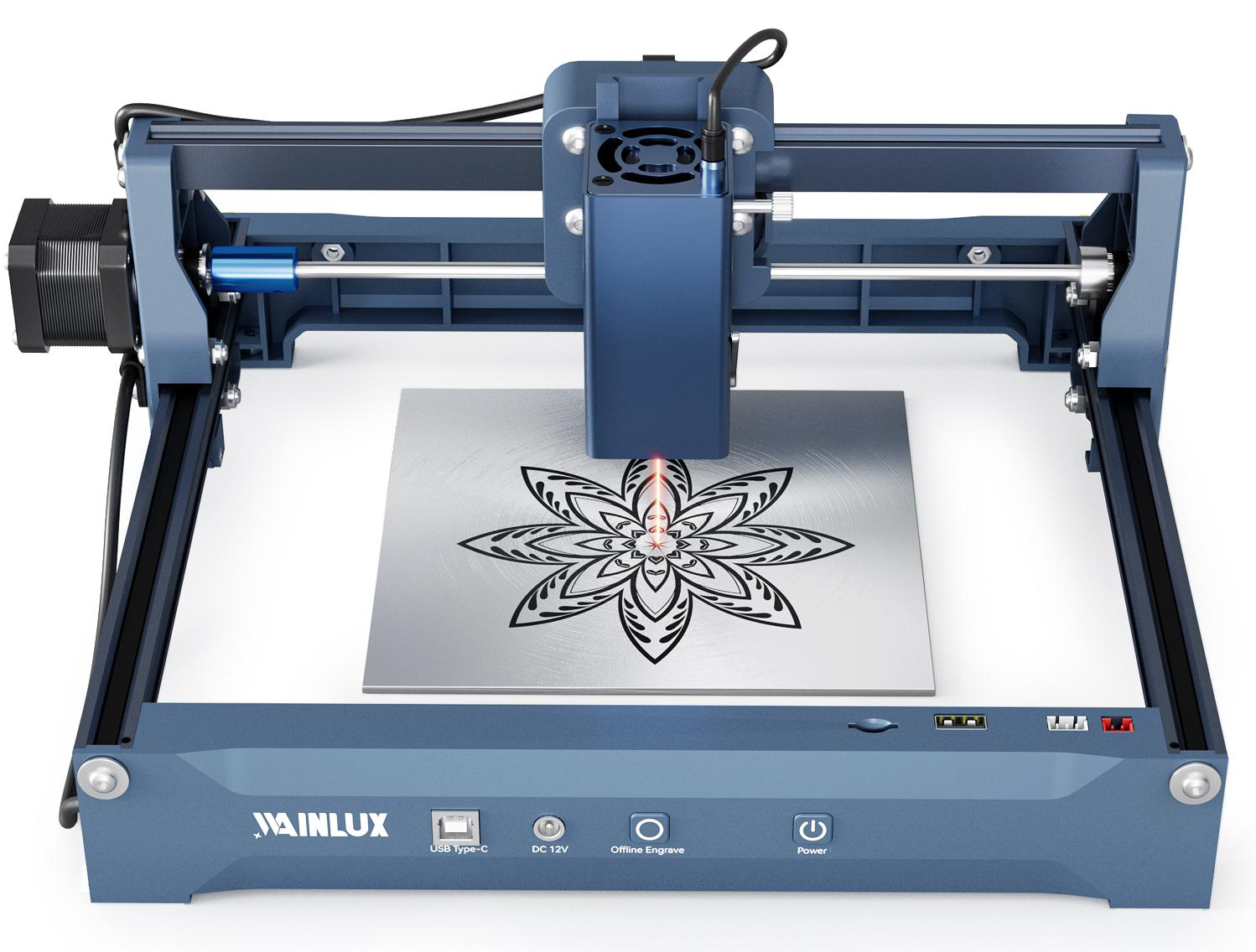
A dual-purpose laser machine can handle both cutting and engraving jobs, but the specification required to do one well often compromises the other. This article compares dual-purpose and engraving-first machines using concrete WAINLUX models, explains when one unit is the right investment and when two units make more sense, and gives buyers a short checklist for matching bed size and power to the actual work.
A single laser unit that engraves and cuts looks like the efficient choice: one purchase, one footprint, one operator workflow. The problem is that cutting and engraving put different demands on a machine. Cutting depth and speed come from optical power; engraving detail depends more on focus, spot size and the settings you dial in. When one unit has to serve both jobs, at least one of them usually settles for a compromise in bed size or power.
This article lays out that tradeoff without pretending a dual-purpose machine is always the answer — or always the wrong one.
Key Takeaways
- Cutting capacity scales with laser power; engraving detail depends more on focus and settings.
- Running both jobs on one machine forces a compromise on bed size or power for at least one job.
- A 40W machine with a 40 x 40 cm bed (WAINLUX L8-40W) can cut 15 mm plywood and 20 mm pine while also engraving wood, bamboo, acrylic, leather, ceramic and painted metal.
- Low-power engraving-first units (WAINLUX XN001-3W, 3W, 9.8 x 8.8 cm) are not built for cutting thick material.
- The decision turns on your material mix, the thickest cut you need, and how much engraving area each job requires.
Why One Machine Has to Compromise
Power and bed size are the two specifications buyers watch, and they pull against each other when you want both cutting and engraving from one unit.
Cutting follows power. If your thickest cut is 15 mm plywood, the laser has to deliver enough energy density at the workpiece to separate the material, and that requires a higher-wattage source. A 3W or 5W head simply cannot reach that thickness. Engraving, by contrast, is about controlled removal at the surface. A lower-power machine with good focus and well-tuned settings can produce fine, repeatable detail on wood, bamboo, acrylic or leather without needing the same raw power.
The second compromise is area. A large bed is useful for cutting furniture parts, signage panels or long boards. But when engraving has to happen across that same large bed, the machine has to maintain focus and positioning across the full working area, and the settings that cut well at one corner may not engrave as cleanly at another. Buyers who mainly engrave small items often accept a smaller bed; buyers who mainly cut large panels accept that fine engraving across the whole sheet is a secondary job.
| Consideration | Matters more for cutting | Matters more for engraving |
|---|---|---|
| Laser power | Determines maximum thickness and cutting speed | Enough power is sufficient; excess power can reduce finesse |
| Bed size | Must fit the largest panel or part | Must cover the largest engraving area, often smaller |
| Focus and settings | Affects edge quality and kerf | Directly governs detail and consistency |
| Enclosure and safety | Important for fume and debris control | Important for small-item handling and repeatability |
The two jobs overlap on hardware but diverge on what you optimize for.
Dual-Purpose Machines in Practice
The WAINLUX L8-40W is a 455 nm laser with a 40 x 40 cm working area. It cuts 15 mm plywood and 20 mm pine, and it also engraves wood, bamboo, acrylic, leather, ceramic and painted metal. An air pump and honeycomb board are included, which matters for cutting because airflow and a stable, flat bed reduce scorching and support consistent results. If a buyer needs one unit that covers both medium-thickness cutting and everyday engraving, this is the specification class where that combination actually holds together.
At the other end, the WAINLUX XN001-3W is a 3W machine with a 9.8 x 8.8 cm working area, and it is intended for engraving only — not for cutting thick material. It is not a smaller version of the L8; it is a different tool for a different job. Buyers sometimes assume any laser can cut if you slow it down enough, and that assumption leads to disappointment on thicker stock.
Between them sits the WAINLUX K10-5W: 5W, a 10 x 10 cm work area, enclosed, cutting 3–5 mm plywood. It handles light cutting and engraving within a small footprint. It is a good illustration of the compromise in the other direction: the enclosure and compact size suit small, clean work, but the bed and power ceiling rule out large-panel cutting.
When One Unit Is the Right Call
One machine makes sense when your jobs are close in scale. If your thickest cut is thin plywood and your engraving fits within the same bed, a single unit removes a second purchase, a second footprint, a second maintenance schedule and a second operator training burden. That is a real saving, and it is not only about money.
It is also the right choice when cutting is occasional. If most of your output is engraving and cutting is a supporting operation — jigs, fixtures, small brackets — a dual-purpose unit covers the primary job well and the secondary job adequately. The key is honesty about which job is primary: optimize the purchase for that one, and accept that the other gets a workable, not ideal, result.
When Two Units Earn Their Keep
Two machines start to pay when one job is bottlenecked by the other. Common triggers include:
- Thickness exceeds the dual-purpose ceiling. If production regularly cuts stock thicker than a mid-power unit can manage, an engraving-first machine plus a separate cutting machine avoids running every job on the compromise unit.
- Throughput matters. A single machine can only do one job at a time. If cutting and engraving are both production steps, queueing them on one unit creates idle time that a second machine eliminates.
- Fine engraving and heavy cutting live together. The settings and bed conditions that suit 15 mm cutting are not always the conditions that protect fine engraving detail. Separating the machines lets each be set up and left alone.
Two units also mean two of everything else: space, extraction, maintenance and training. That overhead is the reason to stay with one machine until the bottleneck is real, not anticipated.
How to Decide: A Short Sequence
Work through these in order. The first question you cannot answer "yes" to usually decides it.
- What is the single thickest material you must cut? If it is around 15 mm plywood or 20 mm pine, a 40W L8-40W class machine covers it. If it is beyond that, you are looking at a cutting-first machine, and the engraving question becomes secondary.
- What is the largest area you must engrave in one pass? Compare it to the bed of a dual-purpose unit such as the 40 x 40 cm L8-40W. If it does not fit, you need either a larger machine or a two-machine setup.
- What is the largest cutting panel? If it exceeds the bed, the same conclusion applies.
- How often do both jobs run? Occasional use of one job supports a single unit; continuous use of both points to two.
- What materials are involved? Confirm the machine engraves your specific substrate, not just "wood and acrylic" in general. The L8-40W engraves painted metal, for example, which is a different proposition from bare metal cutting.
Buying Checklist
| Question | What a "yes" tells you |
|---|---|
| Is the thickest cut within the machine's rated thickness? | The unit can do the cutting job, not just attempt it |
| Does the largest part fit the bed? | No re-fixturing or tiling needed for standard work |
| Does the machine engrave your exact material? | You are not testing on scrap after purchase |
| Are airflow and a stable bed included or available? | Cutting quality and consistency are supported |
| Is the enclosure adequate for your workshop? | Fume, debris and operator safety are managed |
| Will one machine create a queue between jobs? | You can judge whether a second unit is justified |
Frequently Asked Questions
Can a low-power engraving machine cut if I run it slowly?
Slower passes help within a machine's limits, but they do not change its maximum cutting thickness. As an example, the XN001-3W is an engraving-only unit and is not intended for cutting thick material. Match the machine to the thickest cut before you buy, not after.
Is a 40W machine enough for cutting?
It depends on the material and thickness. The L8-40W cuts 15 mm plywood and 20 mm pine, so if your work sits within that range, a 40W unit is a practical choice. If it sits beyond, a higher-power cutting machine is the correct tool.
Does a larger bed hurt engraving quality?
Not by itself, but it adds variables. Focus and settings have to stay consistent across the whole working area, and that is easier to control on a smaller bed. If engraving is your primary job, a compact machine is often the simpler path.
Can I start with one machine and add a second later?
Yes, and for many buyers that is the sensible sequence. Start with the unit that covers your primary job, measure where the queue or thickness limit actually bites, then add a second machine once the bottleneck is proven rather than assumed.
WAINLUX machines are supplied by Xiamen Spring Technology Co., Ltd., founded in 1998 and operating for 25 years, with ISO9001 at company level and OEM/ODM support for buyers in more than 50 export markets. If you are weighing a dual-purpose unit against a two-machine setup, send the thickest material and the largest engraving area you need to cover, and the specification decision becomes straightforward.
Comparing engraving-first and cutting-capable options? Review the compact enclosed WAINLUX K10-5W laser engraving machine as a starting point, then confirm material thickness and working area against your actual jobs.