
A sourcing guide for leather-goods brands and promotional suppliers on matching diode laser power and work area to wallets, belts, and tags — plus a sample-testing routine to run before placing a bulk order.
If you make wallets, belts, luggage tags, or branded promotional leather goods, the machine you buy is the one that has to hold up across every hide batch you cut from. That is a different question from "which laser is strongest." Power and work area have to be matched to the piece you actually produce, and to the workflow around it — masking, fume control, positioning, and repeat jobs.
This guide covers how 455nm diode power levels and work-area sizes map to common leather products, why the work area often matters more than the wattage, and what to test on offcuts before you commit to a bulk order.
- 455nm diode machines are used for leather engraving. Available power levels in the WAINLUX range are 3W, 5W, 10W, and 20W.
- Work areas in the range run from about 8x8 cm to 30x30 cm. Match the bed to your largest single panel, not to the finished product.
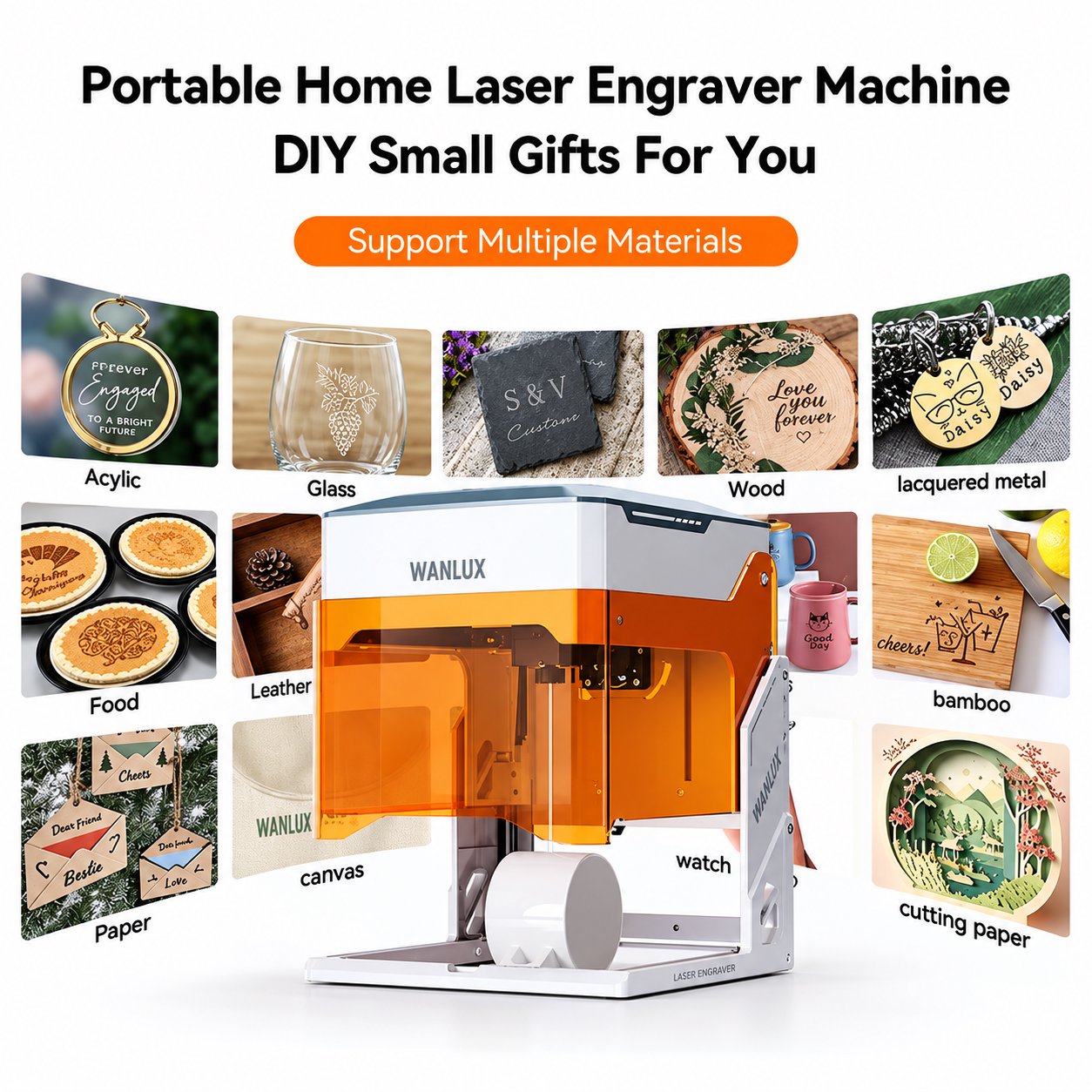
- The WAINLUX K8 ships with leather sheets among its standard accessories and offers an optional rotary roller and air purifier.
- Enclosed machines help with fume control — relevant when leather engraving runs indoors or near finishing stations.
- Test on offcuts from each hide batch and check edge browning and consistency before scaling up. Do not set power and speed from a spec sheet alone.
Start With the Piece, Not the Wattage
Leather goods have a narrow set of shapes. A bifold wallet is a flat panel roughly the size of a palm when it is laid out for engraving. A belt is a long strip that will not fit into a small bed unless you either engrave in sections or use a rotary attachment. A luggage tag or key fob is small enough that most desktop beds handle it with room to spare.
So the first sorting question is: what is the largest flat piece you will engrave in one pass? That number decides your work area. Only after that does power become the deciding variable, and it mainly affects how the beam interacts with a material that is uneven, tanned, and finished to different degrees.
How Work Area Maps to Leather Products
The range spans roughly 8x8 cm to 30x30 cm. In practice:
| Work area | Typical fit | Practical notes |
|---|---|---|
| ~8x8 cm | Tags, key fobs, small monograms, patch panels | Compact and easy to store; a single character or logo at a time. Position carefully — there is little margin. |
| Mid-size desktop | Wallet panels, card holders, notebook covers, small pouch fronts | The common choice for wallet makers. One panel per pass with registration room. |
| ~30x30 cm | Large panels, multi-ups of small items, belts in rotation with a rotary attachment | Suits belt work and batch layout. Requires more bench space and better fume handling. |
For belts, a rotary roller lets you engrave a strip while rotating it through the machine rather than fighting a flat bed. The K8 offers an optional rotary roller, which is the accessory that makes belt work practical on a desktop-format machine.
Choosing Diode Power: 3W, 5W, 10W, 20W
Higher wattage gives you more headroom, but it is not automatically the right answer for leather — the material surface is a thin finish layer over a fibrous hide, and the visible result is a mark, not a cut. The right power level is the one that produces the mark you want consistently, with the least risk of over-scorching an area you need to look clean.
| Power | Reasonable starting scope | What to weigh |
|---|---|---|
| 3W | Small-format marking on tags, fobs, thin leather | Smallest footprint and simplest to run. Confirm the work area suits your pieces before ordering. |
| 5W | Wallet panels, card holders, general logo and text engraving | The WAINLUX K10 5W desktop is a representative desktop entry point for this tier. |
| 10W | Faster jobs on the same leather work, or thicker finished hides | Frequently chosen when output volume per day rises. |
| 20W | Production-oriented setups and larger batches | The WAINLUX X1 20W is a dual-laser format for buyers who need more capability in one unit. |
What to Test Before You Order in Bulk
Do not select a machine from a spec sheet alone. Ask for test marks on leather offcuts that resemble your production stock, then run your own trials on the unit. A practical checklist:
- Offcut material match. Test on the same tannage, thickness, and finish you will buy in volume — not a convenient scrap.
- Edge browning. Check the perimeter of the mark. Brown or charred edging is the first thing that shows on a finished wallet; if it appears on the sample, it will appear on the production run.
- Consistency across hide batches. Ask for marks from at least two different hides. Compare color depth and line sharpness side by side.
- Registration and repeatability. Engrave the same logo twice on one hide and overlay the results. If the two marks do not line up the same way, the positioning workflow needs attention.
- Fume and odor. Run a short job in the space where you intend to work. Confirm ventilation or an air purifier is adequate for your room.
- Post-processing. Note whether you need to clean residue from the mark, and how the leather looks after a light wipe.
Record each test with its material sample and a photo. That record becomes the reference you send to the supplier, and the standard your operator works to later.
Enclosure, Fume Control, and Workshop Fit
Leather engraving produces smoke and odor. Enclosed machines help with fume control, particularly when the laser is used in a shared workshop or near finishing benches. An optional air purifier is the companion accessory for buyers who cannot route exhaust outdoors. The K8 offers an optional air purifier alongside the rotary roller.
For international buyers setting up a production area, decide the following before ordering: whether the machine needs an enclosure, whether exhaust can be ducted outside, and how much bench space the bed requires. These choices constrain usable work area more often than buyers expect.
Sample-Testing Discipline as a Purchasing Habit
The strongest safeguard for a leather goods brand is a repeatable sampling routine. Treat every new hide batch as a fresh test: engrave a control mark, compare it against your reference sample, and only then release the batch to production. This is the same discipline that keeps color consistent across a product line — and it protects you when a supplier changes tannery or finish.
Before bulk ordering, confirm with the machine supplier that samples, accessories (rotary roller, air purifier), and spare parts are available on your terms. If a supplier cannot provide test marks on the leather you actually use, that is a signal to keep looking.
Frequently Asked Questions
Can a diode laser engrave leather?
Yes. 455nm diode machines are used for leather engraving, including wallet panels, tags, and branded goods. The visible result depends on the leather finish and the settings, which is why testing on your own offcuts matters.
What work area do I need for wallets versus belts?
Wallet panels fit a mid-size desktop bed comfortably. Belts are long strips, so they are better handled with a larger bed or a rotary roller attachment. The range spans about 8x8 cm to 30x30 cm, so confirm your largest single panel first.
Which power level is best for leather?
There is no single best level. 3W suits small tags, 5W covers general wallet-panel work, and 10W or 20W are chosen when volume or thicker finished hides demand more capability. Decide based on your pieces and output, then verify on samples.
Does the machine come with leather sheets for testing?
The WAINLUX K8 ships with leather sheets among its standard accessories, which lets buyers run initial trials out of the box.
How do I control fumes when engraving leather indoors?
Enclosed machines help with fume control. An optional air purifier is available for setups where outdoor exhaust routing is not practical. Confirm ventilation for your specific room before running production volumes.
Next Step
To move from shortlisting to a decision, tell the supplier three things: the largest flat leather piece you engrave, your typical daily volume, and whether you need belt work with a rotary attachment. From there you can request test marks on matching offcuts and confirm accessory availability. For a closer look at the desktop and production formats referenced above, see the WAINLUX K10 5W desktop, the WAINLUX K8, and the WAINLUX X1 20W.