
Acrylic is not one material. Cast and extruded sheet behave differently under a laser, and edge quality depends on both the sheet and the head. This buyer-focused guide explains how to identify the two types, what results to expect, which power class matches engraving versus cutting, and a sample-plate test you can run before you buy an acrylic engraving machine.
Acrylic Buying Guide
Most laser buying guides treat acrylic as a generic plastic that any machine can handle. In practice, buyers who run cast and extruded sheet on the same machine discover quickly that the two materials do not behave the same way under the beam. Edge quality, engraving contrast and cutting speed all shift, and the difference often has less to do with the machine than with the sheet itself. This guide is written for buyers choosing an acrylic engraving machine for production work. It covers how to identify the two acrylic types, what results each one gives, how power class maps to engraving versus cutting, how flame-polished edges are produced, why ventilation matters, and a sample-plate test you can run before committing to a machine.
Key Takeaways

- Cast and extruded acrylic are chemically different and produce different edges, cut speeds and engraving frost.
- 455nm blue heads handle acrylic engraving and cutting; 1064nm heads are not for acrylic engraving.
- Power class sets the boundary between engraving detail and through-cutting capacity.
- Flame-polished edges come from the beam and assist gas, not from post-processing.
- Ventilation is a material-specific requirement for acrylic, not an accessory.
Why Acrylic Rewards Material Knowledge
Acrylic is a thermoplastic. When the laser beam hits the surface, the material does not burn away like wood; it melts, vaporizes and re-solidifies. That re-solidification is what produces the glossy, flame-polished edge buyers often ask for. It is also why acrylic is unforgiving of wrong settings: too much energy and the edge clouds or the cut flares; too little and the sheet cracks along the cut line. Because both cast and extruded sheet are commonly sold as clear acrylic under the same nominal thickness, the first job of a buyer is to know which one is in front of them.
This is where an acrylic engraving machine differs from a general-purpose engraver. The laser head and power class must match the acrylic work being done, and the material must be identified before settings are chosen.
Cast vs Extruded Acrylic: How to Tell Them Apart
Cast acrylic is made by pouring monomer into a mold, while extruded acrylic is pushed through a die. The result is two materials with different molecular weight and different behavior under heat.
In a buyer's inspection room, the practical tests are straightforward:
- Edge appearance: Cast sheet typically shows a slightly matte or satin cut edge; extruded sheet tends to give a more transparent, glassy edge.
- Machining behavior: Cast acrylic chips cleanly when drilled or sawed; extruded acrylic tends to gum up on tooling.
- Thermal response: Under a laser, cast acrylic holds its cut line better and engraves with a consistent frost; extruded acrylic cuts faster but is more prone to edge flare and stress cracking.
- Documentation: Reputable suppliers mark the sheet's origin and type on the masking or delivery note. Ask for it.
None of these tests is infallible on its own, but together they give a reliable working identification before you set the machine.
What Results to Expect from Each Type
The table below summarizes the differences buyers most often ask about. Results depend on sheet thickness, power class and settings, so treat the table as a comparison of material behavior rather than a fixed specification.
| Behavior | Cast Acrylic | Extruded Acrylic |
|---|---|---|
| Cut edge after laser | Glossy, flame-polished with minimal clouding | Glossy but more prone to flare and haze |
| Engraving frost | Even, bright white frost | Frost can be less uniform across the plate |
| Cutting speed | Moderate; stable across the plate | Faster, but more sensitive to power spikes |
| Stress cracking risk | Lower | Higher, especially near tight corners |
| Best use in production | Display parts, signage, awards, engraved panels | Fast-cut flat parts, prototypes, low-stress panels |
Buyer tip: Order one sheet of each type before you finalize a machine. The cost of two sample plates is far lower than the cost of discovering mid-production that your chosen acrylic engraving machine cannot hold the edge quality your customer expects.
455nm Blue Heads for Acrylic Engraving and Cutting
Acrylic absorbs blue light efficiently at 455nm, which is why diode heads in this wavelength are the standard choice for acrylic engraving and cutting. The beam couples into the sheet, melts the cut line and leaves the flame-polished edge buyers want.
A 1064nm head is a different tool. It is intended for bare-metal marking and is not for acrylic engraving. Buyers comparing dual-head machines should confirm which head is specified for acrylic work before ordering.
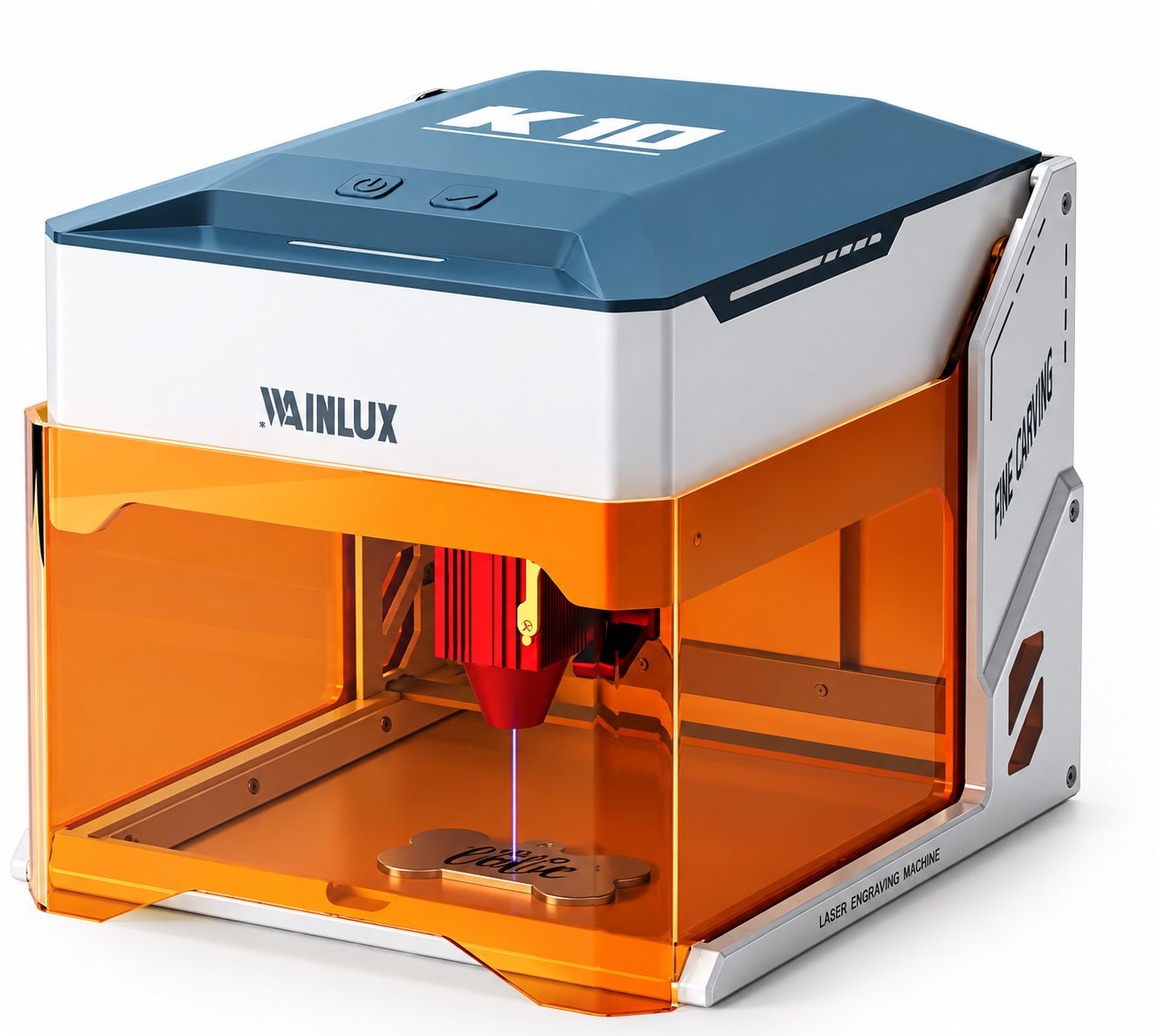
WAINLUX builds both single-head and dual-head configurations for this material class. The WAINLUX K10-5W is a fully enclosed 455nm 5W machine with a tinted shield, WiFi, PC and offline control, and it cuts 3-5 mm plywood. The WAINLUX X1-20W dual-laser pairs a 455nm head with a 1064nm head across a 30 x 30 cm work area with WiFi, USB-C and TF offline control, and handles acrylic. The WAINLUX F1-10W combines a 455nm 10W head with a 1064nm head in a 10 x 10 cm area with WiFi and a built-in screen. Buyers whose work is acrylic only should not select the K8-1064nm, which is a 1064nm bare-metal unit and not for acrylic engraving.
The company behind these machines has been manufacturing since 1998, holds an ISO9001 company-level certificate, and supports OEM and ODM work across more than 50 export countries.
Power Classes for Engraving vs Cutting
Power class is the second decision after material. Engraving and cutting pull in opposite directions.
- Engraving benefits from lower power and higher resolution. A 5W blue head is well suited to surface frost on acrylic, where the goal is contrast and detail rather than depth.
- Cutting benefits from higher power. A 10W head gives more headroom for thicker sheet and faster feed, while a 20W head is the choice when the acrylic laser cutter needs to move through production runs rather than samples.
A dual-laser machine is useful when the shop runs both acrylic and metal work, because the 455nm head handles the acrylic and the 1064nm head handles bare metal without changing machines.
Flame-Polished Edges and Ventilation
A flame-polished edge is a melted and re-solidified edge. It is produced by the beam itself when power, speed and assist gas are balanced, and it is one of the main reasons acrylic buyers choose laser cutting over mechanical cutting. Cast acrylic polishes more predictably than extruded sheet, which is why material choice and machine choice cannot be separated.
Ventilation is the other material-specific requirement. Acrylic vapor contains fumes that must be extracted at the source. A fully enclosed machine with a tinted shield, such as the K10-5W, gives a controlled working area, but the enclosure does not replace extraction. Buyers should plan the exhaust route as part of the machine installation, not as an afterthought.
Sample-Plate Test: Run Both Types Before You Buy
This test takes one session and answers the question that matters most: can this machine hold the acrylic work you sell?
- Prepare matched sample plates. Cut one plate of cast acrylic and one of extruded acrylic to the same size and thickness. Label the back so you cannot mix them up.
- Run one engraving pass and one cutting pass on each plate. Use identical power and speed settings for both plates so the material is the only variable. Record the settings next to each sample.
After the run, compare four things: the evenness of the engraved frost, the gloss on the cut edge, any haze or flare along the cut line, and whether the cut closed cleanly without stress cracks. If the machine holds a clean edge on cast acrylic and only mild flare on extruded sheet, it is matched to acrylic work. If both plates haze or crack, the settings or the machine class is wrong for the job.
Next Step
Acrylic is a two-material world, and the machine that suits cast sheet is not always the one that suits extruded. If you are specifying an acrylic engraving machine for a defined sheet type and thickness, tell us the material, thickness and edge finish you need. We will match the head and power class to the job.