
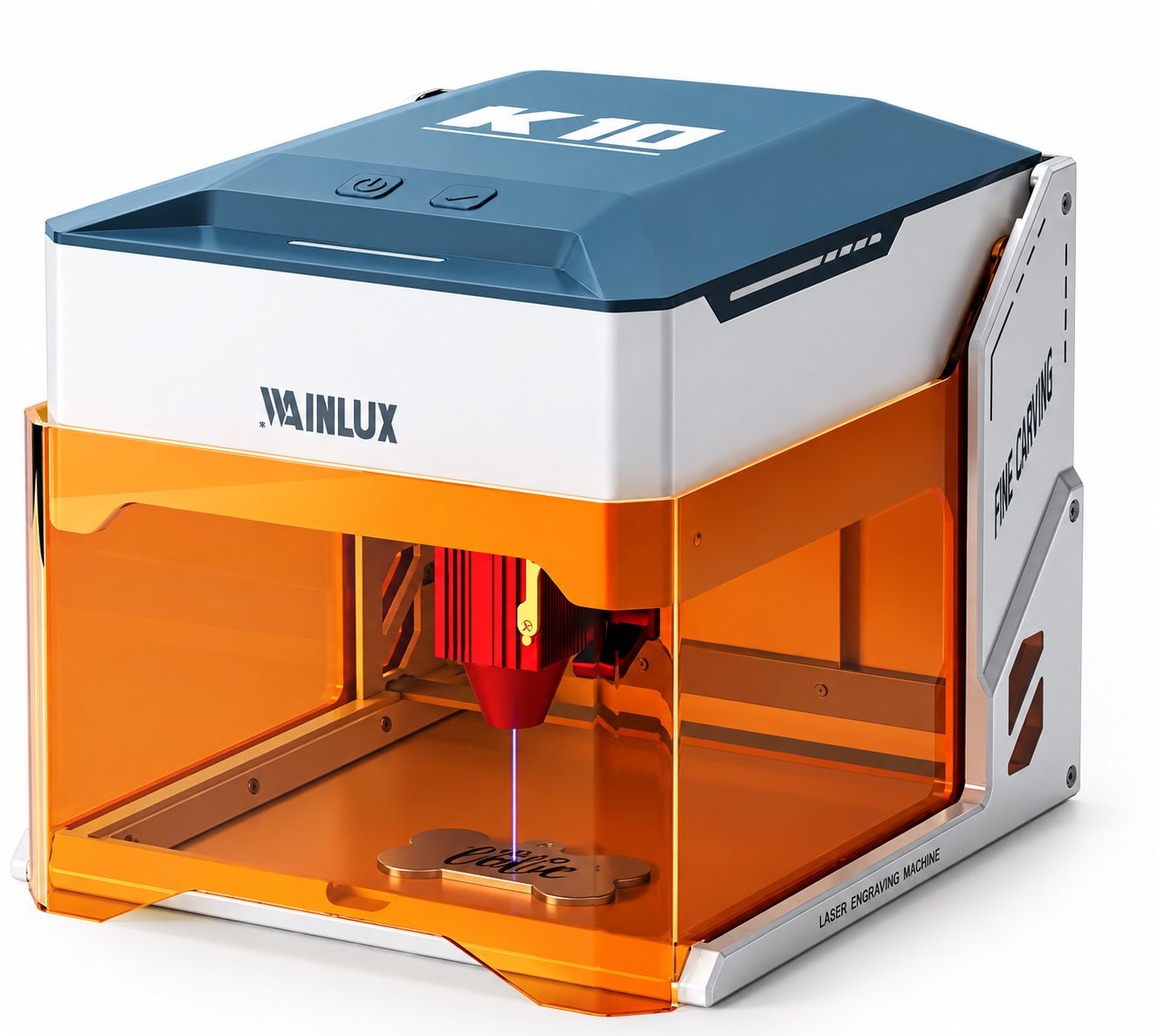
Hobbyists cutting plywood, acrylic, leather, or cardstock don't need the highest wattage — they need a machine whose power class and bed fit their material stack. This guide maps craft projects to realistic wattage bands, explains where small beds waste power you pay for, and gives a first-week test plan for any new hobby laser cutter.
Hobby project guide
A hobby laser cutting machine is usually bought once, used for years, and judged by what it can actually cut at the kitchen table. The most common mistake is treating wattage as a score: 20W must beat 10W, so buy 20W. In a small bed, that logic breaks down. This guide maps four common craft material stacks to realistic power classes, explains where hobbyists buy power their bed cannot use, and closes with a first-week test plan you can run on any new craft laser cutter.
Key takeaways
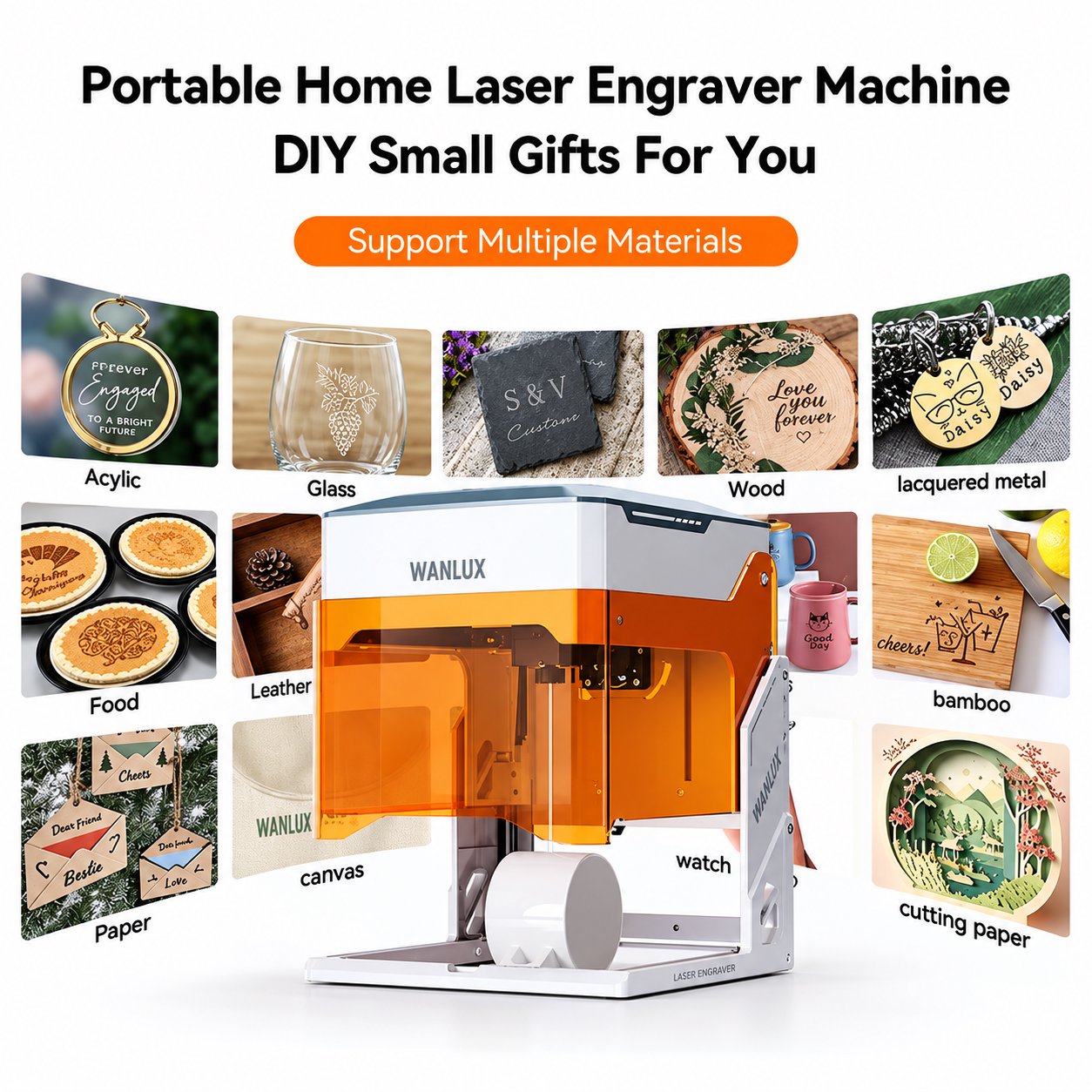
- Match the machine to your thickest regular cut, not to a spec number. A 5W diode such as the enclosed WAINLUX K10-5W handles 3-5 mm plywood, which covers most hobby work.
- Cutting and engraving pull in different directions. A 1064nm head addresses materials that a 455nm blue diode handles poorly, such as bare metal and some engineered plastics.
- Bed size sets a ceiling on useful power. On a 9.8 x 8.8 cm or 10 x 10 cm area, you rarely feed sheets thick enough to justify a big wattage jump.
- Buy for your project stack, then verify with a material test before you commit to production settings.
Why hobby cutting projects differ by material stack
Two hobbyists can buy the same wattage and get opposite results, because they cut different stacks. One cuts 3 mm birch plywood, leather, and cardstock. The other cuts 8 mm MDF, black acrylic, and thin metal blanks. The first stack rewards control and enclosure; the second rewards wavelength and, to a degree, power.
Material behavior is the reason. Cardstock and leather char or discolor if you push too much energy too slowly. Plywood and MDF cut cleanly but generate smoke that must be managed. Acrylic cuts with a flame-polished edge but can re-melt if settings are wrong. Thin metal or coated blanks often ignore a 455nm blue diode entirely and need 1064nm infrared. A hobby laser cutter is not a single tool; it is a set of power and wavelength choices wrapped in one enclosure.
That is why the useful question is not "how many watts?" but "what is the thickest material in my regular stack, and what wavelength does it need?"
Project-to-machine mapping by power class
The table below groups typical hobby projects by material stack, then points to the power class and only the WAINLUX models whose confirmed specifications fit that class. It is a starting filter, not a guarantee for every sheet on the market.
| Craft project stack | Typical material thickness | Power class that fits | WAINLUX model and confirmed facts |
|---|---|---|---|
| Cardstock, paper, thin leather, felt shapes, stencils | Under 1 mm | Low power, fine focus | XN001-3W: compact and foldable, 9.8 x 8.8 cm working area |
| Wooden keychains, bookmarks, engraved boxes, 3-5 mm plywood parts | 3-5 mm plywood | Entry diode with enclosure | WAINLUX K10-5W: fully enclosed with tinted shield, 455nm 5W blue diode, cuts 3-5 mm plywood, WiFi, PC, or offline control |
| Mixed-material jewelry, leather patches, small acrylic, cardstock, occasional thin metal blanks | Up to 5 mm on organic stock, thin metal with infrared | Dual-wavelength desktop unit | WAINLUX F1-10W: pairs a 455nm 10W head with a 1064nm head, 10 x 10 cm working area, WiFi and built-in control screen |
| Larger signs, acrylic displays, leather panels, plywood assemblies, metal tags | 5 mm plus on organic stock, thin metals | Dual-laser, larger bed | WAINLUX X1-20W: dual-laser, 30 x 30 cm area, 455nm and 1064nm heads, WiFi, USB-C, and TF-card offline working |
Read the table by column, not by row. First decide your thickest regular cut. Then decide whether any material in the stack needs 1064nm. Only then compare models. Hobbyists who buy in the opposite order — wattage first, materials second — often end up with unused headroom and a bed too small to use it.
Where hobbyists overbuy wattage they cannot use
Overbuying shows up in three specific ways.
A small bed limits thick-material work
High power matters most when cutting thick material slowly. But thick material usually comes in large sheets, and a 9.8 x 8.8 cm or 10 x 10 cm bed cannot hold a large sheet. If your working area is 10 x 10 cm, you are cutting small parts from 3-5 mm stock, not 10 mm panels. The extra watts mostly become heat in the material and more smoke in the room, not more finished pieces.
People compare engraving speed, then cut thick stock
A higher wattage diode engraves faster, and that is a real benefit. But hobby users often shop for cutting and then evaluate on engraving speed, or the reverse. Decide which job dominates. If cutting 3-5 mm plywood is the main job, the 5W class is a deliberate fit; if you also engrave a lot of small items, higher power buys time back.
Wavelength is ignored until metal appears
Many hobbyists buy a 455nm-only machine, then discover that thin metal and some coated surfaces do not respond. No amount of wattage on the wrong wavelength fixes that. This is where a dual-head model earns its price: the 1064nm head covers materials the blue diode cannot.
Budget check: add up the actual hours you will cut per week. Most hobby projects run under an hour of cutting at a time. If your thickest regular cut is 3-5 mm plywood, the 5W class is enough, and the money saved is better spent on ventilation, a honeycomb bed, and material.
For a tighter look at enclosure and control, see the WAINLUX K10-5W product page.
Match the fixture setup to the material, not the machine
Power class gets you in the door; fixtures decide whether the cut is repeatable.
- Plywood and MDF: a honeycomb bed lets smoke escape and reduces flashback marks. Light hold-down clips stop thin sheets from lifting.
- Acrylic: a flat sacrificial layer under the sheet. Aim for a clean, flame-polished edge rather than a slow, re-melted one.
- Leather and cardstock: low-tack tape or a magnetic mat keeps thin pieces flat. Multiple lightweight passes usually beat one heavy pass.
- Thin metal: use the 1064nm head and accept a narrower set of materials; test a scrap before committing.
Common failure modes are consistent: smoke residue on light materials, partial cuts at the bottom of a sheet, edge char on leather, and warped cardstock from too much speed or too little hold-down. Each points back to fixture setup or pass strategy, not to a missing kilowatt.
A first-week test plan for a new hobby laser cutter
- Cut one small square from each material in your regular stack — 3 mm plywood, acrylic, leather, cardstock. Write the material, thickness, and setting on the back. This becomes your own reference library.
- For each material, test two passes at different speeds and pick the one with the cleanest edge. Record it in a notebook or a shared file.
- On a dual-head model, cut the same shape with the 455nm head and the 1064nm head on a scrap of each candidate material, and note which head the material responds to.
- Run a small real project — a bookmark, a keychain, a stencil — from design file to finished piece, and time it. That number tells you whether your power class matches your actual hobby pace.
- Note smoke behavior and cleanup effort at each setting. If the room fills with smoke, fix ventilation before increasing power.
What to confirm before you buy
Ask which materials the machine is intended to cut at your usual thickness, and whether the workpiece fits inside the stated bed without a frame. Ask the supplier to confirm the working area and head configuration for the exact model you are comparing. If you plan to cut thin metal, confirm the 1064nm head covers it before purchase, not after.
WAINLUX has manufactured laser equipment since 1998, holds an ISO9001 company-level certificate, supports OEM and ODM work, and exports to 50+ countries. That background matters less than the match between your stack and the machine; use it to ask better questions about the specific model you are considering.
A quick FAQ
Is 20W overkill for a hobby laser cutter?
Not automatically. If you cut thicker organic stock in a 30 x 30 cm area or engrave at speed, a 20W dual-laser such as the X1-20W fits. On a 10 x 10 cm bed, the same power is harder to use because large, thick sheets do not fit.
Do I need 1064nm as a hobbyist?
Only if thin metal or a specific material in your stack needs infrared. If your projects are plywood, acrylic, leather, and cardstock, a 455nm diode at the right power class covers them.
How much power do I need for 3-5 mm plywood?
The K10-5W, a 455nm 5W diode, is confirmed to cut 3-5 mm plywood. That makes it a reasonable reference point if plywood at that thickness is your regular job.
Next step
Tell us your project stack — the materials, the thicknesses, and the largest piece you need to cut. We will point you to the power class and bed size that fit, instead of the highest number on the page.