
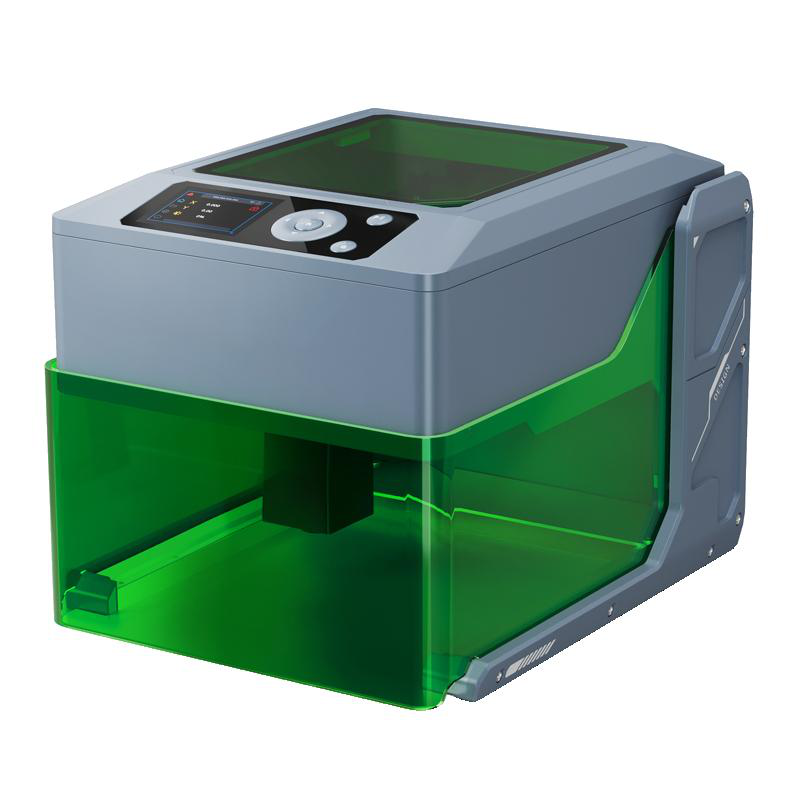
Choosing a home engraving machine comes down to one structural decision: an enclosed cabinet or an open frame. This guide compares dust, fumes, noise, pets, children, footprint, materials, and upkeep, and shows which WAINLUX models sit on each side of the line.
The short version
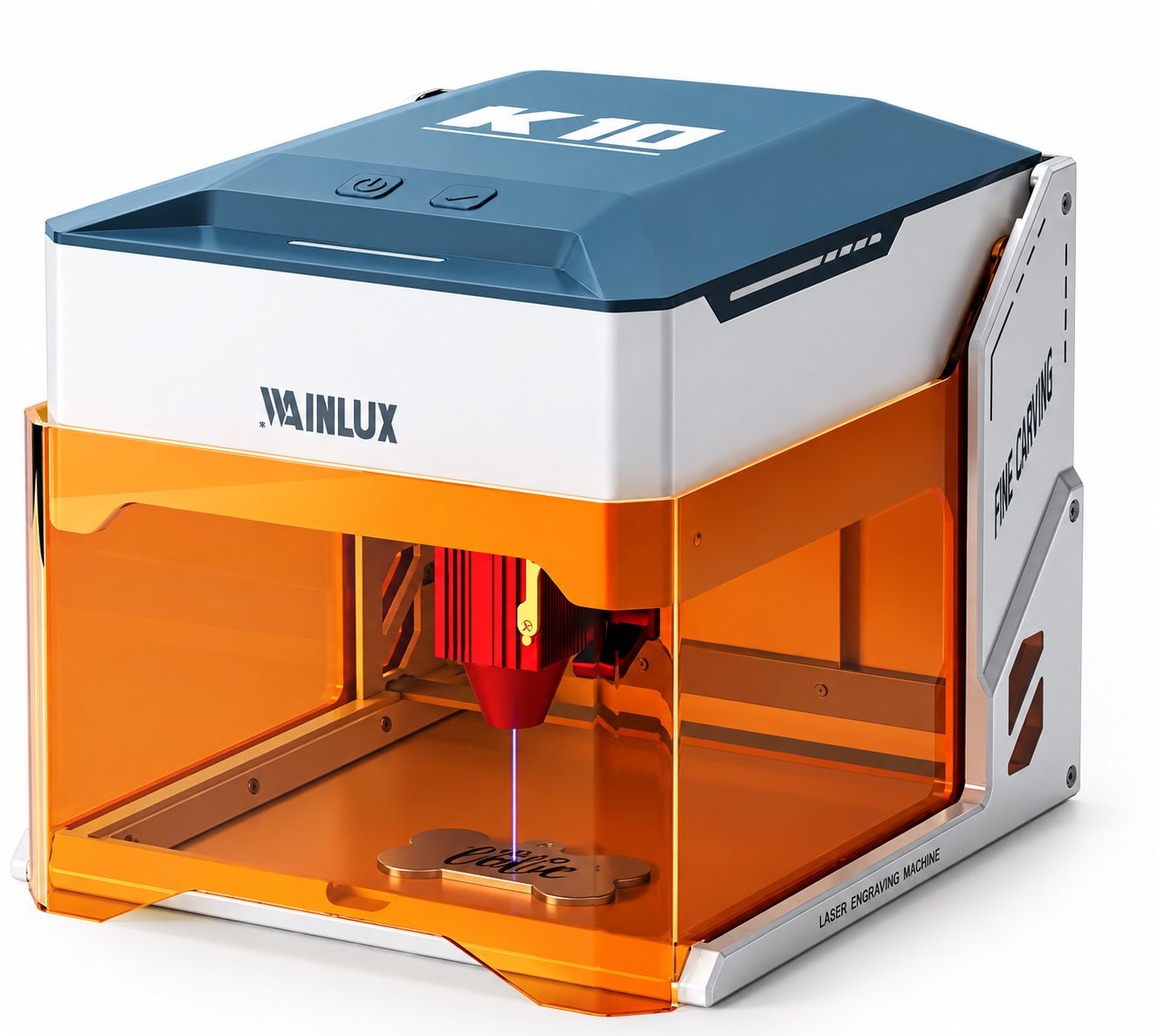
- An enclosed machine contains dust and fumes and muffles noise, but it takes a fixed spot on the bench.
- An open frame is cheaper to place, folds away, and can run from a power bank, but the work area is exposed to the room.
- Both frame types handle coated metal, leather, wood and paper in different ways. Only certain laser sources mark bare metal.
- Match the frame to the material and to who shares the room, not to a brand name.
A home engraving machine has to live in a room somebody also lives in. That changes the question. It is not only what the laser can cut; it is what the laser does to the air, the noise level, the desk, and the people and animals nearby. The two structural choices, an enclosed cabinet and an open frame, solve those problems differently.
What enclosed and open frame actually change
An enclosed machine puts a box between the laser and the room. WAINLUX K10-5W is built this way: a fully enclosed body with a tinted shield, a 455nm 5W blue diode head, and it cuts 3-5 mm plywood. It can be driven over WiFi, from a PC, or offline. The shield is the point. Dust from wood or leather stays inside the cabinet instead of settling on your desk, and the operator is not looking directly into the beam path.
An open frame leaves the work area visible from every side. WAINLUX XN001-3W is a compact foldable machine with a 9.8 x 8.8 cm working area. It runs from USB, a Bluetooth app, or an offline button, and it can be powered from a power bank. It marks coated metal only. The trade is clear: you get portability and a small footprint, and you give up the containment a cabinet provides.
Dust and fumes: the real dividing line
Engraving wood, leather, paper and some plastics produces fine particulate and odor. In an enclosed unit, most of that stays in the cabinet while the lid is closed. You still need ventilation when you open it, and you still need to clean the interior, but the room is not the first place the debris lands.
With an open frame, every pass sends dust into the air of the room. A small desk fan pointed at the work area pushes smoke sideways, but it does not filter it. If the machine sits in a bedroom, a shared office or a room with a return air vent, the smell and particles will reach the rest of the house.
Tip: If you cannot open a window near the machine, treat the enclosure as the first filter and an external exhaust or fume extractor as the second. An enclosure contains debris; it does not make a sealed cleanroom.
Noise: what the neighbors and the household hear
A diode laser itself is quiet; the fan and the stepper motors are not. An enclosed cabinet acts like a simple sound barrier, softening the stepper whine and the fan hum. That matters if the machine runs in the evening while children sleep, or in an apartment with thin walls.
An open frame broadcasts the same sounds directly into the room. In a home shop where the machine runs during the day, this is a minor issue. In a shared living space, it is the difference between a tolerable background hum and a machine you avoid running after 8 p.m.
Pets and children in the same room
This is where the enclosed-versus-open choice becomes a safety decision rather than a convenience one. A 455nm blue diode is bright enough to matter. An enclosed machine with a tinted shield blocks the direct beam path and puts a physical barrier between a curious child or a cat and the work area. You still should not leave the machine running unattended, but the barrier changes how much attention the machine needs every second.
An open frame leaves the beam path, the moving gantry and the hot work surface exposed. If a household has toddlers, climbing pets or a dog that bumps the table, an open frame demands a dedicated room with a door, or a strict rule that the machine only runs when an adult is present and the room is otherwise empty.
Bench and desk space
An enclosed machine occupies a fixed rectangular footprint. It does not fold, and it usually needs clearance at the front or top for the lid. Once placed, that part of the bench is committed.
An open frame can be smaller in use and smaller again when stored. The XN001-3W folds, so a buyer who shares a desk with a computer can put it away after a session. If the only workspace in the home is the kitchen table, that foldability may matter more than containment. If the machine has a permanent spot in a garage or spare room, the fixed footprint of an enclosure costs nothing.
Materials each frame type can handle
Frame type and laser source are separate decisions. Enclosed or open tells you how the machine contains the process; the wavelength and power tell you what it can mark or cut.
WAINLUX K10-5W uses a 455nm 5W blue diode and cuts 3-5 mm plywood, which suits wood, leather, paper and coated surfaces. WAINLUX XN001-3W is a 3W machine with a 9.8 x 8.8 cm working area; it can mark coated metal only and is best kept to light engraving on small parts.
If bare metal is on your list, the laser source changes. WAINLUX F1-10W+1064nm pairs a 455nm 10W head with a 1064nm head, marks bare metal with the 1064nm head, has a 10 x 10 cm working area, a translucent shield and a built-in control screen. WAINLUX K8-1064nm works over an 8 x 8 cm area and weighs 4.4 kg. In both cases the 1064nm head is the one that marks bare metal; the 455nm head handles the coated-metal and organic-material work.
Comparison table: enclosed versus open frame at home
| Factor at home | Enclosed frame | Open frame |
|---|---|---|
| Dust and debris | Contained in the cabinet while the lid is closed; interior needs periodic cleaning | Released into the room; needs ventilation and a wipe-down of the surrounding bench |
| Fumes and odor | Reduced inside the room; still vent when opening the lid | Directly into the room air; external exhaust is the practical answer |
| Noise | Cabinet softens fan and stepper noise | Full noise reaches the room |
| Pets and children | Tinted shield and body block the direct beam path | Exposed beam path and moving parts; needs a controlled room |
| Bench space | Fixed footprint, clearance for the lid | Small footprint; can fold and store away |
| Typical material focus | Wood, leather, paper, coated surfaces; plywood up to 3-5 mm on K10-5W | Small coated-metal and light engraving jobs; bare metal only with a 1064nm source |
| Upkeep | Clean the interior, the shield and the lens; check the lid seal area | Clean the lens, the rails and the open frame; more frequent dusting around the machine |
Upkeep each type needs
Both types need a clean lens, because residue on the lens degrades the beam. The difference is where the residue ends up elsewhere.
An enclosed cabinet collects char and fine dust inside, on the bed and under the gantry. How often you clean depends on how much wood and leather you cut. The tinted shield also picks up smoke film and needs a soft wipe to stay clear.
An open frame leaves the residue on the bench, the rails and the floor nearby. You clean the machine more or less the same way, but you also clean the room. If the machine shares a desk with a computer or fabric, that extra cleaning is part of the routine, not an occasional task.
Setting up a home workspace: a practical order
The sequence below works whether you buy an enclosed or an open frame machine. It keeps the safety decisions ahead of the purchase decision.
- Decide who shares the room. If children or pets use the same space, plan for an enclosure or a lockable room before choosing a model.
- Decide where the exhaust goes. A window, a door or a ducted extractor should be within reach of the machine, not on the other side of the house.
- Measure the bench. Note the machine footprint plus the lid clearance for an enclosure, or the unfolded size for an open frame.
- List the materials. Wood, leather and coated metal point to a 455nm diode; bare metal requires a 1064nm head.
- Check how you will send files. WiFi, PC, USB, Bluetooth app or offline button each suit a different workflow; pick the one you will actually use.
- Set the rules. Define when the machine can run, who can be in the room, and where eye protection lives.
Which type fits your home shop
Choose an enclosed frame if the machine will sit in a living area, if wood and leather dust is a concern, if noise matters in the evening, or if children and pets share the room. The WAINLUX K10-5W is fully enclosed with a tinted shield and a 455nm 5W diode, cuts 3-5 mm plywood, and runs from WiFi, a PC or offline.
Choose an open frame if the workspace is small, if the machine needs to pack away after each session, if you want to run from a power bank, or if your work is small-format engraving on coated metal and similar surfaces. The WAINLUX XN001-3W folds, has a 9.8 x 8.8 cm working area, and works from USB, a Bluetooth app or an offline button.
If bare metal marking is the goal, neither of those two is the right starting point. Look at a machine that pairs a 455nm head with a 1064nm head, like the F1-10W+1064nm, and treat the shield and control screen as separate choices from the laser source.
Questions buyers ask before ordering
Can an enclosed machine run without ventilation?
The enclosure contains debris while closed, but you still open it to remove the workpiece. Plan for ventilation near the machine, especially for wood and leather.
Is an open frame safe around a cat or a child?
The beam path and moving parts are exposed. Treat the room as the safety barrier: a closed door, adult supervision, and no running the machine when the room is otherwise occupied.
Does frame type decide whether it can mark metal?
No. Metal marking depends on the laser source. Coated metal can be marked by a 455nm diode; bare metal needs a 1064nm head such as the one on the F1-10W+1064nm or the K8-1064nm.
How much bench do I need to leave free?
Leave the machine footprint plus working clearance. For an enclosed unit, include room to open the lid; for a foldable open frame, allow space to unfold it and reach the work area from the front.
Talk to a manufacturer about your home setup
WAINLUX has manufactured laser equipment since 1998, holds an ISO9001 company-level certificate, and supports OEM/ODM work with customers in more than 50 export countries. If you are comparing enclosed and open frame machines for a home shop, tell us the materials, the room, and the space you have, and we will point you to the model that fits.