
Laser engraver cost is driven by six variables buyers can compare directly: laser type and wavelength, wattage tier, work area, enclosure, optional accessories, and supplier qualifications. This breakdown explains each driver and gives you a quote checklist so offers can be compared fairly.
How Much Does a Laser Engraver Cost? What Actually Drives the Price
Buyers searching for laser engraver cost usually get two unhelpful answers: a single figure that does not match any real quotation, or a vague "it depends." Neither helps you compare suppliers. What does help is knowing exactly which variables move the price, so you can read a quote and see what you are being charged for.
This article breaks laser engraver cost into the drivers that actually change between two offers for the same apparent machine, and ends with a quotation checklist you can send to suppliers before you compare numbers.
- Laser type and wavelength change the machine category, not just the specification.
- Wattage tiers and work area are the two specifications buyers most often compare across quotes.
- Enclosed machines and optional accessories are separate cost drivers from the base unit.
- Supplier qualification, after-sales support and spare-parts access affect long-term cost, not sticker price alone.
Start With the Laser Type, Not the Price
The first thing that separates one quotation from another is the laser source. Two machines can look similar on a web page and belong to different categories.
Diode laser modules commonly emit at 455 nm and are used for engraving wood, leather, cardboard, some plastics and coated metals. Fiber-style machines using a 1064 nm wavelength are built for bare metal marking and engraving, a job a 455 nm diode module does not perform. Because these are different technologies with different optical assemblies, a 1064 nm metal-capable machine sits in a different cost band from a diode entry machine, even when the frame size and power figures look close.
When a seller quotes a laser engraver without naming the wavelength, you cannot yet compare it to anything. Ask for the wavelength on the quotation itself.
Wattage Tiers: What Changes Between Levels
Within a product line, wattage is usually offered in steps rather than a continuous range. In our current range, the tiers are 3W, 5W, 10W and 20W. Higher tiers generally mean a higher configured price, but the practical reason to move up a tier is throughput and material capability, not a single number.
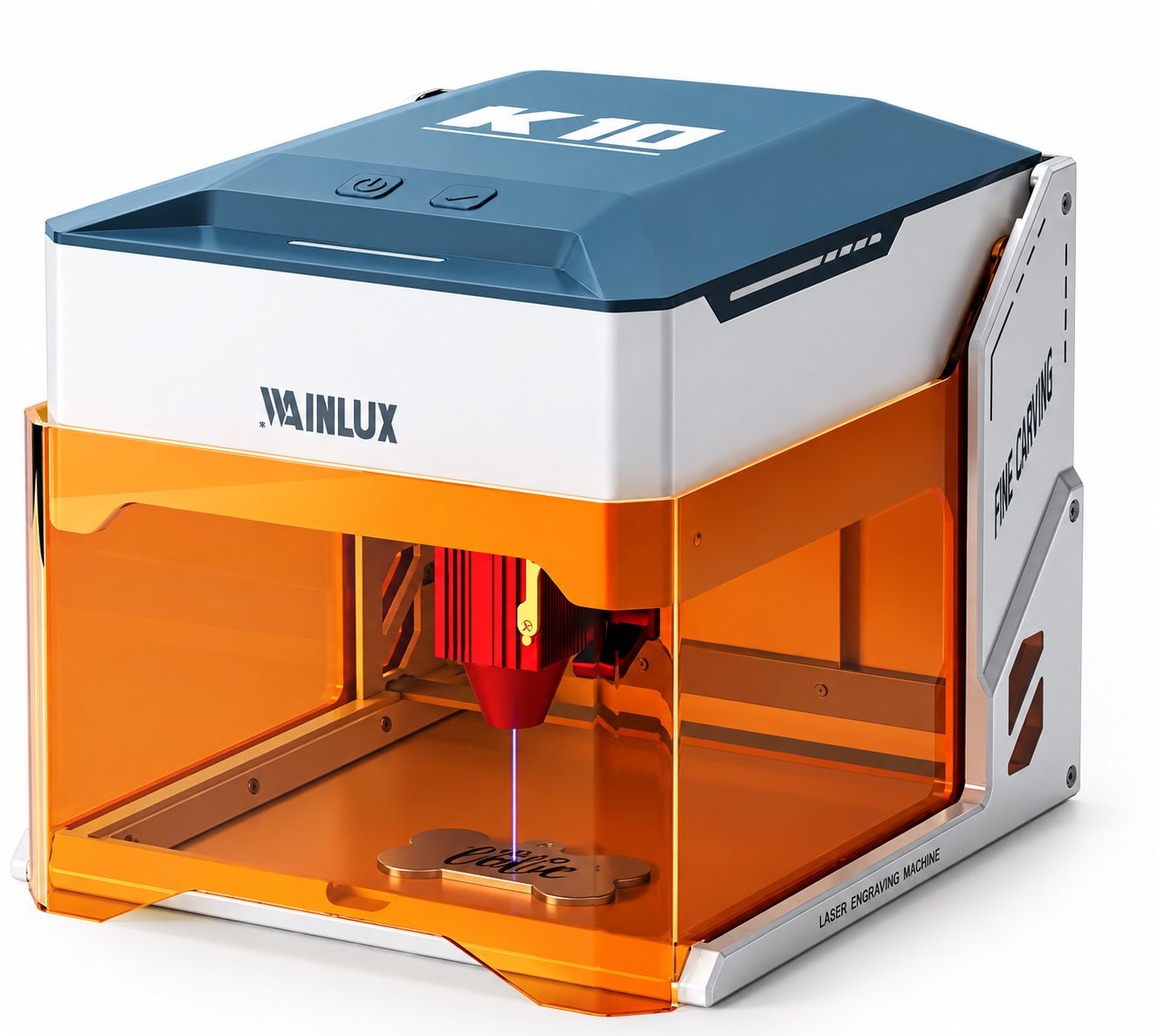
If your work is small-format marking on wood or leather, a lower tier may cover the job. If you cut thicker stock or run production batches, the extra capability of a higher tier is what you are paying for. This is why two quotes at "20W" can still differ: wattage alone does not define the rest of the machine. For a concrete example of a mid-tier configuration, the WAINLUX K10 5W shows how a 5W diode platform is specified in a compact frame.
Work Area: The Specification Buyers Underweight
Work area determines what you can physically fit on the bed, and it is a direct cost driver. Across our range, work areas run from about 8x8 cm up to 30x30 cm. A larger bed requires a larger frame, longer motion system and more material, which is reflected in the price.
For buyers, the useful question is not "what is the biggest bed available" but "what is the largest single piece I need to engrave, and how many parts do I need per cycle." A 30x30 cm bed supports batch layouts and larger panels. An 8x8 cm bed suits small tags, jewellery and personalisation work. If you buy a larger bed than your workflow needs, you pay for capability you will not use; if you buy smaller, you may be forced to reposition workpieces, which costs labour on every order.
Open Frame vs Enclosed Machines
Machines with a dust box or protective cover cost more than open-frame versions of comparable power. The difference buys two things: containment of fumes and debris, and a safer working arrangement for operators in a shared space.
Whether that is worth the step up depends on where the machine will run. In a workshop with extraction and a dedicated operator, an open-frame machine can be appropriate. In a retail, office or classroom setting, an enclosure changes what is practical. This is a genuine cost driver, not an upsell: the enclosure is additional structure and hardware on the same base platform.
Accessories: Optional, and Should Be Quoted Separately
Rotary rollers and air purifiers are typically optional extras rather than part of the base unit. A rotary attachment lets you engrave cylindrical work such as cups and tubes. An air purifier addresses fume management where external extraction is not available.
Because these items are optional, they are a common source of misleading comparisons: one quote includes a rotary roller and purifier, another does not, and the totals are read as a price difference on the machine. When you compare laser engraver cost across suppliers, list accessories as their own line items.
Total Cost of Ownership Beyond the Machine
The purchase price is only the first cost. Before deciding, work through the recurring and support costs that follow the machine into service:
- Consumables and wear parts: lenses, belts and other service items are replaced over the machine's life. Confirm which parts are user-replaceable and which are not.
- Spare parts availability: a machine with no accessible spare parts becomes a full replacement when a single component fails. Ask how spare parts are supplied and from where.
- After-sales support: technical support during commissioning and fault diagnosis reduces downtime. Ask what support channel is provided and in what language.
- Supplier qualification: an ISO9001-certified factory with CE-marked machines indicates a documented quality system and conformity to applicable European requirements. Certificates are issued to specific products and scopes, so request the relevant documents rather than assuming they cover every model.
Two machines at the same headline price are not equivalent if one has a documented quality system, accessible spare parts and a support channel, and the other does not.
A Quote Checklist to Compare Offers Fairly
Laser engraver cost cannot be compared from a single figure. Send suppliers this list and ask for each item to be written on the quotation:
| Variable | What to ask for |
|---|---|
| Laser type and wavelength | The source technology and its wavelength, e.g. 455 nm diode or 1064 nm fiber-style. |
| Wattage tier | The exact tier offered, e.g. 3W, 5W, 10W or 20W. |
| Work area | Bed dimensions in centimetres, not a screen-size description. |
| Enclosure | Whether a dust box or protective cover is included or extra. |
| Accessories | Rotary roller, air purifier and any other add-ons, listed as separate line items. |
| Software | Which control software is supplied and its licensing terms. |
| Supplier credentials | ISO9001 factory certification, CE documentation for the quoted model, after-sales terms and spare-parts supply. |
When every supplier answers the same seven rows, the comparison becomes a specification comparison rather than a guess. Our dual-laser WAINLUX X1 20W dual-laser is an example of a configuration where laser type, wattage and work area all need to be read together before pricing makes sense.
Questions Buyers Ask About Laser Engraver Cost
Why do two quotes for a "20W laser engraver" differ so much?
Because wattage is one variable among several. Check the wavelength, work area, enclosure status, included accessories and software licensing on both quotes. A 20W diode machine and a 20W 1064 nm metal-capable machine are different products, and a machine quoted with a rotary roller and purifier is not the same offer as a bare unit.
Is a higher wattage always the better buy?
No. Wattage determines capability and throughput, and a tier you cannot use adds cost without adding output. Match the tier to your material and batch size, then spend the difference on the work area, enclosure or support you actually need.
Do I need an enclosed machine?
It depends on the installation. Enclosed machines cost more than open-frame equivalents, and the enclosure contains fumes and debris and separates the operator from the work area. If your site has dedicated extraction and a controlled workshop, an open frame may be suitable; in shared or public spaces, an enclosure is usually the more practical choice.
How should I evaluate suppliers when prices differ?
Ask for ISO9001 certification for the factory, CE documentation for the specific quoted model, the after-sales support channel, and how spare parts are supplied. These factors determine downtime and replacement cost over the life of the machine, which is part of what you are really buying.
Next Step: Request a Line-Item Quote
If you send the checklist above to suppliers, you will get comparable quotes instead of a single number you cannot verify. Xiamen Spring Technology manufactures the WAINLUX range under an ISO9001-certified system with CE-marked machines, and can return a quotation itemised by laser type, wattage, work area, enclosure, accessories and software. Tell us your material, your largest workpiece size and your expected batch volume, and we will quote the configuration that fits — not the largest one on the list.
Specification figures in this article refer to our current product range: 455 nm diode and 1064 nm fiber-style lasers, wattage tiers of 3W, 5W, 10W and 20W, and work areas from about 8x8 cm to 30x30 cm. Confirm the exact configuration and documentation for any model before ordering.