
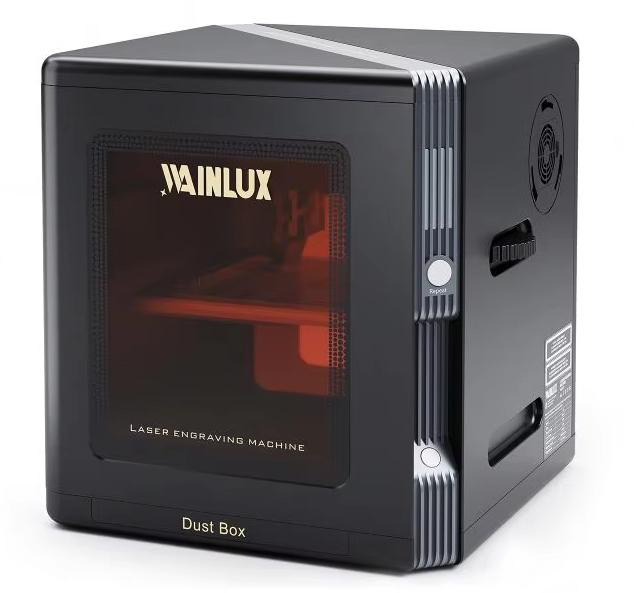
Why glass engraving depends on wavelength and surface preparation, how diode and 1064nm machines differ, and the real price drivers behind glass laser engraving machines.
Shopping for a glass laser engraving machine is confusing because two searches collide: buyers who want to engrave glassware, and buyers comparing the two laser types that dominate desktop equipment — blue diode and 1064nm. This guide separates the physics from the marketing, then explains what actually drives the price difference between machines.
First Principle: Glass Is Transparent at Most Laser Wavelengths
Standard glass passes through the near-infrared and visible spectrum with little absorption — which is exactly why a laser beam can pass through a wine glass and mark the table underneath. Practical desktop glass engraving therefore relies on the laser interacting with something on or in the glass surface. That is the engineering reality behind every honest product description, including ours: diode machines engrave glass when it is painted or covered with color paper, and the laser works through the coating.
Blue Diode (455nm): the Practical Choice for Glassware Personalization
Blue diode machines are the workhorse of the customization business: they mark wood, bamboo, acrylic, leather, coated metals — and glass with surface preparation (paint coat or color-paper masking). The workflow is simple and repeatable: prepare the surface, engrave, clean. For drinkware, awards and gift personalization at small-to-medium volume, this is the cost-effective route. Machines like the WAINLUX K10-5W and the 10W X2 cover it at desktop scale.
1064nm: a Metal Machine, Not a Glass Machine
1064nm fiber-class machines vaporize bare metal — gold, silver, copper, aluminum, stainless steel, zinc alloy — leaving clean marks without smoke, which is why they dominate jewelry and tag marking. But for clear glass, that same wavelength mostly passes through: a 1064nm unit is the wrong tool for transparent glassware. It earns its place in your shop for the other half of a mixed product line — metal bases, plaques, closures — not for the glass itself. Units like the WAINLUX K8-1064nm fill exactly that role.
What About Bare-Glass Industrial Marking?
High-volume industrial glass marking (pharmaceutical vials, automotive glass) uses UV lasers or CO2 systems with specific process controls — a different equipment class entirely. If your product line genuinely requires marking bare glass surfaces at industrial volume, raise that requirement explicitly with any supplier and confirm the process on samples before committing. Do not let a spec sheet blur this line.
What Really Drives the Price
- Wavelength and laser source: the single biggest cost driver. 1064nm sources cost more than diode modules at comparable quality.
- Output power: 3W→5W→10W→20W→40W tiers change what the machine can cut, not just how fast it engraves.
- Work area: 8x8cm desktop units versus 30x30cm and 40x40cm production beds — bed size cannot be upgraded later.
- Beam architecture: galvanometer steering costs more than gantry motion and pays back only at batch volume.
- Build and accessories: aluminum alloy frames, smart positioning or autofocus, included air pump and honeycomb board.
- Dual-laser configurations: two wavelengths in one frame cost more than either alone — but less than two machines plus the duplicate workflow.
A Price-Sanity Checklist Before Ordering
- Does the supplier state, in writing, that glass needs surface preparation?
- Is the quoted power tier matched to your cutting needs, or just the highest number available?
- Is the work area sized to your largest product?
- Are the accessories you will actually need included?
FAQ
Can a diode laser engrave glass without any coating?
Reliable results on clear glass require surface preparation — paint or color-paper masking. Suppliers who claim bare-glass engraving from a desktop diode should be asked to demonstrate it on your glassware.
Why is 1064nm more expensive?
The laser source and its power supply cost more to build, and metal-marking performance justifies it — for metal. For glassware-only work, that budget belongs in a better diode machine.
Which single machine for a mixed shop?
A dual-laser unit covering 455nm plus 1064nm handles prepared glass, organics and bare metal in one workflow. Confirm both wavelengths' specs independently before buying.
Get a Quote Matched to Your Glassware
Email your product list and glass types to [email protected]. Xiamen Spring Technology Co., Ltd. manufactures the WAINLUX diode, 1064nm and dual-laser lines and will confirm the right configuration — and the honest process requirements — before you order.