
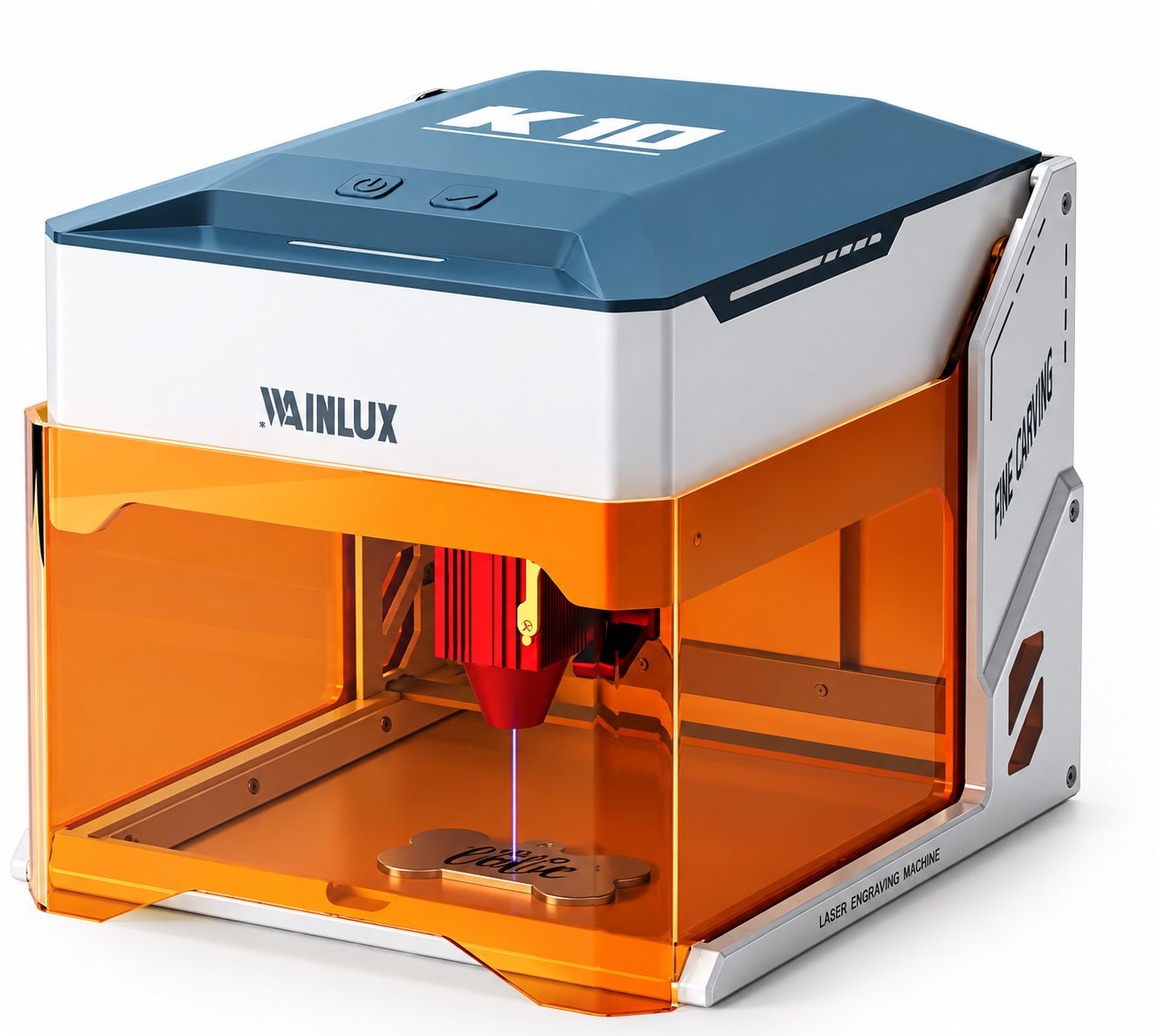
When buyers compare a small engraving machine, the work area decides most of the purchase. This guide shows the real engraving footprint of common products, maps WAINLUX work areas from 8x8 cm to 40x40 cm to those products, and explains when power matters and when it does not.
If you are comparing a small engraving machine for a product line, the size of the working area is the number that decides whether the machine fits your workflow. Everything else in the listing is usually negotiable. The work area is not.
Key takeaways
- Measure the whole part first, then add repositioning margin. A 10 cm keychain rarely needs a 10 cm work area.
- WAINLUX work areas in the small machine range run from 9.8x8.8 cm (XN001-3W) up to 40x40 cm (L8 series). K8 series is 8x8 cm, K10-5W and F1 series are 10x10 cm, X2 series is 15x20 cm, and X1 series is 30x30 cm.
- Laser power is a secondary variable once the work area fits. It changes marking speed and material response, not whether the part fits on the bed.
- Any part wider or taller than the working area must be split into multiple jobs with manual repositioning between passes.
Start with the product, not the machine
Buyers searching for a small laser engraving machine usually have a product in mind: keychains, metal tags, jewelry, phone cases, coasters, leather patches, small signage, or company gifts. The first practical question is not "how many watts" but "what is the largest single pass I need?"
Lay out a real part from your line and measure it. Use the outer dimensions of the finished piece, not the artwork. Include any jig, fixture, or holding bracket that sits under the laser, because those add to the footprint in the X and Y axes. If you plan to run several parts per pass, multiply the count accordingly.
A common mistake is to size the machine to the artwork. A 4 cm logo on a 10 cm keychain still occupies the full keychain on the bed. The machine must cover the part, not the graphic.
Map work area to product type
The table below matches published WAINLUX work areas to typical product categories. It is a starting filter, not a fixed rule, because part orientation and fixtures change the effective footprint.
| Work area | WAINLUX series (published) | Product types that commonly fit in a single pass |
|---|---|---|
| 9.8x8.8 cm | XN001-3W, foldable, power-bank form factor | Small metal tags, jewelry charms, slim keychains, marking on small personal items |
| 8x8 cm | K8 series; K8-1064 nm version published at 8x8 cm with 0.01 mm accuracy for gold, silver, copper and steel | Metal blanks, rings, dog tags, small identification plates |
| 10x10 cm | K10-5W; F1 series | Larger keychains, coasters up to roughly 10 cm, leather patches, small logo plates |
| 15x20 cm | X2 series | Phone cases, notebook covers, flat gift items, small signage panels |
| 30x30 cm | X1 series | Wooden plaques, larger signs, multi-part nesting on one bed |
| 40x40 cm | L8 series | Large flat panels, bulk nesting, production batches of small parts in one pass |
Work areas above are published WAINLUX figures. Product fit depends on part orientation and any fixture used.
Why one or two centimetres matter
The difference between an 8x8 cm and a 10x10 cm bed looks small on paper. In practice it decides whether an item is a one-pass job or a two-pass job. A coaster that measures 9.5 cm across fits a 10x10 cm bed with minimal margin. The same coaster on an 8x8 cm bed needs repositioning and a second pass, which introduces alignment risk and doubles handling time.
For a buyer comparing compact units, the honest question is: how many of my regular products sit within one or two centimetres of the bed edge? If several do, move up one size. The cost difference between a K8 series machine and a K10-5W is usually smaller than the labour cost of repositioning every second part.
What happens when the part is too big
Oversized parts are not a defect in the machine; they are a workflow constraint. If a sign or panel exceeds the working area, the job is split into multiple passes. The operator engraves the first section, moves the workpiece or the origin, and runs the next section. Repositioning requires alignment marks, a stop, or a fixture to keep the passes registered.
This is workable for low-volume or one-off custom work. It becomes expensive in production because each repositioning step adds labour and a potential misalignment point. If your product range regularly exceeds 15 or 20 cm, size the machine to the part instead of planning around splitting.
Where laser power actually fits
Power is a real specification, but it is not the first filter. It changes how the beam interacts with the material: marking speed, contrast, and the range of materials that respond well. Work area determines whether the part fits in one pass at all.
The published WAINLUX range includes 3 W and 5 W diode-style units in the small machine tier and 1064 nm versions for metals. The K8-1064 nm model is published at 8x8 cm with 0.01 mm accuracy and marks gold, silver, copper and steel. That is a metal-focused configuration. A diode unit at the same work area targets different materials.
For buyers, the practical sequence is: confirm the work area first, then confirm the material response you need, then choose the power tier that matches. Reversing this order often leads to a machine that marks beautifully but cannot hold the part.
Compact form factor: when a foldable unit makes sense
The XN001-3W is a foldable unit with a 9.8x8.8 cm work area and a power-bank form factor. It suits sellers who need to mark small metal items on location, at markets, or during client meetings. The trade-off is the smaller bed and lower power tier. It is a portable marking tool, not a production bed.
If your products are consistently small and portability is a requirement, this class of machine answers a real need. If your product range includes anything larger than a business card, a fixed 10x10 cm or 15x20 cm unit is the more stable production choice.
A quick sizing checklist
- List your top five products by sales volume.
- Measure each one at its widest and tallest point, including any fixture.
- Add 10 to 20 mm of margin on both axes for positioning and jig clearance.
- Compare the largest value against the published work areas above.
- If more than one product exceeds the bed, size up rather than planning to split the job.
- Only then compare power tiers and material compatibility.
About the supplier
WAINLUX is produced by Xiamen Spring Technology Co., Ltd., founded in 1998 and operating for 25 years. The company holds ISO9001 certification at company level, offers OEM and ODM services, and exports to more than 50 countries.
Two representative models in the small machine range:
- WAINLUX K10-5W laser engraving machine — 10x10 cm work area, suited to keychains, coasters, leather patches and small logo plates.
- WAINLUX K8-1064 nm laser engraving machine — 8x8 cm work area, published at 0.01 mm accuracy, marks gold, silver, copper and steel.
FAQ
Is a 10x10 cm work area enough for keychains?
For most standard keychains, yes. Measure the longest dimension of your largest keychain and add margin for the fixture. Keychains wider than 10 cm need repositioning or a larger machine.
Can I engrave a 20 cm sign on an 8x8 cm machine?
Yes, by splitting the job into sections with repositioning between passes. This works for one-off pieces. For repeat production it adds handling time and alignment risk, so a larger work area such as the X1 series at 30x30 cm is a better fit.
Does more power mean a better small engraving machine?
Not automatically. Power affects marking speed and material response. Work area determines whether the part fits. A high-power machine with a bed that is too small still cannot engrave the part in one pass.
What accuracy does the K8-1064 nm model offer?
The published figure is 0.01 mm accuracy on an 8x8 cm work area, with marking on gold, silver, copper and steel. Confirm details for your specific materials and part geometry with the supplier.
Can I engrave multiple small parts in one pass?
Yes, if the combined layout fits inside the work area. Nesting several small parts on one bed is common with the X2 series at 15x20 cm and the L8 series at 40x40 cm.
Still deciding? Send us your product dimensions and material list. We will match them against the published WAINLUX work areas and recommend the smallest machine that fits your line.
Request product details