
Most specs pages tell you what a laser engraver can do in a workshop. This guide covers what home use actually demands: ventilation, footprint, enclosure, eye safety, material scope, and power supply — and which machine classes meet those conditions.
Most pages about a home laser engraving machine describe what the hardware can do in a workshop: maximum power, cutting thickness, software features. Very little of that answers the question a home buyer actually faces, which is whether the machine can be used in a room where people live. Home use puts a different set of requirements first — where the fumes go, how much bench space it takes, whether you can watch it safely, what materials a diode laser can realistically handle, and what it needs from your power supply.
This guide works through those requirements in the order they affect a buying decision, then shows which machine classes satisfy them.
Why Home Requirements Differ From Workshop Specs
A workshop can dedicate a corner to an open-frame laser, run an extraction fan to the outside, and keep the area clear of people. A home typically cannot. The machine shares space with a desk, a kitchen counter, or a spare room, and it is used in short sessions rather than full shifts.
That changes the priority order. In a workshop, cutting thickness and speed drive the purchase. At home, five conditions drive it:
- Where the fumes and smoke go during and after a job
- How much permanent bench or table space the machine occupies
- Whether the work area is enclosed and the laser light is shielded
- What materials the available laser type can actually engrave or cut
- What power source the machine needs and how it is connected
Power still matters, but it matters within the limits the first four conditions set.
Requirement 1: Ventilation and Fume Control
Laser engraving burns or vaporises material. Even at low power, that produces smoke and fine particulate, and some materials release fumes that are unpleasant or worse. Home use means you cannot treat this as a workshop problem to be solved with a big extraction system.
Practical home fume control comes down to three things:
- Where you run the machine. A window-adjacent table lets you direct exhaust outside with a short duct or a small fan. A windowless interior room limits your options.
- How long each session runs. Short engraving jobs on small items produce less total fume than long cutting sessions.
- What you engrave. Some materials are unsuitable for any indoor laser use regardless of ventilation.
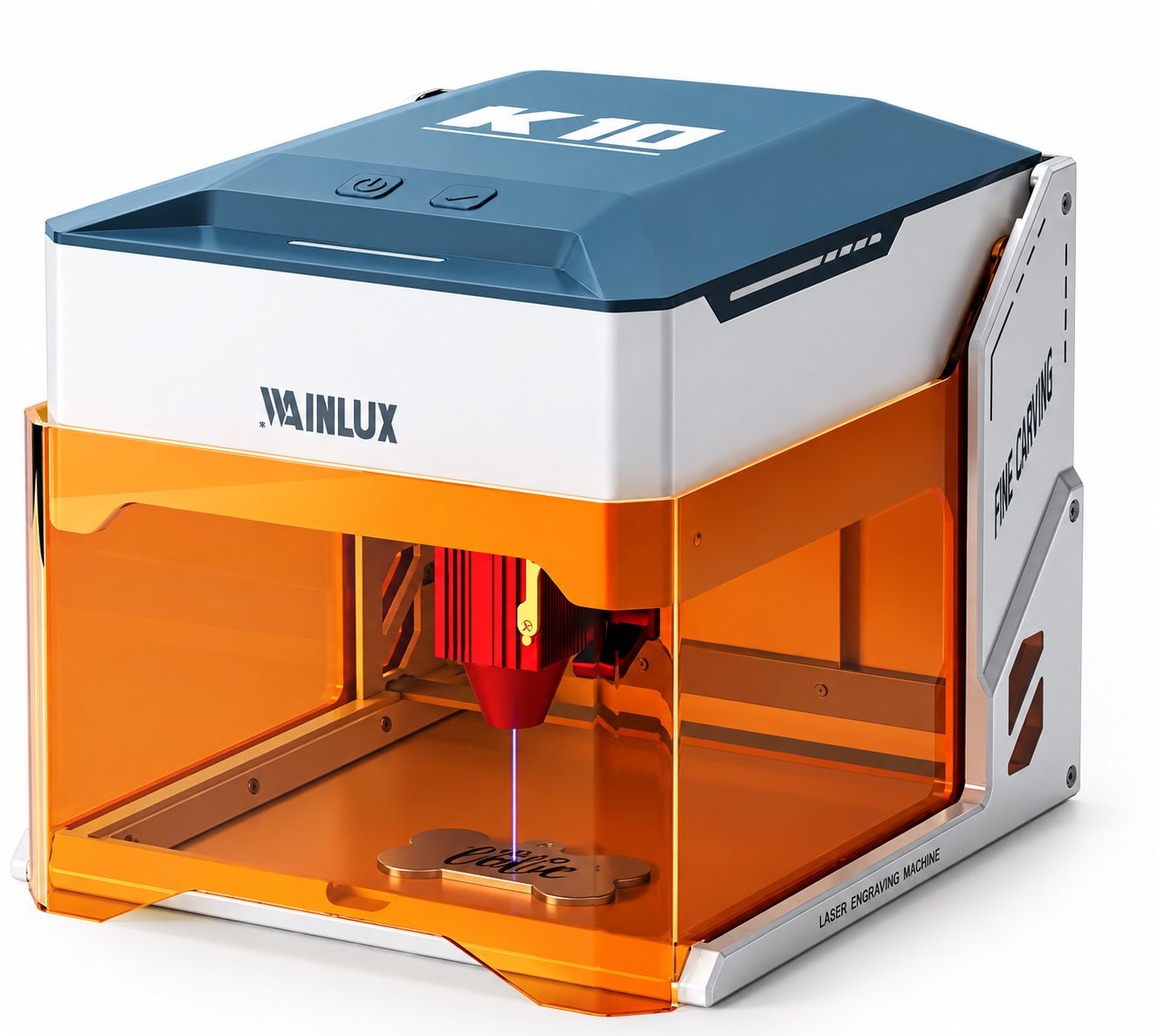
The machine class matters here too. A fully enclosed unit contains smoke within the housing during the job and gives you a defined point to attach extraction, which is easier to manage at home than an open frame that releases fumes into the room. The WAINLUX K10-5W is an example of this enclosed approach: the entire work area sits inside a housing, so fumes are not freely released into the room while a job runs.
Choosing a location before choosing a machine
- Identify a table or bench near a window that opens.
- Check that the surface is stable and non-flammable.
- Confirm you can route a duct or place a fan between the machine and the window.
- Keep the area free of clutter that could block airflow.
- Decide where the machine will live permanently — a machine that has to be packed away after each use gets used less.
Requirement 2: Footprint and Work Area
Home buyers often overestimate the work area they need. A 10x10cm work area covers most small-format craft work: keychains, small signs, coasters, jewellery tags, phone accessories, and personalised gifts. If your projects fit within that, a compact machine leaves more of your bench free and is easier to move.
Compare the trade-off directly:
| Machine class | Work area | Home footprint consideration |
|---|---|---|
| Compact enclosed unit | 10x10cm | Fits on a desk or small table; stays in place |
| Foldable unit | 9.8x8.8cm | Can be folded and stored between sessions |
| Mid-size open unit | 15x20cm | Larger bench space required; less portable |
If most of your projects are small, the compact class gives you a machine that lives on the bench without dominating it. If you regularly need larger panels, the 15x20cm class (such as the X2-5W) offers more room, at the cost of a larger permanent footprint.
Requirement 3: Enclosure and Eye Safety
Diode lasers emit visible light that is hazardous to look at directly. In a workshop, this is handled with laser safety glasses and controlled access. At home, where children or guests may walk in, an enclosure does part of that work for you.
There are two levels of protection to distinguish:
- A tinted transparent shield around the work area blocks the direct beam path and lets you watch the job without leaning into the laser line.
- A fully enclosed housing surrounds the work area on all sides, so the beam is contained within the machine.
The K10-5W has a fully enclosed housing with a tinted transparent shield around the work area — you can observe the engraving through the shield while the laser operates inside the enclosure. That combination is a meaningful safety feature for home use, where the operator is also the person answering the door or watching a child nearby.
Requirement 4: Material Scope of a Diode Laser
Diode lasers are the common choice for home machines because they are compact and need less support equipment than other laser types. Their material scope is specific, and understanding it prevents disappointment.
What diode lasers handle well: wood and plywood, leather, some plastics, paper and card, and painted or coated surfaces.
Cutting: a 5W diode laser such as the K10-5W cuts 3-5mm plywood. That suits small craft parts and inlay work. Thicker stock is generally outside the range of this class.
Metals: blue diode lasers can mark painted or coated metal — for example, anodised tags or powder-coated surfaces — but they cannot engrave or cut bare metal. If bare-metal marking is your goal, a diode laser is not the right tool.
Glass: glass does not absorb the diode wavelength well on its own. Engraving glass usually requires a paint or colour-paper treatment on the surface to create the mark. Without that preparation, results will be inconsistent.
Matching materials to your project list
- Write down the materials you actually plan to work with.
- Mark which ones are wood, leather, paper, or coated surfaces — these are the diode laser's strengths.
- Mark any bare metal or untreated glass separately; these need a different approach or a different machine type.
- If most of your list falls in the first group, a diode laser covers your work.
Requirement 5: Power Supply and Control
Home machines draw modest power, but how they are powered and controlled affects where you can use them.
The WAINLUX XN001-3W is an engraving-focused unit that is foldable and power-bank compatible, with a 12V/2A adapter included. Power-bank compatibility matters for home users who want to work away from a wall outlet or who prefer not to run a cable across a room. Its ABS shell includes overheat protection, and its 9.8x8.8cm work area keeps it compact enough to store between sessions.
Control method is the other half. The K10-5W supports Wi-Fi, PC, and offline control; the X2-5W supports PC, Bluetooth, and offline control. Offline control matters at home because you can start a job without keeping a computer tethered to the machine — useful when the laser sits on a kitchen counter or a shared desk.
Which Machine Class Fits Which Home User
Putting the five requirements together, three home-use profiles emerge:
| Home user profile | Priority requirements | Machine class that fits |
|---|---|---|
| Craft work on small items, used indoors in a shared room | Enclosure, fume containment, small footprint | Fully enclosed compact unit (K10-5W) |
| Occasional engraving, machine stored between sessions | Foldability, flexible power, compact size | Foldable power-bank-compatible unit (XN001-3W) |
| Larger panels, more bench space available | Work area, control options | Mid-size unit with 15x20cm work area (X2-5W) |
None of these classes is universally better. The right choice depends on which requirement is hardest to satisfy in your home — usually ventilation or space.
Buyer FAQ
Can I use a laser engraver in an apartment?
Yes, with the right setup. The constraint is fume management, not the machine itself. Use a room with an openable window, choose an enclosed machine so smoke is contained during the job, and keep sessions short. Avoid materials that produce heavy fume regardless of ventilation.
Do I need laser safety glasses if the machine is enclosed?
An enclosure with a tinted transparent shield contains the beam path and lets you observe the job through the shield. Follow the machine's operating instructions for any additional personal protection, and never defeat the enclosure to watch the work area directly.
Can a home diode laser engrave metal?
It can mark painted or coated metal surfaces. It cannot engrave or cut bare metal. If your projects centre on bare-metal marking, a diode laser will not meet that requirement.
What is the most common mistake home buyers make?
Buying for power instead of for the room. A more powerful open-frame machine that you cannot run indoors without fume concerns gets used less than a lower-power enclosed unit that fits your bench and your ventilation.
Next Steps
Before comparing models, settle the two conditions you cannot change later: where the machine will sit and how fumes will leave the room. Those answers narrow the field quickly — usually to a fully enclosed compact unit, a foldable engraving-focused unit, or a mid-size machine if you have the bench space.
WAINLUX is a brand of Xiamen Spring Technology Co., Ltd., founded in 1998, with more than 25 years of manufacturing experience and an ISO9001 company-level quality management system. The company exports to over 50 countries and offers OEM/ODM services. For home-use questions about a specific model, or to discuss which class fits your projects, contact the supplier with your material list and available bench space.