
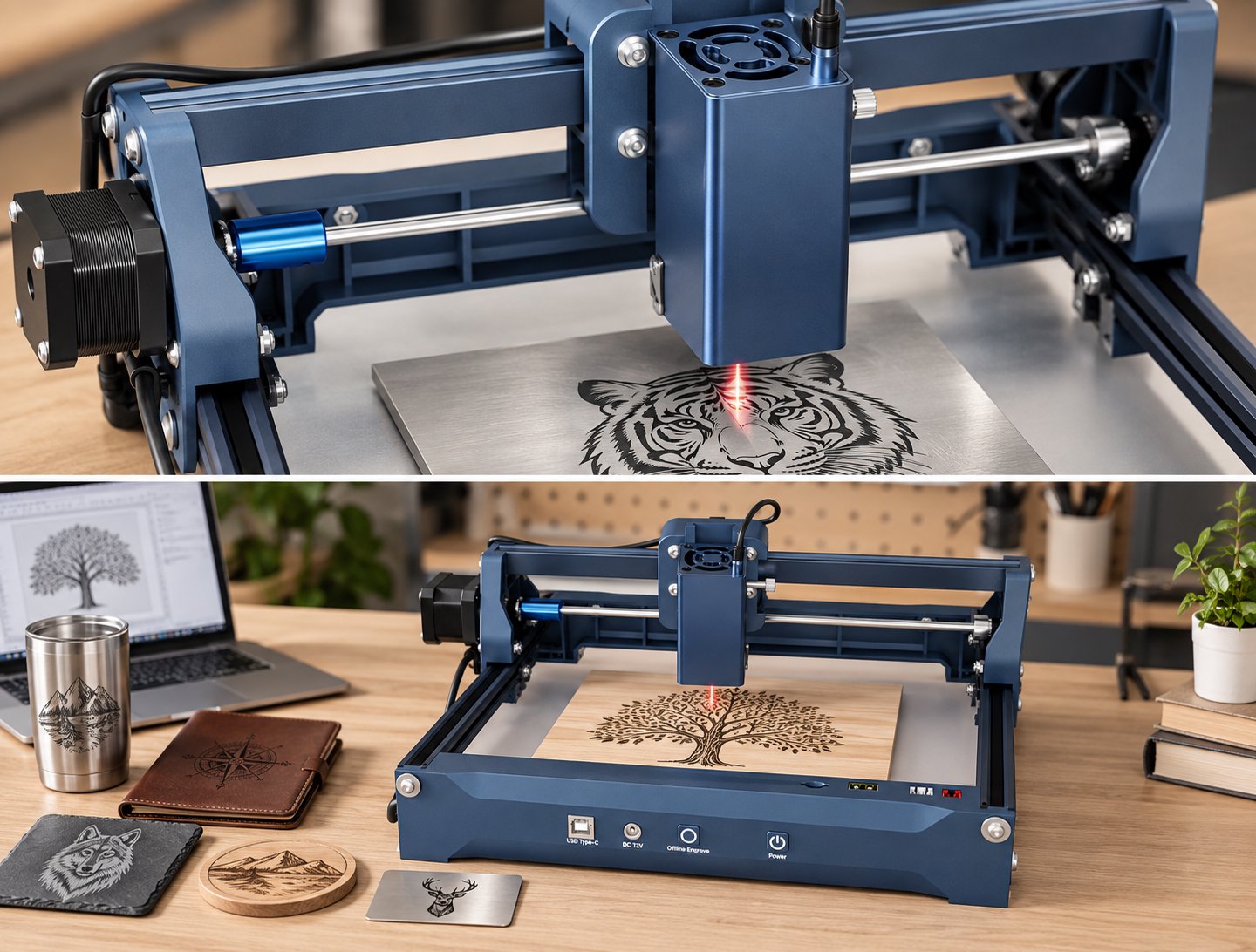
A practical decision framework for overseas B2B buyers comparing portable and commercial laser engraving machines. Learn how business stage, workpiece size, and material determine your choice, with real WAINLUX model examples and sourcing guidance from Xiamen Spring Technology Co., Ltd.
Laser Engraving Machine Buyer's Guide
The decision between a portable laser engraver and a commercial laser engraver rarely comes down to budget alone. It comes down to the size of what you engrave, the materials you process, and the production stage your business is in. This guide lays out a practical framework for overseas importers, workshop owners, and small-batch producers who need to match a machine to real requirements before placing an order.
Key Takeaways
- Workpiece size and daily output determine whether a portable or commercial engraving machine fits your operation.
- Wood, leather, and acrylic generally call for a 455 nm diode laser; bare metal such as gold, silver, and copper requires a 1064 nm laser.
- Dual-laser machines handle mixed-material production on a single platform, reducing the need for two separate units.
- Supplier evaluation should cover MOQ, sample availability, warranty terms, and engineer support before you commit to a container order.
Portable vs Commercial: Start With Business Stage and Workpiece Size
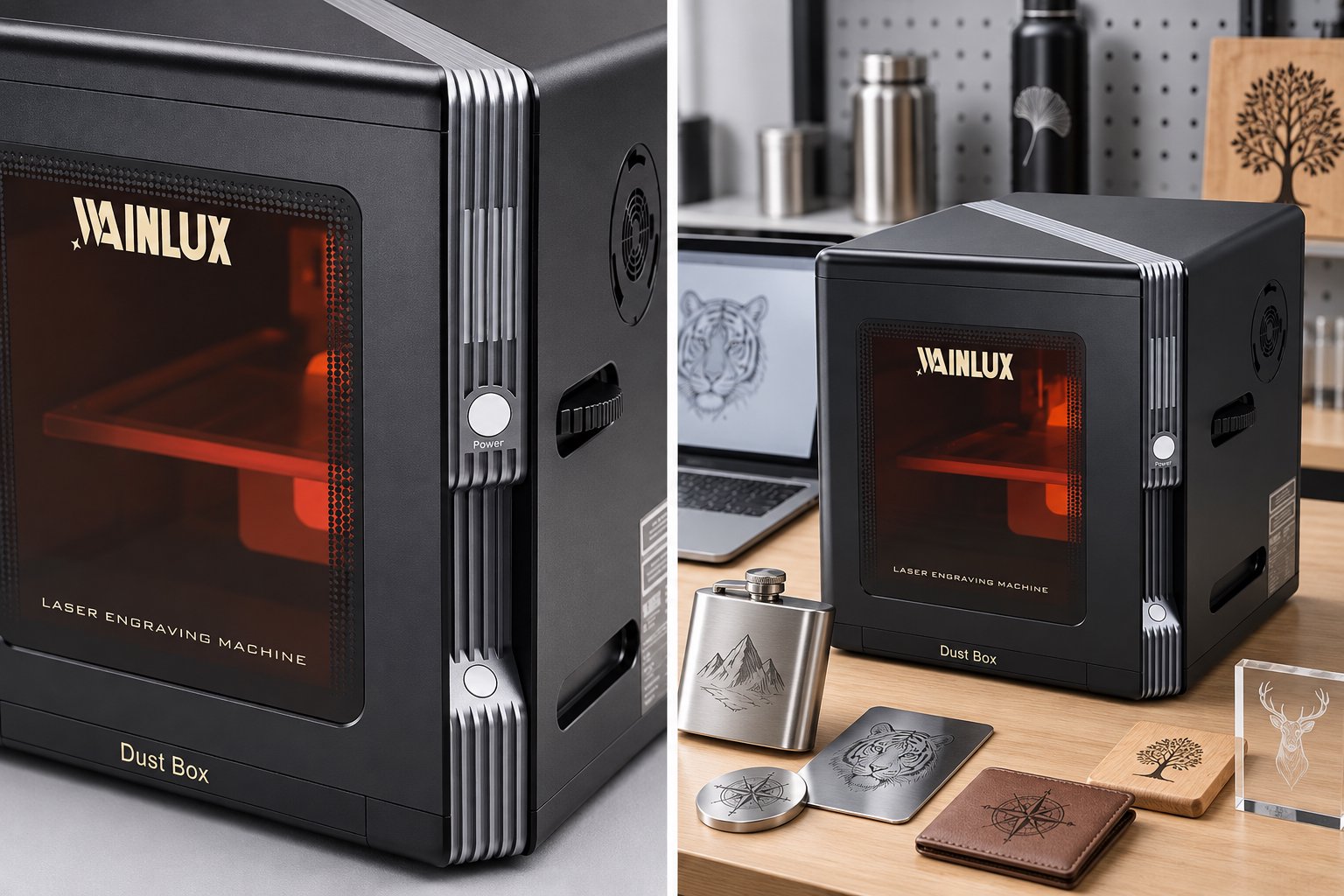
The first filter is not the laser source — it is how much area you need to cover and how many pieces you produce per day. A portable laser engraver is built around a compact work area and a lightweight frame, which suits personalization counters, sample development, and flexible field work. A commercial laser engraver trades that portability for a larger work area and the throughput consistency that small-batch production demands.
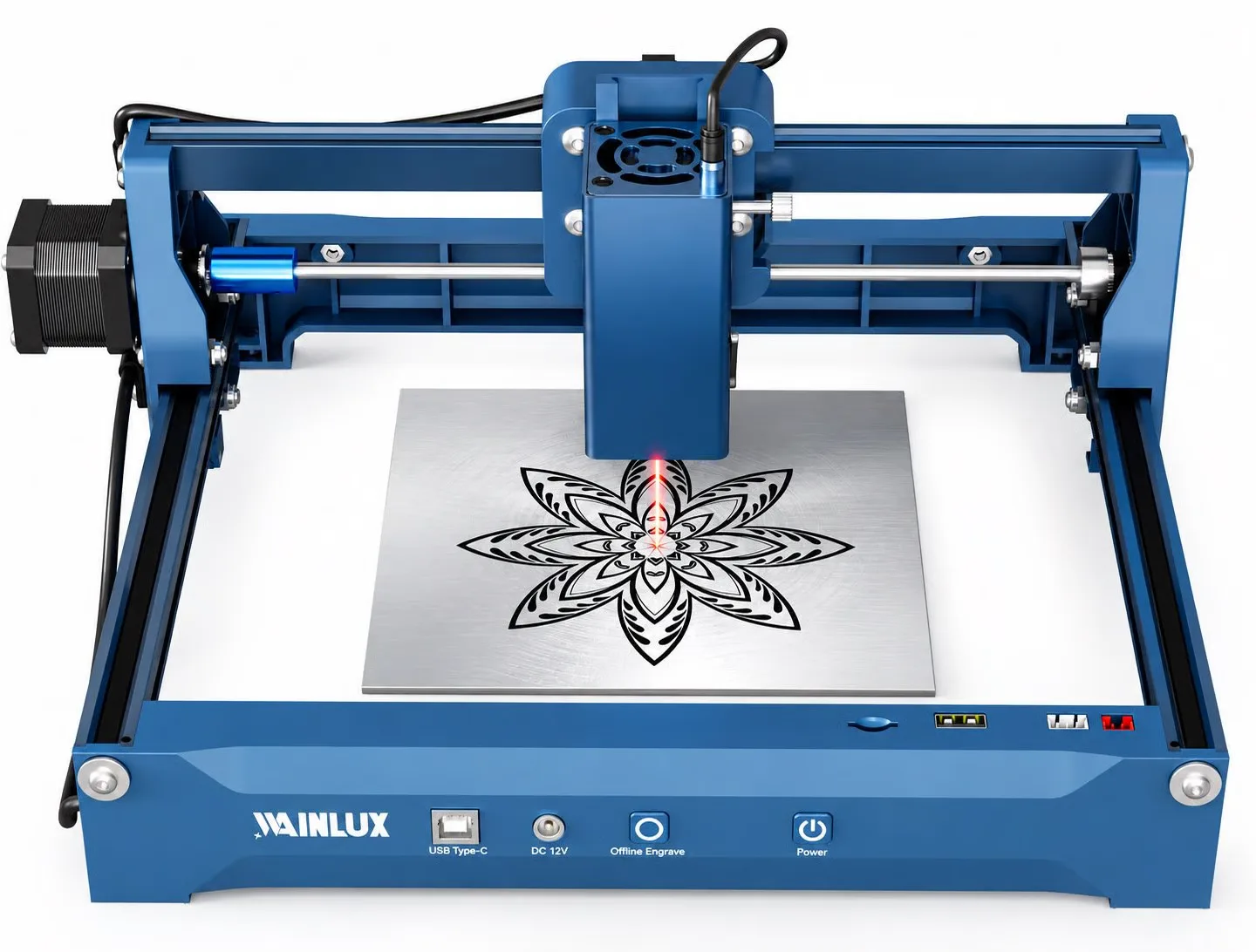
For buyers starting with entry-level portable units, the WAINLUX K10-5W and WAINLUX K6-3W sit at the accessible end of the portable range. They are reasonable starting points for testing a market, running one-off commissions, or serving customers who need small personalized items. When you need portable capability beyond entry work, the WAINLUX K8-1064nm brings a 1064 nm red laser into an 8x8 cm work area with 0.01 mm accuracy and a 0.1–1 mm engraving depth range, running at speeds up to 2000 mm/s. At 4.4 kg and 190×286×313 mm, it is genuinely transportable, and it connects via USB, WiFi, or Bluetooth for Windows without requiring professional software.
Commercial buyers who need to process larger workpieces or run repeat batches should look at the WAINLUX X1 20W Dual Laser Engraver, which offers a 30x30 cm work area and dual 455 nm and 1064 nm laser heads. The WAINLUX F1-10W+1064NM is another dual-laser commercial option for buyers comparing configurations. If you are still mapping the full range, the laser engraving machine category page lists the complete line.
| Model | Class | Work Area | Laser Type | Typical Fit |
|---|---|---|---|---|
| WAINLUX K6-3W | Portable entry | Confirm with supplier | Confirm with supplier | Market testing, small personalized items |
| WAINLUX K10-5W | Portable entry | Confirm with supplier | Confirm with supplier | Entry-level portable work |
| WAINLUX K8-1064nm | Portable | 8x8 cm | 1064 nm red laser | Small metal and wood pieces, 0.01 mm accuracy |
| WAINLUX X1 20W | Commercial dual-head | 30x30 cm | 455 nm + 1064 nm | Mixed-material small-batch production |
| WAINLUX F1-10W | Commercial dual-laser | Confirm with supplier | 1064 nm plus diode | Commercial buyers comparing dual-laser setups |
Material-to-Wavelength Matching: What Laser Actually Marks Your Workpiece
Laser type is where many first-time buyers make an expensive mistake. A diode laser and a 1064 nm laser interact with materials differently, and choosing the wrong wavelength means a machine that simply cannot mark your product.
455 nm Diode Lasers: Wood, Leather, and Acrylic
The 455 nm blue diode is the standard choice for organic materials. If your product line centers on a laser engraver for wood — plaques, coasters, signage blanks, decorative panels — a 455 nm diode handles that work. The same wavelength is also effective on leather and acrylic, which is why diode machines dominate personalized gift and craft production.
1064 nm Lasers: Bare Metal and High-Contrast Marking
The 1064 nm wavelength is what lets a machine mark bare metal directly. Gold, silver, copper, and steel require this wavelength; a standard diode will not produce a durable mark on raw metal without a coating. The K8-1064nm covers gold, silver, copper, and steel alongside wood, bamboo, leather, glass, and acrylic, so it can handle both sides of a mixed product catalog within its 8x8 cm work area.
When One Wavelength Is Not Enough
If your orders regularly combine wood and bare metal — engraved wooden boxes with metal clasps, for example — a single-wavelength machine forces a compromise. Dual-laser machines address this by mounting both a 455 nm and a 1064 nm head on one platform. The X1 engraves wood, leather, acrylic, coated metal, and bare metal, and supports Wi-Fi, USB-C, and TF-card offline operation, which matters in workshops without a dedicated PC at every station.
Commercial Dual-Head Machines for Mixed-Material Small-Batch Production
Small-batch producers face a specific problem: order volumes are too high for manual personalization but too varied for dedicated single-material equipment. A commercial laser engraver with dual heads lets you switch between jobs without swapping machines or re-fixturing the workpiece.
- Work area: The X1's 30x30 cm bed accommodates larger panels and multi-piece nesting, which a portable 8x8 cm unit cannot.
- Material coverage: Dual 455 nm and 1064 nm sources cover wood, leather, acrylic, coated metal, and bare metal on one machine.
- Workflow flexibility: Offline operation via TF card and USB-C, plus Wi-Fi connectivity, supports production floors with limited network or PC access.
For a buyer whose catalog spans materials, the commercial dual-head route avoids buying two separate engraving machines and training operators on two different workflows.
Supplier Evaluation Checklist for Importers
Once the machine class and wavelength are settled, the remaining risk is supplier reliability. Xiamen Spring Technology Co., Ltd., founded in 1998 in Xiamen, China, manufactures thermal printers, laser engraving machines, and heat press machines. The company operates a 11,000 sqm factory with 12 production lines and a 42-member R&D team, holds ISO9001, ISO14001, 3C, ROHS, and CE certifications, and exports to more than 50 countries. It offers OEM/ODM services.
Use these points when vetting any supplier, including Xiamen Spring Technology Co., Ltd.:
- MOQ and samples: Sample orders of 1–5 units are available here for evaluation; official orders start at 50 pcs and above. Confirm the same terms with any alternative supplier before quoting your own customers.
- Warranty: A 1-year warranty for spare parts is offered. Clarify what is covered, what is excluded, and how replacement parts ship.
- Engineer support: Ask whether technical support is available during your business hours and in your language, and whether setup documentation is provided.
- Certifications: Match certificates to the exact model you are importing; company-level certificates do not automatically cover every SKU.
- Customization: If you need private labeling or modified configurations, confirm OEM/ODM scope, tooling responsibility, and lead time in writing.
Frequently Asked Questions
What is a laser engraver?
A laser engraver is a machine that uses a focused laser beam to remove or alter material surfaces, producing permanent marks, text, or images. The wavelength of the laser determines which materials it can process.
What are the different types of laser engravers?
For the portable and commercial classes covered here, the main distinction is the laser source: 455 nm diode lasers for wood, leather, and acrylic, and 1064 nm lasers for bare metals such as gold, silver, copper, and steel. Some machines, like the X1 and F1, combine both in a dual-laser configuration. Form factor further divides machines into portable units and commercial units with larger work areas.
How do I choose a laser engraving machine?
Work through three filters in order: the largest workpiece you must process, the materials you must mark, and your daily output. Workpiece size rules out portables first; material rules out single-wavelength machines if you handle bare metal; output volume determines whether a commercial unit pays for itself.
What is the best laser engraver for wood?
Wood is processed effectively by 455 nm diode lasers, so any machine in this range with a diode head is a candidate. The deciding factors are work area and volume. A portable unit suits small pieces and low volume, while a commercial machine with a 455 nm head handles larger panels and repeat batches. Buyers who also mark metal should consider a dual-laser machine rather than a wood-only unit.
Where to buy a laser engraver?
Buy through a manufacturer or authorized exporter that can provide model-level certification, sample units, and spare-part warranty terms. Confirm the exact model's specifications against your material list, and request a sample engraving on your own material before committing to a production order.
Next Step
Match the machine to the workpiece, not the other way around. If your work fits an 8x8 cm area and involves small metal or wood pieces, a portable 1064 nm unit like the K8-1064nm covers both. If you need a 30x30 cm bed and mixed-material capability, the X1 dual-laser commercial engraver is the closer fit. For entry-level testing, compare the K10-5W and K6-3W. Review the full laser engraving machine range and request a sample unit under the 1–5 unit sample terms to validate output on your own materials before scaling.